Building Recommender Systems with Machine Learning and AI
Learn to design, implement, and deploy recommender systems using machine learning and AI. This step-by-step guide covers data prep, modeling choices, evaluation, and production deployment for scalable, real-world recommendations.


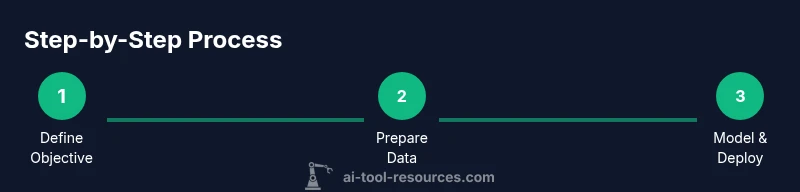
By the end of this guide, you will be able to build a basic, scalable recommender system using machine learning and ai. You'll define objectives, collect and preprocess data, select a modeling approach, evaluate offline with relevant metrics, and deploy a maintainable pipeline with monitoring. Essential prerequisites include a clean data schema, a baseline model, and a small, reproducible prototype.
What is a recommender system and why it matters in AI
A recommender system helps people discover items—movies, products, articles—by predicting what they are likely to enjoy next. In the field of AI, these systems blend data science, machine learning, and user insights to personalize experiences at scale. The phrase building recommender systems with machine learning and ai captures a broad spectrum of techniques, from simple heuristic rules to complex neural models. In practice, you’ll balance accuracy, latency, and interpretability. According to AI Tool Resources, a well-scoped objective guides data collection and model choice, enabling faster iterations and measurable business impact. The core idea is to translate raw interactions into user-centered recommendations while maintaining user trust and privacy.
Data foundations and objective setting
Effective recommender systems start from clear objectives and solid data foundations. You’ll typically collect user interactions (clicks, views, purchases), item metadata (categories, features), and contextual signals (time, device). The objective could be ranking items for a feed, predicting click-through rate, or suggesting new items to mitigate cold-start. Building recommender systems with machine learning and ai requires aligning the modeling goal with business KPIs (engagement, retention, revenue). Data quality matters more than fancy algorithms: clean IDs, stable schemas, and careful handling of missing values reduce noise. AI Tool Resources analysis shows that a strong data foundation enables reliable offline evaluation and meaningful live experiments.
Modeling options: collaborative filtering, content-based, and hybrids
There are several modeling paradigms for recommender systems. Collaborative filtering learns from user-item interactions, often via matrix factorization or neural embeddings. Content-based approaches rely on item features to suggest similar items, which helps with cold-start. Hybrids combine both signals to improve coverage and accuracy. In practice, you’ll select a baseline method, then experiment with neural recommenders, sequence models, or graph-based approaches as data and compute allow. Building recommender systems with machine learning and ai also demands attention to evaluation protocols to avoid optimization for a single metric at the expense of user experience. The choice should reflect data availability, latency constraints, and business goals.
Data engineering and feature engineering for recommendations
A robust data pipeline is the backbone of a reliable recommender system. You will ingest logs, normalize timestamps, join with item metadata, and extract features such as user history, item popularity, and contextual signals. Feature engineering can dramatically improve performance, but missteps—like leakage between train and test sets or leakage from future events—erode validity. As you design features, maintain versioning and provenance. Building recommender systems with machine learning and ai benefits from clear feature definitions and automated data checks to catch anomalies early.
Evaluation: offline metrics and online experiments
Offline evaluation uses held-out data to compute ranking metrics such as NDCG, Recall@K, and Mean Average Precision. Online experiments (A/B tests) measure real user impact, balancing business goals with user experience. It’s crucial to establish robust train/validation/test splits that reflect realistic user behavior and to guard against data leakage. AI Tool Resources emphasizes that combining offline signals with controlled online experiments yields the most actionable insights. Remember to predefine success criteria before running experiments to avoid biased interpretations.
Systems design for scale: latency, throughput, and reliability
Production-grade recommender systems require careful systems design. Consider serving latency targets (e.g., sub-50 ms for high-traffic feeds), caching strategies for popular candidates, and efficient retrieval pipelines. Batch scoring can reduce compute but may introduce freshness trade-offs. You’ll typically deploy models behind an API, with streaming updates or scheduled retraining to keep recommendations current. Designing for reliability means monitoring error rates, traffic patterns, and feature drift, and establishing rollback plans for model updates.
Privacy, fairness, and user trust considerations
Ethical considerations are essential for recommender systems. Respect user privacy by following data minimization and consent practices, and consider differential privacy where feasible. Fairness concerns—such as demographic parity or exposure bias—should be assessed and mitigated. Transparent explanations (where possible) and opt-out options bolster user trust. As you implement, keep governance in mind: data retention policies, audit trails, and reproducible experiments help sustain responsible experimentation.
Building a practical baseline: a minimal reproducible pipeline
A practical baseline enables you to measure progress and iterate quickly. Start with a small, well-documented pipeline: clean data, simple retrieval-based scoring, and a basic ranker (e.g., a matrix factorization model). Use a reproducible environment, versioned datasets, and a simple evaluation harness. This baseline acts as your reference point for improvements, helping you avoid overfitting and enabling clearer comparisons as you experiment with more advanced models. Building recommender systems with machine learning and ai benefits from this disciplined, incremental approach.
Experimentation workflow: A/B testing and ablation studies
Structured experimentation is the engine of progress. Plan a roadmap of ablation studies to isolate the contribution of each feature or model component. Use A/B tests to validate improvements on real users, with clear success criteria and power calculations to ensure reliable results. Maintain logs of configurations, random seeds, and outcomes to support reproducibility. A disciplined experimentation workflow accelerates learning while keeping risk under control in production.
Deployment and monitoring in production
Deploying a recommender system is not the end of the journey—it’s the start of ongoing monitoring. Containerize the service, implement feature flagging to roll back changes safely, and instrument dashboards that track latency, throughput, hit rates, and drift metrics. Set alert thresholds for anomalies and schedule retraining when data shifts are detected. In practice, a robust deployment includes a rollback plan, observability instrumentation, and a clear process for updating models without disrupting user experience.
Getting started: a starter template and resources
If you’re new to building recommender systems with machine learning and ai, start with a small, well-documented template: a data schema, a simple baseline model, and a lightweight evaluation harness. Use public datasets like MovieLens to prototype, then port the pipeline to your internal data. Commit to reproducibility by versioning data, code, and experiments. The journey from idea to production is iterative, but a solid starter kit accelerates learning and reduces risk.
Tools & Materials
- Python 3.9+(Modern ML tooling and libraries)
- Jupyter Notebook or JupyterLab(Interactive exploration and prototyping)
- Pandas(Data wrangling and feature engineering)
- NumPy(Numerical computations and array ops)
- scikit-learn(Baseline models and evaluation utilities)
- TensorFlow or PyTorch(Deep learning options for neural recommenders)
- Training data (public or internal)(e.g., MovieLens or click/log data)
- Experiment tracking (MLflow, Weights & Biases)(Optional but recommended for reproducibility)
- Compute infrastructure (CPU/GPU, cloud or on-prem)(Ensure sufficient resources for training and serving)
Steps
Estimated time: varies by project scope (data size, compute, and team expertise)
- 1
Define objective and success criteria
Clarify the problem type (ranking, recommendation, or discovery). Identify quantitative success metrics (e.g., recall@K, NDCG@K) and align them with business goals. Document this in a concise plan to guide later decisions.
Tip: Start with a single KPI that matters most to users or business. - 2
Collect and prepare data
Ingest user-item interactions, item attributes, and contextual signals. Clean and normalize identifiers, handle missing values, and split data into train/validation/test with care to prevent leakage.
Tip: Use time-based splits to reflect real-world ordering. - 3
Choose modeling approach
Evaluate collaborative filtering, content-based, and hybrid strategies. Consider data availability, latency, and explainability when choosing a baseline.
Tip: Document rationale for the baseline model to track progress. - 4
Build baseline model
Implement a simple matrix factorization or shallow neural model to establish a performance baseline. Validate with offline metrics before moving to complex architectures.
Tip: A strong baseline helps you measure genuine improvements. - 5
Train, validate, and evaluate
Train on the training set, tune hyperparameters on the validation set, and assess against held-out data. Use multiple metrics to get a rounded view of quality.
Tip: Keep a separate test set to report final performance. - 6
Design serving architecture
Plan retrieval, ranking, and latency budgets. Decide between batch scoring and real-time inference, and implement caching to meet latency targets.
Tip: Measure end-to-end latency in production-like conditions. - 7
Deploy and monitor
Containerize the service, set up dashboards for latency, accuracy, and drift. Schedule retraining when data shifts or metrics degrade.
Tip: Have a clear rollback and rollback-testing plan.
FAQ
What is the difference between collaborative filtering and content-based recommender systems?
Collaborative filtering makes predictions from user-item interaction patterns, while content-based systems rely on item features. Hybrids combine both signals to improve coverage. Each approach has tradeoffs in cold-start, scalability, and explainability.
Collaborative filtering uses user behavior to predict preferences, while content-based methods use item features. Hybrids blend both signals for better performance.
What data do I need to start building a recommender system?
You typically need user interactions, item metadata, and contextual signals. Start with a small, well-structured dataset, and ensure you have a clear plan for data splits and privacy.
Start with user interactions, item features, and context, and ensure you have a plan for data splits and privacy.
Which evaluation metrics should I use for recommender systems?
Common offline metrics include Recall@K and NDCG@K. Online metrics involve A/B testing user engagement and retention. Use a mix to capture accuracy and real-world impact.
Use Recall@K and NDCG@K offline, plus A/B tests for real-world impact.
How do I deploy a recommender system with low latency?
Adopt a two-stage pipeline: retrieve candidates with a fast method, then rank with a more intensive model. Use caching and ensure the serving path meets latency targets.
Use a fast candidate retrieval step, then a ranking model, plus caching to keep latency low.
How to handle cold-start problems for new users or items?
Incorporate content-based features and explore hybrid models that can leverage item metadata. For new users, use initial onboarding signals and active learning to gather preferences.
Use content-based signals and hybrid models; bootstrap new users with onboarding data.
Watch Video
Key Takeaways
- Define clear objectives and success metrics before modeling
- Start with a simple baseline to gauge improvements
- Prioritize data quality and feature engineering
- Balance accuracy with latency and scalability in production
- Establish a reproducible workflow for experiments