How AI Tools Can Personalize Learning: A Practical Guide
Explore how AI tools personalize learning, enhance engagement, and tailor journeys for students and professionals. Practical steps, governance tips, and measurable outcomes from AI Tool Resources.


AI-powered tools can tailor content, pace, and feedback to each learner, enabling personalized learning at scale while preserving instructional quality. This quick-start guide breaks down practical steps, essential tools, and governance considerations for implementing AI-driven personalization in education. You’ll learn how to design adaptive curricula, monitor progress, and iterate responsibly, with concrete examples and templates for developers, researchers, and students.
What personalized learning means in AI-enabled education
Personalized learning, in its essence, is about meeting learners where they are, offering pathways that adapt to their pace, interests, and prior knowledge. When AI-powered systems enter the classroom or online environment, they can move beyond one-size-fits-all curricula by analyzing interaction data, outcomes, and preferences to craft individualized learning experiences. This allows educators to shift emphasis from delivering fixed content to guiding students through tailored journeys that emphasize mastery, not simply time on task. The central question for practitioners is often: how can ai tools help with personalised learning in practical settings? The answer lies in embracing a cycle of data-informed decision making, clear goals, and iterative design. Early pilots show that students benefit most when personalization is purposefully integrated with strong instructional supports, well-defined rubrics, and transparent governance. Importantly, personalization should not replace high-quality teaching but augment it, enabling teachers to dedicate more time to coaching, feedback, and addressing misconceptions. In short, AI-enabled personalization aims to amplify human instruction, not replace it.
Core capabilities of AI tools for personalization
AI tools expand what is possible in personalization by combining learner modeling, content adaptation, and real-time feedback. Key capabilities include adaptive content sequencing that adjusts difficulty based on demonstrated mastery, personalized recommendations for readings or practice tasks, and predictive analytics that flag students at risk of falling behind. Sophisticated systems build a dynamic learner model from ongoing interactions, so recommendations reflect current knowledge and goals. This enables pacing that respects individual curves, mastery-based progression, and targeted interventions when needed. Importantly, the best implementations blend automated insights with human guidance, ensuring transparency and trust. By understanding what a learner needs next, AI tools help educators craft differentiated experiences without sacrificing scalability or consistency.
Data sources and privacy considerations
Personalized learning relies on diverse data streams—completed tasks, question responses, time-on-task, resource usage, and feedback ratings. Each data point informs the learner model and subsequent recommendations. However, collecting and processing student data requires robust governance: explicit consent, minimization, purpose limitation, and secure storage. Institutions should publish clear data usage policies, implement access controls, and provide learners with dashboards showing how their data informs personalization. Anonymization and pseudonymization should be standard where feasible, and data retention periods should be aligned with privacy laws and institutional policy. Regular audits, bias checks, and impact assessments help ensure responsible AI use. When asked, “how can ai tools help with personalised learning,” the best answers center on privacy-by-design and transparent data practices that put learners first.
Personalization strategies: adaptive learning, mastery, pacing
Three primary strategies drive AI-enabled personalization: adaptive learning, mastery learning, and pacing control. Adaptive learning tailors content paths to student readiness, offering easier or harder tasks based on performance. Mastery learning sets clear thresholds for progression, ensuring students achieve a level of competency before moving on. Pacing control lets learners choose their tempo, with AI nudges to stay on track or accelerate when ready. Combining these approaches with effective rubrics and timely feedback creates an ecosystem where learners advance through material as they demonstrate understanding. The challenge is to design these strategies so they remain equitable and accessible, avoiding biases that favor certain groups while maintaining rigorous standards. A thoughtful blend of automation and teacher support often yields the best results in diverse classrooms.
Real-world use cases across domains
Real-world deployments of AI-powered personalization span K-12, higher education, and corporate training. In K-12, AI can tailor reading companions, math practice, and science simulations to individual readiness, while teachers receive dashboards that highlight misconceptions. In higher education, adaptive assessments adjust to a student’s prior knowledge, enabling more efficient course paths and targeted tutoring. In corporate training, AI-curated micro-lessons align with job roles, track competency progress, and suggest remediation steps. Across domains, personalization helps reduce cognitive overload by surfacing relevant materials, accelerating mastery where appropriate, and flagging gaps early. The common success factors include alignment with learning objectives, strong instructional design, privacy safeguards, and ongoing stakeholder feedback.
Tools that enable personalized learning
A range of tools supports personalization, from learning management systems with AI features to standalone assessment analytics and intelligent tutoring systems. Core tool types include learner analytics dashboards, content recommender engines, adaptive testing platforms, and integrated feedback modules that provide real-time guidance. Interoperability is critical: these tools should connect with existing LMS, content libraries, and student information systems. When selecting tools, prioritize transparent AI models, explainable recommendations, and accessible interfaces that accommodate diverse learners. Organizations should also plan for data governance, teacher training, and a clear implementation roadmap to maximize the benefits of personalization while minimizing risk.
Design patterns: user-centric interfaces and feedback loops
Designing interfaces for AI-powered personalization requires a human-centered approach. Learners should clearly see why a task is recommended and how it connects to their goals. Feedback loops—both automated and human—should be frequent yet unobtrusive, guiding improvement without overwhelming users. Accessibility and inclusivity must be foundational, ensuring support for multilingual learners, neurodiverse profiles, and varying device access. Transparent explainability helps students understand how recommendations were generated, while opt-out options preserve autonomy. For teachers, dashboards should highlight actionable insights, not just raw data, and provide templates for adjusting instruction based on AI signals. The best designs reduce cognitive load, promote trust, and encourage experimentation.
Implementation challenges and governance
Implementing AI personalization is as much about governance as technology. Organizations must define roles, accountability, and ethical guidelines before deployment. Common challenges include data siloing, integration complexity, and transition costs. To mitigate these risks, start with a small pilot, document data lineage and decision rules, and establish a governance committee that includes educators, data scientists, and privacy officers. Regular bias checks and impact assessments should be scheduled, and vendor contracts should specify data ownership, retention, and security requirements. Building a culture of continuous improvement—where feedback from learners and teachers informs iteration—helps sustain success and safeguard trust.
Measuring impact: metrics and evaluation
Measuring the impact of AI-powered personalization involves a balanced set of metrics. Engagement indicators (logins, time on task, completion rates) reveal how learners interact with content. Mastery metrics track gains against defined benchmarks, while progression metrics monitor movement through a curriculum. Qualitative feedback from learners and instructors provides context for analytics, clarifying whether personalization improves motivation, confidence, and perceived learning value. Longitudinal studies can assess retention, transfer of learning, and job-relevant outcomes. To ensure credible results, pair experiments with control groups, document contextual factors, and predefine success criteria aligned with educational goals.
Getting started: a practical roadmap
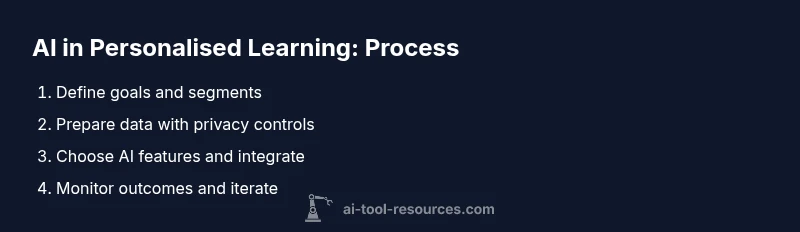
Begin with a practical roadmap that honors both pedagogy and privacy. Start by defining clear learning objectives and measurable outcomes. Inventory data sources and ensure consent processes are in place. Select pilot AI features aligned to your goals, and design a lightweight integration with your LMS. Run a small-scale pilot, collect quantitative and qualitative data, and gather teacher and student feedback. Use findings to refine algorithms, interfaces, and governance. When ready, scale thoughtfully while maintaining strong privacy protections, transparent explainability, and ongoing professional development for educators.
Tools & Materials
- AI-powered learning platform or LMS with personalization features(Ensure privacy/compliance, integration capabilities, and stakeholder buy-in)
- Anonymized learner data(Use for model training and personalization; implement data minimization)
- Data governance policy(Includes consent, retention, access controls, and ethics guidelines)
- Clear learning objectives and rubrics(Guides personalization and evaluation)
- Teacher training and governance plan(Supports adoption and responsible use)
- Security and privacy tools(Encryption, access management, and audit trails)
Steps
Estimated time: 6-8 weeks (pilot phase)
- 1
Define learning objectives and success metrics
Clarify what mastery looks like for each topic and how you will measure progress. Establish benchmarks and criteria for personalization success.
Tip: Document goals and ensure they align with overall curriculum standards. - 2
Audit data sources and privacy controls
Inventory data streams and confirm consent, minimization, and retention policies. Identify data gaps that personalization will require.
Tip: Prioritize data quality and governance before collecting more data. - 3
Choose AI features aligned with goals
Select adaptive content, recommendations, or mastery checks that support your objectives. Map each feature to a specific outcome.
Tip: Avoid feature creep; start with a focused pilot set. - 4
Design data pipelines and LMS integration
Plan how data will flow between sources and the learning platform. Ensure real-time or near-real-time updates where possible.
Tip: Test data pipelines with a small dataset first. - 5
Develop adaptive content modules
Create or curate content blocks that can be sequenced based on learner readiness and mastery levels.
Tip: Keep content modular to maximize reusability. - 6
Pilot with a small learner group
Run a controlled pilot to compare personalized paths against a baseline. Collect both quantitative and qualitative feedback.
Tip: Choose diverse participants to test edge cases early. - 7
Analyze results and refine
Evaluate engagement, mastery, and learner satisfaction. Update models, content, and interfaces based on findings.
Tip: Predefine success criteria to avoid bias in interpretation. - 8
Governance and ethics review
Review privacy, bias, and equity implications with stakeholders. Document decisions and rationale.
Tip: Implement ongoing bias checks and fairness audits. - 9
Plan for scale
Develop a roadmap to expand personalization across courses or cohorts. Align with budget and training plans.
Tip: Pilot learnings should drive scalable design choices. - 10
Establish continuous improvement
Create feedback loops, dashboards, and quarterly reviews to sustain gains and adapt to new data.
Tip: Institutionalize learning from both successes and failures.
FAQ
What is personalized learning with AI?
Personalized learning uses AI to tailor content, pace, and feedback to individual learners based on data from their interactions. It aims to close gaps and accelerate mastery.
AI personalizes learning by adjusting content and pace to fit each learner, helping them master skills more efficiently.
Do AI tools replace teachers?
No; AI supports teachers by handling routine tasks, giving insights, and enabling more individualized support. It augments teaching, not replaces it.
AI tools assist teachers by providing insights and freeing time for coaching.
How do you protect student data when using AI tools?
Data privacy is essential; ensure consent, minimize data collection, and implement safeguards with governance. Regular audits help maintain trust.
Privacy matters; obtain consent and limit data use with strong governance.
How long until you see results from personalization?
Results vary by context, but early signals often appear within weeks of a pilot. Long-term gains emerge with broader adoption and iteration.
You’ll start seeing signals in weeks during a pilot, with longer-term gains after expansion.
What skills do educators need to implement AI personalization?
Educators benefit from data literacy, interpretation of analytics, and the ability to adjust instruction based on AI-driven insights.
Teachers need to read analytics and adapt teaching strategies accordingly.
What common pitfalls should be avoided at the start?
Avoid overfitting to biased data, neglecting accessibility, and bypassing learner involvement in design. Start with a focused pilot and iterate.
Beware biased data and accessibility gaps; involve learners in the design process.
Watch Video
Key Takeaways
- Define clear learning outcomes first
- Protect learner data and privacy
- Pilot, measure, and iterate
- Choose interoperable tools aligned with context