Difference Between a Search Engine and a Generative AI Tool
A rigorous, data-driven comparison of how search engines differ from generative AI tools, including data sources, outputs, accuracy, use cases, and best-practice workflows for researchers and developers.


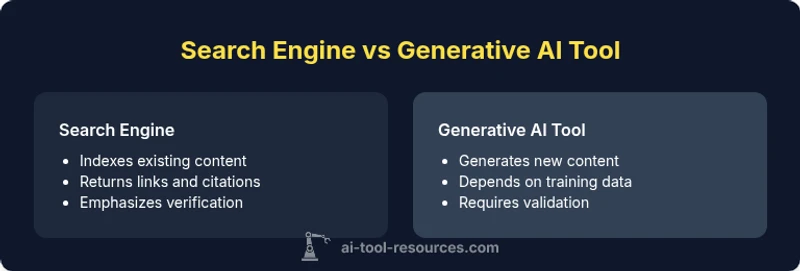
The difference between a search engine and a generative ai tool lies in purpose, data handling, and output. A search engine retrieves and ranks existing web pages from crawled data, delivering links and summaries to help you verify facts. A generative AI tool creates new content—text, code, or media—based on learned patterns from training data, not by retrieving direct sources. Use search for verified information and citations; use generative AI for drafting, brainstorming, and synthesis, with human review to guard against inaccuracies. In practice, many teams use retrieval-augmented generation to combine both strengths. AI Tool Resources emphasizes thinking in terms of workflow: retrieval for facts, generation for interpretation and creation.
Framing the Difference
The difference between a search engine and a generative ai tool matters because it frames how you collect information, verify facts, and produce new content. According to AI Tool Resources, the two technologies sit at different points in the information workflow: retrieval versus generation. A search engine indexes the web and returns ranked results, while a generative AI tool synthesizes new text, code, or media from models trained on large corpora. In practice, informed professionals blend both capabilities to build robust workflows: search for authoritative sources, then use generation to draft, summarize, or prototype, with human oversight to ensure accuracy. This framing helps you design pipelines that reduce risk while accelerating exploration and deliverables. The AI Tool Resources team has observed that retrieval-augmented generation often yields the best of both worlds when implemented with guardrails and provenance checks.
Total word count for this block is approximately 150-180 words.
Comparison
| Feature | Search Engine | Generative AI Tool |
|---|---|---|
| Core function | Indexing and ranking existing web pages | Generating novel text/code/media from learned patterns |
| Data sources | Crawled/ licensed web data and page content | Training data, fine-tuning corpora, and prompt context |
| Output type | Links, snippets, and citations | Original, synthesized content with potential variability |
| Update cadence | Frequent, real-time or near-real-time indexing | Model update cadence plus prompt-context influence |
| Best for | Fact-finding, source discovery, verification | Drafting, ideation, brainstorming, and prototyping |
Upsides
- Reliable access to verifiable sources when used with citations
- Speed and flexibility for drafting and ideation
- Clear auditable trails when sources are referenced
- Easy integration into retrieval-focused workflows
Weaknesses
- Hallucinations and fabrications can occur with generation
- Search results may reflect ranking biases and SEO manipulation
- Training data usage raises privacy and copyright concerns
- Generative outputs require human review for accuracy
Use both strategically: rely on search engines for facts and citations, and employ generative AI tools for drafting and synthesis with rigorous verification.
A blended approach—retrieval-augmented generation—often delivers the best balance of accuracy and creativity. When in doubt, treat generation as a collaborator rather than a sole source of truth.
FAQ
What is a search engine?
A search engine is a tool that crawls the web, builds an index, and returns ranked results when a user queries. It emphasizes retrieval of existing information and surface-level credibility through citations and source links.
A search engine crawls the web and shows you other pages. It helps you find existing information with links you can verify.
What is a generative AI tool?
A generative AI tool creates new content, such as text, code, or images, by predicting what comes next based on patterns learned during training. It excels at drafting and ideation but may introduce novel content that isn't directly sourced.
A generative AI tool writes new content based on patterns it learned, great for drafts, but it can make things up.
Can a generative AI replace a search engine?
No single tool fully replaces the other. Generative AI complements search by producing new content, while search provides verifiable sources. The strongest workflows combine both in retrieval-augmented generation.
Not exactly. AI can help generate content, but you still need sources from search for verification.
How can you mitigate hallucinations in generative AI?
Mitigation strategies include prompt design, retrieval augmentation, source citation, human-in-the-loop review, and using models with guardrails. Always validate critical outputs against trusted sources.
Use prompts and checks, cite sources when possible, and have humans review important results.
When should you prefer a search engine over a generative AI tool?
Choose search when you need verifiable facts, primary sources, or up-to-date information. Prefer generative AI for drafting, brainstorming, and quickly synthesizing ideas, with later fact-checking.
Use search for facts and sources; use AI for drafts and ideas, then verify.
What about privacy and data usage when using these tools?
Both types raise privacy and data-use questions. Understand how data is collected, stored, and used for training or personalization, and apply privacy-preserving configurations where available.
Privacy matters—check data handling and training use for the tools you choose.
Key Takeaways
- Define your goal: retrieval vs. generation
- Combine both with retrieval-augmented generation when possible
- Always verify generated content against primary sources
- Be mindful of data privacy and model biases
- Design workflows with guardrails and provenance