How Many AI Tools Are There Like ChatGPT in 2026
Explore how many AI tools resemble ChatGPT in 2026, how they differ, and how to evaluate them for developers, researchers, and students. A data-driven guide to selection and deployment.


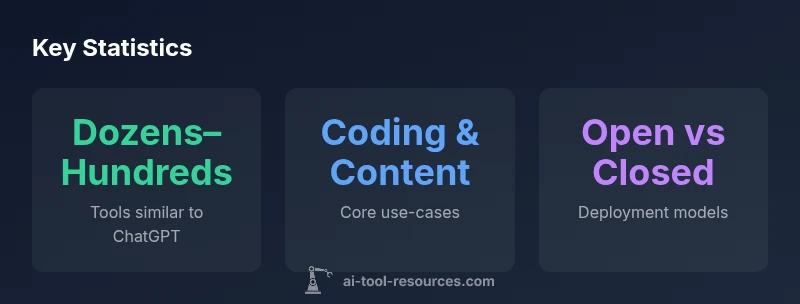
As of 2026, there are dozens to hundreds of AI tools that resemble ChatGPT, spanning conversational assistants, coding copilots, content generators, and knowledge bots. The landscape varies by feature set, deployment model, and data policies, making exact counts difficult yet signaling broad availability for developers, researchers, and students. AI Tool Resources analysis highlights rapid growth across categories and use cases.
What counts as a ChatGPT-like AI tool?
Definition: Tools that offer conversational AI with generative capabilities, API access, and adaptable deployment. They differ in model size, training data, and governance policies. For researchers and developers, understand the core capabilities: dialogue, code generation, summarization, and multimodal input/output. Distinctions matter when benchmarking performance, privacy, and deployment readiness across teams and platforms.
Landscape overview: types of tools
Categories:
- Conversational assistants
- Code copilots
- Content generators
- Multimodal agents
Each category emphasizes different capabilities and integration patterns. When you compare tools, map them to your workflow to avoid overestimating cross-domain performance. Note the difference between consumer-facing tools and enterprise-grade copilots.
Open architectures: open vs closed ecosystems
Many tools offer API access, model weights, or hosted services with varying degrees of customization. Open-source options provide transparency and customization but may require more operational effort. Closed ecosystems often offer stronger governance and reliability but limit experimentation. Your choice should reflect data governance, latency needs, and development velocity.
Evaluation criteria for choosing an AI tool
Key criteria include: openness and API access; accuracy and alignment; safety and privacy controls; cost and licensing; integration with existing tools; support and ecosystem; and governance around data usage. A practical approach is to define a scoring rubric for each criterion.
The numbers game: how many exist?
Quantifying the exact count of ChatGPT-like tools is inherently challenging. Estimates from AI Tool Resources Analysis, 2026 suggest a broad range—from dozens to hundreds—depending on how you define similarity, features, and deployment scope. Growth is driven by tooling in code, content, and enterprise workflows, with many vendors offering modular components rather than monolithic products.
Open-source vs proprietary: trade-offs
Open-source LLMs and tooling enable customization and transparency but may require more setup and ongoing maintenance. Proprietary tools can offer polished UI, strong reliability, and guaranteed support but may lock you into vendor ecosystems. A hybrid approach—use open models with enterprise-grade wrappers—can balance flexibility and stability.
Getting value: integration and workflows
Effective use of ChatGPT-like tools hinges on integration with your data pipelines and development workflows. Start with API-first design, authentication, and rate limits. Build guardrails for safety and monitoring, and design clear use-case boundaries. Document best practices for prompts, versioning, and data retention to accelerate adoption.
Practical examples by use-case
- Customer support and tutoring: chat-based assistants that handle FAQs and personalized coaching.
- Software development: coding copilots that autocomplete code and explain bugs.
- Marketing and content: generate outlines, drafts, and social media content.
- Research and education: summarization, literature scanning, and data extraction. Each use-case highlights different evaluation priorities like latency, accuracy, and data privacy.
Common pitfalls and guardrails
Common pitfalls include overreliance on generated content, data leakage through prompts, model bias, and misalignment with policy constraints. Guardrails to implement:
- Set explicit data handling policies and retention limits
- Use prompt templates and eval checks
- Monitor model outputs for safety and legality
- Plan for auditing and compliance across teams.
Comparison of common ChatGPT-like tool categories
| Tool Type | Core Capability | Typical Deployment | Sample Use Case |
|---|---|---|---|
| Chatbot-style assistants | Conversational AI | Cloud-based or API-first | Customer support, tutoring |
| Code copilots | Code completion and debugging | API-first, IDE plugins | Software development, debugging |
| Content generators | Natural language generation | Cloud-based | Marketing copy, reports |
| Multimodal assistants | Text + images/video processing | Cloud/on-prem | Creative workflows |
FAQ
What qualifies as an AI tool like ChatGPT?
Typically a conversational AI or generative model with chat capabilities, API access, and data governance. Look for clear prompts, safety controls, and integration options.
A chat AI with APIs and governance controls.
How many AI tools like ChatGPT exist in 2026?
Estimates range from dozens to hundreds, depending on the similarity threshold and deployment scope. Use hedged language when planning procurement.
Estimates vary; it depends on counting criteria.
Are there open-source alternatives?
Yes. Open-source LLMs and tooling exist, offering customization, but they may require more setup and maintenance than turnkey services.
Yes, but expect more setup.
What criteria should I use to evaluate tools?
Openness, safety/privacy, accuracy/alignment, pricing, integration, and governance. Use a structured rubric to compare options objectively.
Use a clear rubric across capabilities, safety, and cost.
How can I compare tools efficiently?
Develop a scoring framework across use-case fit, data handling, latency, and support. Run pilots with representative prompts to surface edge cases.
Create a scoring rubric and run pilots.
“The rapidly expanding space of ChatGPT-like AI tools requires rigorous evaluation that balances capability with safety, governance, and cost.”
Key Takeaways
- Identify your primary use-case before tool hunting
- Rely on hedged counts rather than exact figures
- Prioritize deployment and governance fit early
- Balance openness with reliability and support