How to Become AI Tools and ChatGPT Expert
Learn how to become an AI tools and ChatGPT expert with a practical, step-by-step plan. This guide covers fundamentals, core competencies, learning tracks, hands-on projects, and credibility-building strategies for developers, researchers, and students.


By design, you can become an AI tools and ChatGPT expert by following a structured, hands-on learning path. This quick answer highlights the core steps: build foundations, master prompts and tooling, complete guided practice projects, and progressively tackle real-world integrations. According to AI Tool Resources, consistent practice and meticulous documentation accelerate mastery.
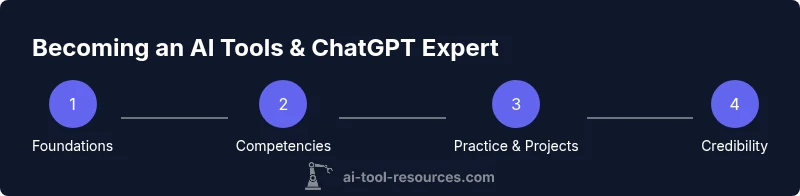
Foundations: What it means to be an AI tools and ChatGPT expert
Becoming an expert means more than knowing a few prompts. It means fluency in how AI tools fit into real workflows, how to design prompts that produce reliable results, and how to orchestrate multiple tools into a coherent solution. In this era, an expert should be comfortable with both the creative and the technical aspects: prompt engineering, API usage, data handling, version control, and ethical considerations. As you start, anchor your journey in three pillars: practical experimentation, reproducible methods, and continual learning. Start by observing how teams in AI Tool Resources operate, and mirror their disciplined approach to experimentation, measurement, and documentation. Over time, your personal toolkit will grow to include prompt libraries, small automation scripts, and documented case studies that demonstrate repeatable success. The focus is on learning by doing, not just reading theory. In practice, you’ll balance exploring new features with mastering dependable patterns you can rely on under pressure. The result is a versatile skill set that scales from a single project to a full research or product development effort.
Core competencies you must develop
Here are the essential skills an AI tools and ChatGPT expert should master:
- Prompt engineering: crafting prompts that steer models reliably across tasks, with clear instructions and failure modes.
- Tool integration: connecting ChatGPT with external APIs, databases, and automation layers to achieve end-to-end workflows.
- Evaluation and benchmarking: defining success metrics, running ablations, and documenting results for reproducibility.
- Data handling and privacy: understanding input/output sensitivity, data retention, and compliance considerations.
- System design and orchestration: building modular pipelines that scale and are maintainable.
- Debugging and troubleshooting: identifying root causes quickly and proposing robust fixes.
- Documentation and communication: keeping a transparent record of experiments, decisions, and outcomes.
In practice, you’ll combine these into repeatable patterns you can apply across domains. A strong expert can translate business problems into AI-enabled solutions, justify design choices with evidence, and explain trade-offs to stakeholders. Keep a personal log of experiments, versioned prompts, and a living glossary that captures common terms and patterns. In addition to technical prowess, perceptive judgment and curiosity are critical: you should constantly ask how a tool could fail in production and what safeguards are needed.
Practical learning path: 3 tracks to mastery
Learning is most effective when it’s structured. This section outlines three tracks you can follow in parallel or sequentially:
- Foundations & prompts: Master the basics of prompt design, model behavior, and simple tool interactions. Dedicate time to building a prompt library and testing prompts against edge cases.
- Tooling & APIs: Learn to connect ChatGPT with external services via APIs, webhooks, and data sources. Practice writing small automation scripts and basic orchestration layers.
- Real-world projects & portfolio: Build end-to-end solutions for real tasks, document outcomes, and present a portfolio that demonstrates impact. This track is where credibility grows and opportunities emerge.
Hands-on projects that demonstrate expertise
Engaging projects are the fastest way to prove your capability. Examples include:
- Prompt engineering sprint: Create a set of prompts for varying tasks, measure performance, and document best practices.
- Build a ChatGPT-powered tool: Create a console app or web service that takes user input, calls an API, and returns results with error handling.
- Data-to-insight pipeline: Combine prompts with data processing to extract insights from structured data.
- Ethics and risk assessment: Evaluate a use case for potential biases, privacy concerns, and safety risks, and propose mitigations.
Each project should include a README, reproducible code, and a short case study highlighting outcomes and learnings.
Tools, datasets, and environments you'll use
A successful expert uses a mix of tools and practices:
- ChatGPT API or advanced chat interfaces for experimentation and production prompts.
- A lightweight orchestration library or framework (for example, a minimal workflow script).
- Version control (Git) with a prompt library and experiment logs.
- Local datasets or synthetic datasets for testing, ensuring privacy and ethics considerations are respected.
- Notebooks or documentation tooling to capture results, decisions, and playbooks.
Organize resources in a knowledge base and keep your environment reproducible across machines and teams.
Measuring progress and building credibility
Progress is best tracked with tangible artifacts. Maintain a portfolio of projects with open-source code, well-documented prompts, and samples of prompt-output results. Establish benchmarks for common tasks and compare models or tool configurations using a consistent evaluation rubric. Present your work in blog posts, talks, or project demos to invite feedback. Regularly update your portfolio to reflect new skills, tools, and patterns. Engage with the community, contribute to open repositories, and seek feedback from mentors or peers to accelerate growth.
Common mistakes and how to avoid them
Avoid overreliance on a single tool or workflow, which creates bottlenecks and reduces adaptability. Skipping data ethics, privacy considerations, or auditability undermines credibility. Failing to document experiments leads to forgotten insights and hard-to-reproduce results. Finally, neglecting real-world validation—testing prompts and integrations in practical contexts—limits growth. Build a culture of reproducibility, transparency, and continuous learning to stay ahead.
Tools & Materials
- A modern computer (laptop or desktop)(Adequate CPU, 8–16 GB RAM; consider 32 GB for heavy data tasks)
- Reliable internet connection(Stable bandwidth; wired Ethernet recommended for large data transfers)
- Access to AI tooling platforms(Sign up for OpenAI API or equivalent; API keys stored securely)
- Code editor and version control(Git installed; use a README-driven workflow and commit prompts)
- Documentation and note-taking tools(Notebook or wiki for experiments, decisions, and lessons learned)
- Sample datasets and prompts repository(Use synthetic or publicly available data; avoid proprietary data)
Steps
Estimated time: 8-12 weeks
- 1
Define your learning goals
Set specific, measurable goals for your journey. Map milestones such as completing a fundamental prompt course, building a basic ChatGPT-powered tool, and delivering a portfolio project. Create a weekly schedule and track progress in a learning journal.
Tip: Break goals into tiny, testable tasks; celebrate small wins to stay motivated. - 2
Learn core concepts (prompts, tools, APIs)
Study prompt design, model behavior, and basic API usage. Practice with varied tasks and document prompt patterns. Build a minimal toolkit for common workflows and maintain a glossary of terms.
Tip: Start a prompt library early and tag prompts by task type and edge cases. - 3
Build a practice project portfolio
Create at least three small projects that demonstrate end-to-end capabilities: prompt design, tool integration, and data handling. Publish code with clear READMEs and reproducible steps.
Tip: Aim for modular, reusable components you can reuse across projects. - 4
Practice with real-world tasks and feedback
Work on tasks drawn from real domains (education, research, coding). Seek feedback from peers or mentors and iterate based on results and measurements.
Tip: Document feedback, tracking changes in prompts and configurations. - 5
Document experiments and results
Maintain a living record of experiments, including inputs, prompts, configurations, outputs, and evaluation metrics. Use versioned notebooks or a structured lab notebook.
Tip: Capture lessons learned and trade-offs for future reference. - 6
Showcase and seek feedback
Publish a portfolio site or GitHub repository with case studies and demos. Present findings to peers or at meetups to validate your approach and gain insights.
Tip: Prepare a short explainable summary for non-technical stakeholders.
FAQ
What defines expertise in AI tools and ChatGPT?
An expert demonstrates practical fluency across prompt design, tool integration, and reliable evaluation, backed by a portfolio of real projects. They can plan, implement, and audit AI workflows in diverse contexts.
An expert combines hands-on skills with a strong portfolio and a clear workflow.
How long does it take to become proficient?
Progress depends on effort, but consistent practice with real tasks accelerates learning. Start with fundamentals and progressively build projects to demonstrate impact.
It varies, but steady practice with real tasks speeds things up.
Which tools should I learn first?
Begin with core prompts, API basics, and a simple orchestration library. Add tooling in stages as you build projects.
Start with prompts and APIs, then add tooling as you work on projects.
Do I need coding experience to become an expert?
Some coding helps, especially for automation and data handling. Start with Python basics and practice integrating APIs.
A little coding goes a long way, but you can start with prompts and gradually code.
What common mistakes should I avoid?
Overreliance on a single tool, neglecting data ethics and documentation, and skipping real-world validation can derail progress.
Avoid tool lock-in and skip documenting experiments.
Watch Video
Key Takeaways
- Master fundamentals before tackling advanced tooling
- Build a portfolio of practical, reproducible projects
- Document experiments and reflect on results weekly
- Engage with communities and share your learnings