What AI Tool Does Meta Use? Inside Meta's AI Stack
Explore the core AI tools Meta uses, including PyTorch, LLaMA, and FAIRSEQ, plus internal tooling for scalability and governance. Learn how Meta combines open-source frameworks with in-house models to drive research and production.


Meta relies on a multi-tool AI stack rather than a single endpoint tool. The core foundations include PyTorch for research and production ML, the LLaMA family of models for large language tasks, and FAIRSEQ for sequence modeling, augmented by internal tooling for governance, scaling, and experimentation. This combination reflects Meta's commitment to open-source collaboration while maintaining rigorous internal standards.
Meta's AI Tool Stack: What tools does Meta use?
According to AI Tool Resources, Meta uses a diversified AI stack designed to balance openness with internal governance. The core question—what ai tool does meta use—has a practical answer: there is no single tool. Instead, Meta leans on a triad of open-source foundations (notably PyTorch and LLaMA) complemented by internal platforms that manage experiments, data governance, and scalable training. This approach aligns with Meta's research culture, which prioritizes reproducibility, collaboration, and the ability to scale cutting-edge ML across products. The resulting ecosystem supports rapid prototyping, robust evaluation, and responsible deployment, alongside a thriving external community that helps drive the ecosystem forward.
Core frameworks and libraries: PyTorch, FAIRSEQ, and more
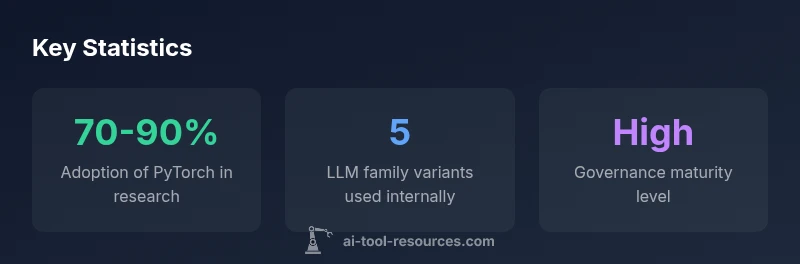
PyTorch sits at the heart of Meta's AI toolkit. It provides the flexibility needed for research iterations and the reliability required for production inference. Alongside PyTorch, FAIRSEQ serves as a high-performance sequence modeling toolkit that underpins many large-scale language and translation experiments. Meta also relies on Hydra for configuration management, enabling researchers to run complex sweeps without losing track of parameters. The combined effect is a modular, scalable toolkit that teams can adapt for vision, language, and multimodal tasks while maintaining interoperability across projects.
LLaMA family and internal model variants: LLMs at scale
Meta’s LLaMA family (including later iterations) exemplifies its strategy for scalable language modeling. LLaMA models are designed to be efficient, adaptable, and accessible for research groups, enabling experimentation with different architectures and training setups. Internal variants and fine-tuned derivatives support product-specific tasks, from content understanding to conversational agents. The use of a robust, open-access family reduces vendor lock-in and accelerates innovation by allowing researchers to validate ideas across multiple settings and datasets.
Internal tooling for experimentation and governance: MLOps at scale
A key part of the Meta stack is the internal MLOps and governance layer. Experiment tracking, dataset versioning, and model governance workflows ensure that models are developed and deployed with traceability, bias checks, and safety constraints. This internal tooling ecosystem supports reproducibility, auditing, and compliance with privacy and safety standards. By standardizing experiments and governance, Meta can move from rapid prototyping to responsible, enterprise-grade deployment more reliably.
Infra and training scalability: Cloud, on-prem, and custom hardware
Meta combines on-prem clusters and scalable cloud-like infrastructure to meet the demands of large-scale model training. The infrastructure emphasizes efficient data pipelines, optimized distributed training, and fault-tolerant deployment. Training at scale benefits from optimized libraries and tooling for multi-GPU and multi-node configurations, reducing time-to-value for new models. This architectural approach helps Meta run exploratory research at speed while ensuring that production workloads stay robust and cost-effective.
Implications for developers and researchers: How to learn from Meta
For developers and researchers, Meta's approach offers practical lessons: prioritize modular tooling, invest in reproducible experiment management, and adopt governance early in the model lifecycle. Open-source frameworks like PyTorch and FAIRSEQ provide a solid foundation, while internal platforms demonstrate how to scale ML workflows responsibly. Students and professionals can apply these patterns by starting with PyTorch-based projects, exploring LLaMA- or other open models for benchmarking, and implementing robust experiment tracking and data versioning in their own pipelines.
Open-source strategy and community impact: Collaboration vs. control
Meta's use of open-source tools like PyTorch reflects a broad strategy to foster community collaboration while maintaining internal controls for safety and compliance. By contributing to and leveraging the wider ML ecosystem, Meta accelerates knowledge transfer, reduces duplication of effort, and invites scrutiny that improves model reliability. For practitioners, this means adopting a mindset that values shared tooling, code transparency, and transparent reporting of model capabilities and limitations.
Practical takeaways for practitioners: A actionable path forward
If you want to emulate Meta's approach, start with a solid, well-supported framework (such as PyTorch) and a robust LLM or transformer model family you can customize. Invest in experiment tracking, versioned datasets, and governance workflows early. Build a modular toolkit that supports rapid prototyping across CV, NLP, and multimodal tasks, and actively engage with the open-source community to contribute back and stay current with best practices.
What this means for the future of AI tooling at scale
Meta's stack signals a broader industry trend toward hybrid stacks that blend open-source flexibility with disciplined internal governance. As models grow in capability and deployment scales increase, teams will rely more on scalable tooling, reproducible pipelines, and governance-first design. For researchers and developers, this implies ensuring your tooling choices support collaboration, auditability, and safe deployment across products.
Representative components in Meta's AI tool stack
| Tool/Framework | Primary Role | Notable Notes |
|---|---|---|
| PyTorch | Core ML Framework | Open-source; widely used in research and production |
| LLaMA/Llama 2 | LLM family | Open models; used for internal experimentation and benchmarking |
| FAIRSEQ | Sequence modeling toolkit | High-performance training for language models |
| Detectron2 | Computer vision toolkit | Object detection and segmentation research |
| Hydra | Experiment management | Config management for large sweeps |
FAQ
What is the LLaMA family and how does Meta use it?
LLaMA refers to Meta's large language model family designed for efficiency and adaptability. Internal variants support product-specific tasks, benchmarking, and research validation. Meta's strategy emphasizes experiments across multiple architectures to advance language modeling while preserving safety and governance.
LLaMA is Meta's family of language models used for experimentation and product tasks, with a focus on efficiency and governance.
Is PyTorch the core framework for Meta's AI work?
Yes. PyTorch is a core foundation across Meta's research and production pipelines. It enables flexible experimentation, rapid iteration, and a consistent runtime for large-scale models.
Yes, PyTorch is central to Meta's AI work for both research and production.
Does Meta share all its AI tools publicly?
Meta shares several key tools and models with the community, notably PyTorch and the LLaMA family under open terms. Some internal tooling and production-grade components are kept private to protect safety, privacy, and competitive advantage.
Meta shares many tools openly, but some internal components remain private for safety and privacy reasons.
What is FAIRSEQ used for in Meta's stack?
FAIRSEQ is used for efficient sequence modeling and training of language models. It provides modular components that support large-scale experiments and benchmarking within Meta's research ecosystem.
FAIRSEQ helps Meta train and compare language models efficiently.
How does Meta handle data governance for AI models?
Meta implements structured governance workflows, dataset versioning, and audit trails to ensure responsible development and deployment. This approach supports compliance, reproducibility, and safety checks throughout the model lifecycle.
Meta uses formal governance to manage data and model safety from development to deployment.
Where can I learn from Meta's AI toolkit?
Start by studying PyTorch tutorials, open LLaMA model papers, and FAIRSEQ benchmarks. Build a modular toolchain with versioned data, track experiments, and participate in open-source communities to mirror Meta's approach.
Begin with PyTorch and LLaMA resources, then build a disciplined, modular ML workflow.
“Meta demonstrates how a deliberate blend of open-source tooling and internal models accelerates AI research while embedding governance at scale.”
Key Takeaways
- Emphasize a multi-tool stack over a single solution
- Open-source frameworks underpin rapid research and production
- Internal governance is integral to scalable deployment
- LLaMA family illustrates scalable language modeling at Meta
- Modularity supports experimentation across domains