How to Get AI Tools for Free: A Practical Guide
Learn how to get ai tools for free through legitimate avenues, free tiers, education programs, and open-source options. This guide from AI Tool Resources balances practicality with responsible usage.


By the end of this guide, you will know how to access AI tools at no cost using legitimate avenues. You’ll learn to evaluate free tiers, open-source options, and education programs, plus practical steps you can take today. According to AI Tool Resources, a diversified mix of free channels minimizes risk and accelerates learning for developers, researchers, and students.
Why free AI tools matter for developers, researchers, and students
Access to AI tools without a large upfront cost accelerates experimentation, learning, and small-scope project development. For learners and researchers, it removes a major barrier to prototyping ideas, validating hypotheses, and sharing results with peers. This is especially true in fast-moving AI fields where early access can lead to meaningful insights long before paid subscriptions are adopted. If you're exploring how to get ai tools for free, you will find that the most effective strategy combines official free tiers, open-source options, and educational programs. According to AI Tool Resources, diversifying your options reduces vendor lock-in and ensures your work remains reproducible. In practice, a thoughtful blend of free channels lets you test multiple approaches, compare results, and choose the right tool for each task—without overcommitting funds or creating data-safety gaps. Throughout this article, we’ll map out concrete steps, evaluation criteria, and best practices tailored for developers, researchers, and students alike.
Where to find legitimate free AI tools
Finding legitimate free AI tools starts with understanding the different access models:
- Official free tiers: Many platforms offer a no-cost tier with limited usage, credits, or feature caps. These are ideal for learning, rapid experimentation, and proof-of-concept work. Always read the terms of service to ensure your use aligns with policy.
- Open-source libraries and models: Community-driven projects provide code, models, and datasets you can run on your own hardware or in a cloud environment. Open-source options foster transparency and reproducibility, which are crucial in research.
- Education and research programs: Universities and research institutes frequently provide access through campus licenses or partnerships. If you’re a student, educator, or researcher, explore these programs first.
- Community platforms and repositories: Community-maintained tools, notebooks, and example projects enable hands-on practice and rapid prototyping. Carefully assess licensing and data-handling rules before publishing results.
To maximize your chances of success, assemble a short-list of tools across these categories and track their strengths and constraints. This approach supports iterative learning, performance comparisons, and safe, compliant experimentation. The goal is to build a versatile toolkit that you can rely on for different tasks, from data preprocessing to model evaluation and deployment. Finally, always document your findings so you can reproduce results and justify tool choices to teammates or instructors.
Free tiers, trials, and open-source options
Free tiers and trials let you explore core capabilities without committing funds, while open-source options give you full control, customization, and long-term cost predictability. When evaluating free options, consider:
- Feature limits: Free tiers usually cap compute, data volume, or API calls. Ensure the limits align with your workflow and testing needs.
- Data privacy and licensing: Review data handling policies and the licensing terms for generated content or contributed data. Favor tools with clear, permissive licenses for open research where appropriate.
- Community activity and support: A vibrant user community accelerates troubleshooting and knowledge sharing. Look for active forums, documentation, and example projects.
- Upgrade paths and future access: Check how easy it is to move from free to paid tiers if your project grows, and whether free access persists for your user category (students, researchers, educators).
Open-source options allow you to run models locally or in your own cloud, removing vendor constraints and enabling customization. They often require more setup but reward you with flexibility, auditability, and long-term sustainability. Free tools should be seen as building blocks rather than permanent substitutes for production-grade solutions. Use them to prototype ideas, validate assumptions, and design a robust tooling strategy for when you scale.
Educational programs and research licenses
Educational programs can unlock substantial access to AI tools for students and researchers. Universities may offer licenses, credits, or cloud credits as part of coursework or research collaborations. If you’re enrolled or affiliated with an institution, start by speaking with your department or library about available licenses. Researchers can often obtain grants or partnerships that provide access to premium platforms for the duration of a project. Even independent researchers can benefit from community-driven academic programs or negotiated group licenses through educational alliances. When applying, be prepared to outline your use case, anticipated data types, and a brief justification for access. These programs align with responsible conduct of research and support reproducibility by providing stable access to essential tools without the burden of high costs.
Evaluating safety, licensing, and data policy
Working with free AI tools requires careful attention to licensing, data handling, and user rights. Always verify:
- Licensing clarity: Is the tool open-source, or does it use a share-alike or commercial license? Ensure you understand what you can do with generated content and how it may be used in publications or products.
- Data privacy and retention: Some free tools store or process user data. Understand what data is sent, stored, or used to improve models, and apply appropriate data minimization.
- Compliance with terms: Free access does not negate compliance obligations. Be mindful of usage limits, rate throttling, and restrictions on sensitive datasets.
- Provenance and reproducibility: Prefer tools with clear audit trails, versioning, and change logs so you can reproduce results in the long term.
By prioritizing safety and licensing checks, you protect your work and your collaborators while maintaining ethical standards in research and development.
Ethical considerations and usage boundaries
Free AI tools are powerful, but they come with responsibilities. Respect terms of service and licensing agreements, especially when sharing results or publishing code. Be mindful of data privacy, bias, and fairness when experimenting with AI-driven insights or automated decisions. When combining multiple free tools, document the data flow and any transformations to ensure reproducibility and accountability. Finally, avoid over-claiming capabilities; free tools may offer impressive features but can introduce risk if used in critical decision-making. This adherence to ethical practice strengthens your research integrity and supports sustainable reuse of free resources across projects.
As you proceed, keep a living checklist of compliance items and privacy considerations to guide future work and avoid avoidable missteps.
How to integrate free tools into your workflow
A practical integration plan helps you turn free tools into a productive part of your development cycle. Start by mapping tasks to tool capabilities (data prep, model testing, evaluation, deployment). Create lightweight pipelines that allow you to switch tools with minimal friction. Use notebooks or scripts to orchestrate tasks and capture outputs for comparison. Where possible, automate data collection and logging to support reproducibility. Finally, establish a routine to review tool performance, update licenses, and retire components that no longer meet your needs. With discipline, a free-tool stack can support meaningful experiments, rapid prototyping, and iterative learning without breaking budgets.
Common mistakes and how to avoid them
Common pitfalls include relying on a single free tool, ignoring licensing, and underestimating data privacy risks. Avoid vendor lock-in by maintaining portable workflows and documenting tool decisions. Don’t assume free means unlimited; track usage and implement governance to prevent cost surprises or data leaks. Also beware of hidden terms in free trials or open-source licenses—some licenses require attribution or restrict commercial use. Finally, remember that free tools are often best used for experimentation and skill development, not as a drop-in replacement for production-grade systems.
A practical plan to build a free AI tool stack
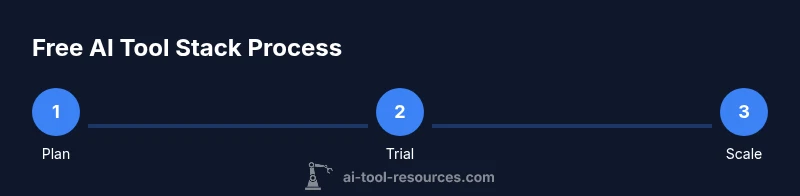
Executing a practical, 8-week plan can help you assemble a robust free tool stack while maintaining ethical and legal standards. Week 1–2: define goals and data schemas; identify candidate free tools and open-source alternatives. Week 3–4: set up local or cloud environments with secure data handling; run small tests on synthetic data. Week 5–6: compare outputs across tools, document results, and refine your evaluation criteria. Week 7–8: consolidate the final stack, establish governance, and write up a reproducible workflow. The aim is to create a repeatable process that can scale as needs grow, while keeping costs predictable and compliance in focus.
Tools & Materials
- Stable internet connection(Broadband or reliable Wi-Fi with minimal downtime)
- Web browser(Latest version of Chrome/Edge/Firefox; disable blockers if necessary for sign-ups)
- Email account(Active email for signups, verification, and recovery)
- Note-taking/app for cataloging tools(Optional but helpful to track tool choices and licenses)
- Small test dataset or synthetic data(Useful for initial evaluations without exposing real data)
Steps
Estimated time: Total time: 2-6 hours
- 1
Define goals and success criteria
Clearly articulate what you want to achieve with AI tools and what success looks like. Specify data sensitivity, required outputs, and acceptable latency. This focus will guide tool selection and evaluation.
Tip: Document your use case, datasets, and expected outcomes before exploring tools. - 2
Survey available free options
Create a short list of platforms offering free tiers, trials, or open-source libraries. Note the usage limits, data policies, and licensing terms for each option.
Tip: prioritize tools with clear terms of service and reproducible results. - 3
Register for official free tiers or open-source deployments
Sign up for the free tier or deploy an open-source alternative on your local machine or a safe cloud account. Ensure you can access documentation and support when needed.
Tip: Keep account credentials organized and enable two-factor authentication where possible. - 4
Run a focused test with a small dataset
Apply a simple, representative task to compare multiple tools. Capture outputs, timing, and any errors, then note limitations.
Tip: Use synthetic data first to avoid privacy risks during initial experiments. - 5
Compare outputs and document results
Benchmark results side-by-side, note strengths and weaknesses, and decide which tool best fits each task in your workflow.
Tip: Create a versioned record of results to support reproducibility. - 6
Scale responsibly and track usage
If you expect growth, establish governance, usage quotas, and an upgrade plan. Keep track of licenses and data policies as you scale.
Tip: Set alerts for quota thresholds to avoid surprise costs or feature loss.
FAQ
Is it legal to use free AI tools for research and development?
Free AI tools are typically legal to use as long as you comply with their terms of service. Always read licensing and data policies to ensure your use aligns with allowed activities and data handling rules.
Yes, free tools are generally legal to use if you follow the terms and data policies.
What are safe ways to access AI tools for free?
Look for official free tiers, educational licenses, and open-source options. Use synthetic data for testing and document each tool's capabilities and limits.
Use official free tiers and open-source options, testing with safe data.
Are free AI tools enough for serious projects?
Free tools are excellent for prototyping and learning but may not meet production-grade requirements. Plan for upgrades or migrations as needed.
They’re great for prototypes; for production you may need paid options.
How do I verify the credibility of a free tool?
Check the source’s reputation, licensing, privacy policy, and community activity. Look for documented benchmarks or user reports.
Check reputation, licensing, and community support.
Can schools provide free AI tools?
Many institutions offer access through campus licenses or partnerships. Check with your department or library to learn what’s available.
Your school may offer access via licenses or partnerships.
What are common mistakes to avoid with free AI tools?
Relying on a single free tool, ignoring terms, or using sensitive data without policy checks. Diversify tools and document choices.
Avoid relying on one tool and always read the terms.
Watch Video
Key Takeaways
- Define your needs before choosing tools.
- Mix free tiers with open-source options for flexibility.
- Check licensing and data policies before experiments.
- Monitor usage to avoid unexpected costs or compliance issues.
- Document your toolkit to support reproducibility.