Can You Create Your Own AI Tool? A Practical Step-by-Step Guide
Learn how to design, prototype, test, and deploy your own AI tool with practical steps, best practices, and safety tips for developers, researchers, and students.


Yes—by following a disciplined process: identify a real problem, define success metrics, select an appropriate model, gather and label data, and iterate through an MVP to production. This guide outlines the key steps, tools, and safety considerations to help you can you create your own ai tool with confidence.
Defining the problem and success metrics
If you’re asking can you create your own ai tool, the answer begins with problem framing. Define the real problem, who benefits, and what success looks like in measurable terms. According to AI Tool Resources, starting with a clearly defined problem reduces scope creep and guides data, modeling, and evaluation decisions. The AI Tool Resources team found that engaging potential users early helps validate assumptions and align expectations. In this phase, map user stories, success metrics, and the minimum viable capability you need to demonstrate value. This clarity keeps the project focused as you move into data strategy and model selection. Your goal is to articulate a problem statement that is small enough to prove quickly, but meaningful enough to spark learning for all stakeholders. Throughout, write down decision criteria and acceptance criteria, so you can tell a persuasive story to evaluators and teammates.
Data strategy and privacy
A successful AI tool depends on high-quality data and responsible data handling. Begin with a data strategy that defines data sources, labeling plans, and data curation rules. Prioritize privacy by designing data collection processes that minimize personally identifiable information, employ consent where required, and implement de-identification where feasible. Also consider governance: who owns the data, who can access it, and how you’ll respond to data requests. In practice, you should create a data dictionary, outline labeling guidelines, and establish data versioning so every experiment is reproducible. For researchers and developers, this stage is a chance to align on data quality standards, bias checks, and audit trails that will matter when you scale.
Choosing the right approach: models and alignment
The core decision in can you create your own ai tool is selecting the modeling approach that fits your problem and constraints. Options range from rule-based systems for narrow tasks to general-purpose learning models that require substantial data. Begin with an alignment plan: what capabilities are essential, and which edge cases must be managed? Consider model size, latency, and compute costs. Outline evaluation criteria beyond accuracy—robustness, fairness, and interpretability matter for ethical deployment. If you’re new to this space, start with a simple baseline (e.g., a lightweight classifier or a rule-based fallback) to establish a reference point and then iterate toward a more capable solution as data and compute allow.
Data collection, labeling, and augmentation
Data is the lifeblood of any AI tool. Plan data collection with quality, diversity, and privacy in mind. Create labeling guidelines, recruit diverse labelers if needed, and implement quality checks to catch mislabeled data. Data augmentation can expand limited datasets and improve generalization, but use augmentation techniques that reflect real-world variation. Maintain a data labeling audit trail so you can justify decisions and reproduce experiments. In your notes, keep track of data sources, licensing terms, and any transformations applied to inputs and labels to support future debugging and compliance.
Building a minimal viable product (MVP)
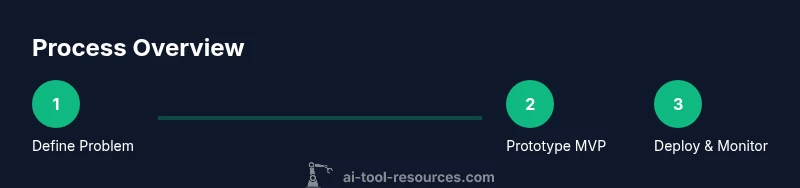
An MVP helps you test core value quickly while avoiding feature bloat. Focus on a single core capability that delivers tangible value to a defined user group. Build a compact pipeline: data ingestion, preprocessing, model inference, and a simple user interface or API. Prioritize reliability over perfection—your MVP should run end-to-end, produce visible results, and allow early user feedback. Document the architecture and decisions, then prepare a reproducible environment so teammates can replicate results. This phase is where you’ll learn what users actually care about, not just what you think they need.
Testing and validation in practice
Testing in AI projects is multi-faceted. Validate accuracy on held-out data and test edge cases that reveal biases or failures. Use real-world scenarios to evaluate usability, latency, and error handling. Implement monitoring for drift, performance degradation, and anomalous inputs. Establish a triage process for failures and a plan for retraining or updating models. Engage diverse users in testing to surface a range of perspectives and use cases. Remember to document test results, limitations, and remediation steps for future audits and governance.
Deployment considerations and tools
Deployment turns an MVP into a usable tool. Decide whether you’ll host on-premises, in the cloud, or as a hybrid solution. Containerize components, set up APIs, and implement authentication and rate limiting. Establish monitoring, logging, and alerting so you can respond to issues quickly. Plan for scale by considering model refresh pipelines, data retention policies, and rollback strategies. This stage often reveals practical constraints (latency, reliability, cost) that shape subsequent iterations and optimizations.
Safety, ethics, and governance
Ethical considerations should accompany every step of can you create your own ai tool. Define guardrails to prevent harmful outputs, bias, and privacy violations. Conduct risk assessments, involve stakeholders, and ensure compliance with applicable laws and regulations. Maintain transparent documentation of data usage, model limits, and decision criteria. Build governance processes for ongoing monitoring, audits, and updates as your tool matures. This proactive approach reduces risk and builds trust with users and collaborators.
Scaling beyond MVP and maintenance
After validating an MVP, delineate a path to production. Plan for ongoing data collection, model retraining, and performance monitoring. Establish a maintenance regime that includes versioning, rollback plans, and clear ownership. Prioritize user feedback loops and feature prioritization to guide future work. Finally, document lessons learned and refine your governance framework to support scaling responsibly. The journey from MVP to scalable tool is iterative, data-driven, and collaborative.
Tools & Materials
- Development environment (IDE, Python)(Set up virtualenv, install numpy, pandas, and a ML framework)
- Data storage and version control(Git repo; data management plan; proper commit discipline)
- Compute resources(Access to CPU/GPU as needed; plan for training and inference costs)
- Data labeling tools(Labeling platform or internal workflow; ensure labeling guidelines)
- Model libraries and frameworks(TensorFlow, PyTorch, or alternative; choose based on problem)
- Experiment tracking and monitoring(Track metrics, hyperparameters, and results for reproducibility)
- Privacy and governance tools(Data anonymization, consent management, and access controls)
- Deployment platform and APIs(Containerization, serverless options, and API endpoints)
- Testing and validation data(Holdout set, cross-validation, and bias checks)
Steps
Estimated time: varies by project (roughly 3-8 weeks)
- 1
Define the problem and success metrics
Clarify who will use the AI tool, what problem it solves, and how you will measure success. Establish acceptance criteria and a narrow scope to accelerate learning.
Tip: Document the problem statement and success criteria in a shared spec. - 2
Choose architecture and data strategy
Select a modeling approach aligned with the problem, constraints, and data availability. Outline data collection, labeling, and privacy considerations.
Tip: Start with a simple baseline to establish a reference point. - 3
Assemble data and establish quality checks
Gather diverse data, implement labeling guidelines, and create quality checks to catch errors early. Version data and track its lineage.
Tip: Keep a data provenance log for audits and debugging. - 4
Build the MVP pipeline
Create a compact, end-to-end pipeline: data ingestion -> preprocessing -> model inference -> API or UI. Keep it lean but functional.
Tip: Limit features to reduce time-to-feedback and increase learning speed. - 5
Validate with real-world tests
Test on held-out data and simulate edge cases. Monitor latency, accuracy, and user experience.
Tip: Incorporate user feedback early to guide iterations. - 6
Prepare deployment and monitoring
Containerize components, set up monitoring, and establish alerting for failures or drift.
Tip: Create an easy rollback plan for production changes. - 7
Governance and safety controls
Implement guardrails, bias checks, and privacy protections. Document governance policies.
Tip: Review legal and ethical implications with stakeholders. - 8
Scale responsibly and maintain
Plan data updates, model retraining, and ongoing maintenance. Create ownership and a release calendar.
Tip: Treat scaling as an iterative, collaborative process.
FAQ
What is the first step to create an AI tool?
Define the problem, audience, and success metrics. This sets the direction for data, model, and evaluation choices.
Start with problem definition, audience, and success metrics to guide every decision.
Do I need a large dataset to start building an AI tool?
Not always. You can begin with a smaller, high-quality dataset and a baseline model. Use data augmentation and simulated data when appropriate.
You can start with smaller, quality data and a solid baseline; you can grow the dataset over time.
What are the main risks when deploying an AI tool?
Risks include privacy violations, bias in outputs, model drift, and system downtime. Mitigate with guardrails, monitoring, and governance.
Be mindful of privacy, bias, and drift; set up monitoring and governance from the start.
Can open-source models be used safely for production?
Yes, with appropriate evaluation, licensing compliance, and safeguards like monitoring and fallback rules. Tailor deployment to your risk tolerance.
Open-source models can be production-ready if properly evaluated and guarded.
How long does it take to move from MVP to production?
Time varies by scope, data, and infrastructure. Plan for iterative releases, with clear milestones and governance.
It varies, but plan for multiple iterations and governance checks.
What should I document for governance?
Document data sources, model limits, decision criteria, privacy protections, and monitoring plans.
Keep clear records of data, model limits, and monitoring plans.
Watch Video
Key Takeaways
- Define a clear problem and audience
- Prototype with an MVP to accelerate learning
- Prioritize ethics and governance
- Plan for maintenance and monitoring