How to test AI tools: a practical guide
A practical, step-by-step guide to testing AI tools, covering goals, data, reproducibility, safety, and bias with templates and checklists for developers, researchers, and students.


According to AI Tool Resources, you can test AI tools by defining evaluation goals, selecting representative data, and running reproducible benchmarks. This quick guide introduces a practical, step-by-step approach to measuring reliability, safety, latency, and bias, with checklists you can apply to any AI tool in development or research settings, including reproducibility checks and governance considerations.
What testing AI tools means in practice
Testing AI tools means validating that the tool's outputs are accurate, reliable, safe, and fair across real-world scenarios. It requires clear goals, measurable criteria, and repeatable experiments. By framing tests around user impact and governance, teams can distinguish between cosmetic improvements and meaningful reliability gains. According to AI Tool Resources, successful testing combines quantitative metrics with qualitative analysis to capture edge cases and unexpected behaviors. A practical testing approach starts with a simple pilot, then scales as confidence grows: identify critical tasks, gather representative data, and document every run so results can be reproduced by others. The aim is to create a living test protocol that evolves with the tool, its data, and the domain it serves. In practice, you’ll switch between closed-box testing (where you don’t modify the model) and white-box testing (where you inspect internals) to understand both performance and safety risks.
Defining evaluation goals and success metrics
Start by translating product or research goals into measurable criteria. What does “good enough” mean for this tool in your context? Common goals include accuracy, fairness, latency, robustness to input noise, and safe handling of uncertain or harmful inputs. For each goal, define success thresholds, acceptable error rates, and how results will be validated. Use a mix of quantitative metrics (precision, recall, F1, latency, memory footprint) and qualitative signals (user satisfaction, interpretability, auditability). AI Tool Resources analysis shows that clarity in goals improves test focus and reduces analysis paralysis; without it, teams chase vanity metrics instead of meaningful improvements. Keep your metrics tied to real user impact, and document your rationale so future teams can reproduce decisions.
Selecting representative datasets and test scenarios
Data choice drives test relevance. Assemble datasets that reflect the tool’s intended use, including corner cases and real-world noise. Avoid leakage by keeping training and test data separate, and anonymize any sensitive content. Create test scenarios that stress core capabilities: multi-turn interactions for chatbots, image or video inputs with challenging contexts, or code and data analysis tasks for developer tools. Use stratified sampling to cover different user types, data distributions, and rare but impactful cases. Track data provenance and versioning so tests can be rerun with exact inputs. This is where AI Tool Resources’s guidance emphasizes the balance between diversity and practicality: you want broad coverage without an unmanageable test backlog.
Designing reproducible test workflows
Reproducibility is the backbone of credible testing. Build test pipelines that capture inputs, model versions, environment details, and random seeds. Use containerized environments and pinned dependencies so tests run the same way every time. Store test data and results in a centralized repository with metadata: who ran the test, when, on what hardware, and under what conditions. Automate the execution of tests, generate standard reports, and store artifacts in a version-controlled project. Include both automated checks and manual review steps, so humans can interpret edge cases that numbers miss. Document any deviations between runs and explain why they occurred. The more deterministic your process, the easier it is to audit results and compare across tools.
Safety, bias, and governance considerations
AI tools operate in social and ethical contexts. Incorporate safety tests that catch unsafe outputs, privacy violations, or safety policy breaches. Assess potential biases by testing across diverse user groups and use-case scenarios; record where fairness metrics succeed and where they fail. Build governance checks into your pipeline: require sign-offs for high-risk outputs, audit logs for decision points, and clear escalation paths for flagged issues. Remind stakeholders that tools can drift over time as data shifts, so plan periodic re-testing and batch reviews. If a test reveals harmful behavior, pause deployment, roll back changes, and investigate root causes before re-running tests.
Practical templates and next steps
To turn theory into action, start with a lightweight testing template: a one-page goals sheet, a data provenance log, a metric dashboard, and a runbook for how to reproduce results. Expand gradually: add more data, more scenarios, and more users consulted for qualitative feedback. Create a shared checklist for every tool you test, and require that results be stored in a central, versioned repository. Schedule regular review cycles to refine goals, thresholds, and test data. Finally, use the outputs to drive concrete improvements in the tool, the data, and the deployment process.
Tools & Materials
- Representative datasets (privacy-compliant)(Data mirrors intended use cases; include edge cases.)
- Benchmark scripts and metric definitions(Predefined metrics: accuracy, latency, robustness, bias indicators.)
- Logging and monitoring platform(Capture inputs, outputs, timings, resource usage.)
- Reproducible environment (containers or environment files)(Pin versions; use Docker/Conda; include seeds.)
- Validation and bias-checking tools(Fairness metrics, bias tests, and error analysis tools)
- Data privacy and compliance guidelines(Ensure de-identification and compliance.)
- Documentation templates(One-pagers, run reports, decision logs)
Steps
Estimated time: 60-90 minutes
- 1
Define evaluation goals
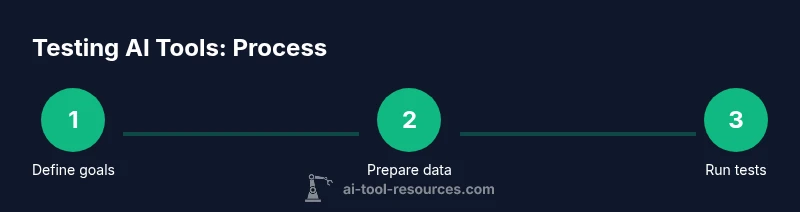
Translate product or research goals into clear, measurable criteria. Identify what success looks like for each core capability (accuracy, safety, fairness, latency). Align with stakeholders to set expectations and thresholds, so the rest of the process has a concrete target.
Tip: Involve product owners and researchers early to ensure alignment. - 2
Choose representative data and scenarios
Assemble datasets that reflect real use cases and edge cases, while preventing data leakage. Create test scenarios that stress the tool’s strongest and weakest points, including noisy inputs and boundary conditions.
Tip: Use stratified sampling to cover diverse user types. - 3
Select metrics and benchmarks
Pick a mix of quantitative metrics (accuracy, latency, robustness) and qualitative signals (usability, interpretability). Define how you will validate results and what constitutes a passing benchmark.
Tip: Document metric definitions and calculation methods. - 4
Set up a reproducible environment
Lock down environments with containers or environment files and pin dependencies. Use version control for data and code, including seeds for deterministic runs.
Tip: Capture environment details in every test run. - 5
Run tests and collect results
Execute automated tests and capture outputs, timings, and resource usage. Generate standard reports and store artifacts in a central repository.
Tip: Tag runs with metadata to enable filtering later. - 6
Analyze results and iterate
Review results with stakeholders, identify root causes, and plan iterations to address gaps. Update data, tests, or models and re-run as needed to validate improvements.
Tip: Treat results as evidence to guide product changes.
FAQ
What is the main goal of testing AI tools?
The main goal is to verify that the tool delivers accurate, safe, and fair outputs under expected conditions, and to identify risks before deployment.
The main goal is to verify accuracy, safety, and fairness before deployment.
What metrics should I use for AI tool tests?
Use a mix of quantitative and qualitative metrics: accuracy, latency, robustness, bias indicators, and user feedback.
Use a mix of quantitative and qualitative metrics.
How often should tests be run?
Run tests on new releases and data shifts; schedule periodic re-testing to detect drift and regression.
Run tests on new releases and data shifts.
How do I handle biases in tests?
Assess performance across diverse groups; adjust datasets or models if disparities emerge; document findings.
Assess performance across diverse groups and document findings.
What tools can help with testing AI models?
Look for frameworks that support reproducible benchmarks, logging, and privacy-preserving testing for your stack.
Look for frameworks that support reproducible benchmarks.
What about data privacy during testing?
Use de-identified or synthetic data when possible; follow privacy-by-design and regulatory guidelines during testing.
Use de-identified or synthetic data during testing.
Watch Video
Key Takeaways
- Define clear testing goals before starting.
- Use representative data to reveal real issues.
- Automate tests and track changes with version control.
- Document results for reproducibility and audits.