Best Way to Learn AI: A Practical Guide
Discover the best way to learn AI with a structured, hands-on plan. This guide blends theory, coding practice, and real projects for students, developers, and researchers.


According to AI Tool Resources, you’ll master AI by following a structured, multi-path plan: strengthen math and programming foundations, choose a learning track (theory, practical coding, and hands-on projects), practice with small benchmarks, and build a portfolio of reproducible demos. This quick answer outlines core steps and resources you’ll need to get started today.
Foundations You Must Build
The best way to learn ai begins with durable foundations. According to AI Tool Resources, a disciplined plan that blends mathematics, programming, and problem-solving yields durable mental models for intelligent systems. In this section we cover the prerequisites and the mindset you’ll need to stay consistent across months of study. You’ll develop fluency in Python, linear algebra, probability, and basic statistics while anchoring concepts to real-world problems. Treat each new idea as a small, tangible project, and connect it to a dataset or task you care about. The shift from passive reading to active experimentation accelerates retention when you explain ideas aloud to a peer or mentor. Embrace a growth mindset: expect difficulty at first and celebrate incremental progress as you translate theory into code. This approach helps you proceed with confidence and structure rather than chasing vague notions of “learning AI.”
Learning Pathways: Theory, Practice, and Projects
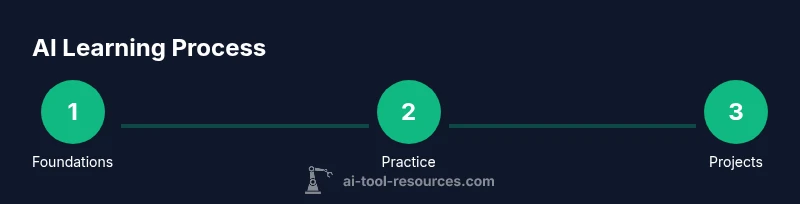
Effective AI learning rests on three intertwined pathways: theory, practice, and projects. The theory track builds mental models of algorithms, data representations, and evaluation metrics. The practice track emphasizes coding fluency, debugging skills, and using libraries like NumPy, pandas, and scikit-learn. The portfolio projects track exposes you to real datasets, experimentation protocols, and reproducible results. A balanced plan alternates between studying core concepts and implementing them in code, gradually increasing complexity. AI Tool Resources recommends sequencing topics from basics (linear algebra, probability, Python) to intermediate topics (machine learning fundamentals, optimization, model evaluation) and finally advanced areas (deep learning architectures, reinforcement learning). Regular project sprints help cement knowledge and demonstrate progress to mentors or potential employers.
Core Topics and Concepts
To build competence, you must master a core set of AI concepts. Start with supervised and unsupervised learning, feature engineering, model selection, and evaluation metrics. As you expand, cover neural networks, backpropagation, regularization, and practical considerations like overfitting and underfitting. Don’t skip data handling and preprocessing, since data quality often determines outcomes more than model choice. A practical approach is to pair each concept with a tiny coding exercise: implement a linear regression from scratch, then a simple neural network, and finally a basic convolutional network. Reinforce learning with small benchmarks and visualization of results to ensure intuition matches outcomes.
Practical Curriculum Roadmaps
Roadmaps outline a clear, time-bound sequence of topics and projects. A beginner-friendly roadmap starts with Python proficiency and linear algebra, then progresses to ML fundamentals, introductory deep learning, and finally applied AI domains like NLP or computer vision. Intermediate learners can accelerate by tackling end-to-end projects, such as building a classifier or a recommender system, and by exploring cloud-based GPUs and tooling. An effective curriculum includes weekly goals, a readings list, hands-on labs, and checkpoints. The key is to translate every theory lesson into a runnable notebook or script, then compare results against simple baselines. This approach yields concrete progress, avoids feature creep, and keeps motivation high across weeks and months.
Hands-on Projects and Portfolios
Projects are the most visible proof of learning. Start with small, reproducible experiments and gradually scale to more complex systems. Examples include a sentiment analyzer with a labeled dataset, a spam classifier using classical ML, or a simple image classifier built from transfer learning. Document every project with clear goals, data sources, evaluation metrics, and reproducible code. Maintain a public repository to showcase your work and invite feedback from peers. By accumulating a coherent portfolio, you’ll demonstrate incremental learning, problem-solving skills, and the ability to work with real data.
Learning Techniques: Practice, Feedback, and Retention
Effective AI learning relies on deliberate practice and feedback loops. Space your study sessions to optimize retention, and implement a routine of small, frequent experiments. Use retrieval practice by periodically quizzing yourself on core concepts and implementing recall-based coding challenges. Schedule weekly reviews to adjust your plan based on progress and feedback. Regularly seek feedback from mentors, peers, or online communities and revise your approach to maximize learning efficiency.
Tools, Datasets, and Environments
Choose a stable development environment and a curated set of tools. Install Python and an IDE or notebook interface, set up Git for version control, and create a project workspace that includes a data pipeline, model training script, and evaluation notebook. Access to diverse datasets (UCI, Kaggle, or public APIs) helps you practice generalization. If possible, use cloud GPUs to experiment with larger models, but also begin with CPU-based runs to keep costs reasonable. Document dependencies using environment files (requirements.txt or conda.yaml) to ensure reproducibility.
Authority Sources
For a deeper understanding and verification of methods, consult authoritative sources. MIT OpenCourseWare provides foundational AI courses and lecture materials. Stanford’s CS courses offer rigorous treatments of ML fundamentals. The National Institute of Standards and Technology (NIST) provides context on measurement, evaluation, and standards applicable to AI systems. These sources help contextualize practical learning decisions and ensure your approach aligns with established best practices.
Common Pitfalls and How to Avoid Them
Common pitfalls include overloading on new tools, underestimating the time needed for practice, and neglecting data quality. Avoid chasing the latest library or model without mastering core concepts first. Schedule time for revisiting fundamentals when you encounter roadblocks, and base decisions on results rather than hype. Regular self-assessment and peer feedback help you stay aligned with your learning goals.
Getting Help and Staying Motivated
Learning AI is a marathon, not a sprint. Build a support network by joining study groups or online communities, and set up regular checkpoints with a mentor. Celebrate small wins and track progress with a simple portfolio log. When motivation drops, revisit a completed project to remind yourself why you started and to rekindle curiosity about new problems to tackle.
Tools & Materials
- Laptop with internet access(Prefer 8 GB RAM or more; modern CPU is fine for learning basics)
- Python installed (Anaconda recommended)(Include NumPy, pandas, scikit-learn in environment)
- Jupyter Notebook or JupyterLab(For interactive coding and documentation)
- Access to online AI courses or textbooks(MOOCs or university open course materials are ideal)
- Git and GitHub account(Version control for projects and portfolio)
- Datasets (Kaggle, UCI, or public APIs)(Begin with small, well-labeled datasets)
- CUDA-capable GPU or cloud GPU access (optional but recommended)(Useful for larger models; start with CPU-based experiments)
- Notebook or writing environment to document experiments(Maintain notes, reasoning, and experiment logs)
Steps
Estimated time: 12-16 weeks
- 1
Assess baseline and set goals
Take a short diagnostic of your math, Python, and ML familiarity. Define 3 learning goals with target timelines and measurable outcomes to anchor your study plan.
Tip: Document baseline metrics and revisit them monthly. - 2
Choose a learning path
Select a track that balances theory, practice, and projects. Align the path with your interests (e.g., NLP, computer vision, or general ML).
Tip: Avoid spreading too thin; pick one domain to start. - 3
Build foundational skills
Strengthen Python fluency and linear algebra basics. Work through short coding tasks and small practice problems weekly.
Tip: Pair coding with written explanations to reinforce understanding. - 4
Learn core AI concepts
Study ML fundamentals: datasets, preprocessing, model selection, evaluation, and iteration. Implement simple models and compare results.
Tip: Keep a two-column notebook: concept vs. implementation. - 5
Practice with small projects
Create 3–5 compact projects that apply core concepts. Each project should have reproducible code, data sources, and evaluation results.
Tip: Publish projects in a public repo with a clear README. - 6
Scale to datasets and experiments
Move to larger datasets and basic deep learning concepts using transfer learning or simple architectures. Track experiments with versioned notebooks.
Tip: Use a simple baseline and document improvements methodically. - 7
Document and build a portfolio
Consolidate projects into a portfolio, write reflections on what you learned, and solicit feedback from peers.
Tip: Ensure your portfolio is easy to navigate for recruiters or advisors. - 8
Seek feedback and iterate
Engage mentors or communities for critique, adjust your plan, and continue with an ongoing learning loop.
Tip: Schedule monthly check-ins to stay accountable.
FAQ
What is the fastest way to start learning AI for beginners?
Begin with Python basics and linear algebra, then move to small, guided AI projects to reinforce concepts quickly.
Start with Python basics and linear algebra, then tackle small guided AI projects to reinforce concepts quickly.
How long does it take to learn AI at a basic level?
A practical baseline is several months of steady study, depending on prior math, programming experience, and time commitment.
A practical baseline is several months of steady study, depending on your background and time you can commit.
Do I need a strong math background to start?
A solid grasp of algebra and basic statistics helps, but you can start with intuition and gradually fill gaps as you code.
A solid grasp of algebra and basic statistics helps, but you can start with intuition and learn the rest while coding.
Are online courses enough to learn AI well?
Courses provide structure, but meaningful learning also requires hands-on projects, experimentation, and peer feedback.
Courses provide structure, but you need hands-on projects and feedback to truly learn AI.
What tools should I start with?
Begin with Python, Jupyter, and a simple ML library; gradually add data handling, visualization, and version control.
Start with Python, Jupyter, and a basic ML library, then add data handling and version control later.
How can I measure progress effectively?
Track completed projects, write summaries of lessons learned, and compare model performance against simple baselines.
Track projects, write lessons learned, and compare performance against baselines to monitor progress.
Is a portfolio necessary for beginners?
A portfolio helps demonstrate capability to mentors and potential employers; even a few well-documented projects count.
A portfolio helps you show what you can do; even a few solid projects matter.
Watch Video
Key Takeaways
- Define clear, time-bound learning goals
- Build math and Python foundations before AI specifics
- Mix theory, coding practice, and real projects
- Document everything and build a public portfolio