How to Start Learning AI: A Practical Step-by-Step Guide
Discover a practical, beginner-friendly path to learning AI with a clear roadmap, essential concepts, hands-on projects, and study strategies for developers, researchers, and students.


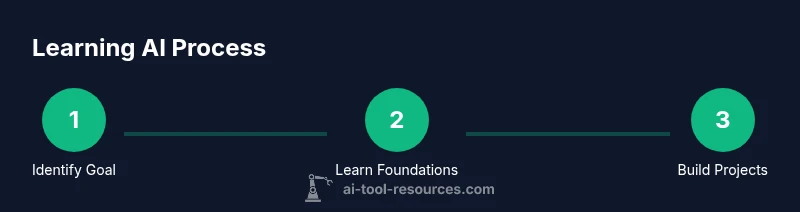
This guide shows how to start learning ai from zero to practical competence. You’ll define clear goals, build essential math and coding foundations, and complete beginner-friendly projects. By following a structured, time-bound roadmap, you’ll gain confidence and steadily progress toward real-world AI tasks. This approach emphasizes hands-on practice, critical thinking, and consistent study habits.
Why AI learning matters
In 2026, AI influences nearly every field, from software engineering to scientific research. If you're asking how to start learning ai, the answer begins with clear goals and practical steps. According to AI Tool Resources, beginners who set concrete outcomes and practice with small, observable wins accelerate progress much more than those who chase breadth first. This philosophy emphasizes bite-size projects, consistent study, and reflection—key to building usable skills quickly. Start by identifying a real problem you want to solve—a simple automation, a classifier for a dataset, or a human-in-the-loop prototype. Then design a simple plan that pairs reading with coding, yields a testable result, and fits your schedule. The AI Tool Resources team notes that steady, incremental learning beats marathon sessions, especially for busy students and professionals. By framing your journey around tangible tasks, you’ll build confidence and create portfolio-worthy artifacts early on.
Setting SMART goals for your AI learning
SMART goals help turn vague ambition into actionable steps. For example, aim to complete one small Python project per week for six weeks, or master linear regression in two weeks and then apply it to a dataset. Write your goals down and review them every Sunday. The AI learning journey benefits from specific milestones (e.g., complete a basic neural network from scratch) and measurable outcomes (e.g., achieve a certain accuracy on a toy dataset). By tying milestones to a timeline, you’ll avoid burnout and maintain steady progress. AI Tool Resources recommends starting with foundational topics and gradually increasing complexity as your competence grows.
Core concepts to learn first
Cover the fundamentals: probability, statistics, linear algebra, calculus basics, and Python programming. Understand data types, data preprocessing, and simple algorithms such as linear regression and k-nearest neighbors. Learn how to evaluate models, avoid overfitting, and interpret results. This foundation enables you to tackle more advanced topics like neural networks later. As you study, pair theory with small experiments and code snippets to reinforce understanding. Make sure your study stack includes reliable references and hands-on practice to avoid common stumbling blocks.
A practical 8-week roadmap
Week 1–2: Refresh Python basics and math foundations (linear algebra, probability). Week 3–4: Dive into core ML concepts (supervised learning, evaluation metrics, basic algorithms). Week 5–6: Build small projects and explore data handling (preprocessing, feature engineering). Week 7: Introduce ethics, data privacy, and responsible AI considerations. Week 8: Assemble a portfolio of mini-projects and reflect on lessons learned. This plan aligns with practical learning paths cited by AI Tool Resources, emphasizing milestones you can show to potential collaborators or employers.
Hands-on practice: projects you can start today
Begin with simple, well-scoped projects that pair theory with code. Examples:
- A linear regression model on a toy dataset to predict a numeric target.
- A binary classifier on a small labeled dataset to practice preprocessing and evaluation.
- A tiny neural-network-from-scratch experiment to understand backpropagation basics. For every project, document your approach, challenges, and results. Use version control to track progress and create a public README that explains your methods and findings.
Tools, environments, and setup
Prepare a lightweight but capable development environment:
- A laptop or workstation with internet access (8GB+ RAM recommended; modern processor helps).
- Python 3.x installed (preferably 3.10+).
- A code editor (VS Code or an equivalent IDE).
- Git and a GitHub account for version control and collaboration.
- Access to a browser and online courses or tutorials.
- Jupyter/Colab notebook setup for interactive experiments. Optional: a GPU-enabled environment for larger experiments, though not required at the start.
Learning strategies that stick
Adopt study habits that promote long-term retention:
- Schedule consistent, short study blocks (25–50 minutes) with a regular rhythm.
- Alternate between theory and hands-on practice to reinforce concepts.
- Maintain a running notebook that summarizes key ideas in your own words.
- Regularly revisit and refine your goals based on what you’ve learned and new interests.
- Join study groups or online communities to stay motivated and gain feedback.
Ethics, safety, and staying up-to-date
Responsible AI practice means considering data privacy, bias, and model safety from day one. Always verify data provenance and experiment with simple fairness checks. Keep up with literature and community discussions, and curate a personal learning feed from trustworthy sources. Revisit core safety principles as you advance to more complex topics, ensuring your work remains grounded in ethical practices.
Quick-start checklist to begin now
- Define a concrete, time-bound learning goal for the next 8–12 weeks.
- Install Python, a code editor, and set up a simple project repository.
- Complete a beginner-friendly Python tutorial and a basic ML concept tutorial.
- Build and document two starter projects with public READMEs.
- Curate a mini-portfolio of artifacts to share with peers or mentors.
Tools & Materials
- Laptop or workstation with internet access(At least 8GB RAM; modern CPU. GPU optional for advanced experiments.)
- Python 3.x(Preferably Python 3.10 or newer.)
- Code editor (e.g., VS Code)(With Python extension for linting and debugging.)
- Git and GitHub account(For version control and collaboration.)
- Web browser and access to online courses(Use reputable platforms for structured content.)
- Jupyter/Colab notebooks(For interactive exploration and sharing notebooks.)
- Public datasets for practice(Begin with small, well-labeled datasets.)
- GPU access (optional)(Helpful for training larger models or experiments.)
Steps
Estimated time: 6-12 weeks
- 1
Define your learning goal
Clarify what you want to achieve with AI and by when. Write a SMART goal that links to a practical outcome, such as building a simple classifier or automating a data task. This clarity guides your weekly actions and helps track progress.
Tip: Write the goal on a sticky note and place it where you study daily. - 2
Strengthen math and Python basics
Review essential linear algebra, probability, and calculus concepts, plus Python fundamentals. Practice by coding small, annotated examples and translating equations into runnable code.
Tip: Use short, focused coding sessions paired with concept sketches to reinforce understanding. - 3
Learn core ML concepts
Study supervised learning, evaluation metrics, bias/variance, and feature engineering. Implement simple algorithms (linear regression, logistic regression) from scratch to internalize mechanics before relying on libraries.
Tip: Explain each algorithm aloud as you implement it to check your understanding. - 4
Build small projects
Apply what you’ve learned to two beginner projects: a numeric predictor and a binary classifier. Document data sources, preprocessing steps, model choices, and results.
Tip: Treat each project as a micro-end-to-end demonstration you can showcase. - 5
Work with real datasets
Shift from toy data to real datasets, focusing on data cleaning, feature selection, and basic model testing. Compare different models on the same data to understand trade-offs.
Tip: Always report data quality issues and how you addressed them. - 6
Document progress and reflect
Maintain a learning journal or weekly recap that captures what worked, what didn’t, and what to adjust next. Include code snippets and performance notes.
Tip: Keeping a narrative helps you communicate your journey to others. - 7
Create a portfolio and share your work
Publish a public repository or blog with two finished projects, explanations, and reproducible steps. Seek feedback from peers or mentors to improve.
Tip: Link your portfolio to your resume or LinkedIn to increase visibility.
FAQ
What is AI learning, and what should I expect?
AI learning is the process of understanding core concepts in artificial intelligence and applying them through coding, experiments, and projects. Expect to build both theoretical knowledge and practical skills via hands-on coding.
AI learning means understanding AI concepts and applying them in projects. Start with fundamentals and progressively build practical skills.
Do I need a strong math background to start?
A basic comfort with algebra, statistics, and probability helps, but you can begin with intuition and gradually strengthen the math as you work on real problems. Focus on applied understanding first.
A solid math foundation helps, but you can begin with intuition and build up as you code.
How long does it take to start learning AI?
The timeline varies with time commitment. A solid fundamentals track can take several weeks to a few months, with ongoing practice to reach comfortable competence.
Depends on how much time you dedicate; many learners reach fundamentals in a few months with steady practice.
What are good starter projects?
Begin with small, end-to-end projects like linear regression on simple data or binary classification on a toy dataset. The goal is to demonstrate a complete workflow from data to evaluation.
Try a basic predictor or classifier to learn end-to-end workflow.
Which resources should I trust?
Look for reputable sources such as university course materials, foundational ML textbooks, and curated online courses. MIT OpenCourseWare and Stanford AI materials are good starting points.
Use university materials and reputable courses to guide your study.
Is programming experience required?
Some programming experience helps, but you can learn by starting with Python basics and gradually applying them to AI tasks. Practice is essential.
You don’t need expert coding to start—just begin with Python basics and build up.
Watch Video
Key Takeaways
- Set clear, achievable learning goals.
- Build foundational math and Python skills first.
- Combine theory with small, hands-on projects.
- Document progress and build a portfolio early.