How to Master AI Tools: A Practical, Hands-On Guide
Master AI tools with a structured, step-by-step approach. Learn tool selection, workflows, and real-project practice to build practical AI proficiency and accelerate your learning journey.


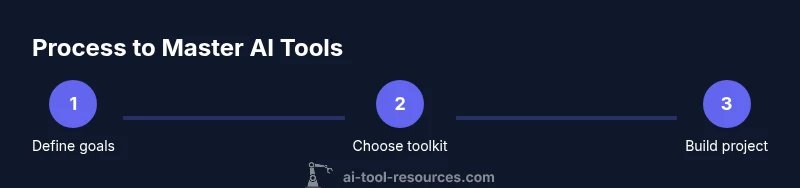
This guide shows you how to master AI tools through a disciplined, hands-on process. You’ll start by identifying your goals, choosing a core toolset, and learning through small, repeatable projects. By building workflows, measuring progress, and iterating, you’ll develop practical fluency in AI toolchains and accelerate your projects.
Defining mastery: what it means to master AI tools
Mastering AI tools means more than knowing a single library or platform. It’s the ability to select appropriate tools for a given problem, configure them to run safely, and interpret the results to drive real outcomes. To begin, set concrete learning goals aligned with your work: e.g., build a small ML model end-to-end, automate a data-cleaning pipeline, or deploy a lightweight inference service. Distinguish between theoretical familiarity and practical fluency by measuring how quickly you can complete a reproducible project, how reliably you can explain your approach to teammates, and how confidently you can iterate when a result falls short. In this path, you’ll practice with repeatable workflows, evaluate results using objective metrics, and document decisions so you can reproduce success later. This clarity is essential for developers, researchers, and students who want tangible competence rather than hype.
As you progress, remember that “mastery” grows with applied experience. Start with small, well-scoped goals and progressively tackle more complex scenarios. The long-term payoff is not just knowing tools, but building a toolkit and mindset that lets you adapt as new AI capabilities emerge.
Building your core toolkit: selecting tools for learning
Choosing a core toolkit is about aligning tools with problems, not chasing the latest hype. Start with a baseline that covers data handling, model development, evaluation, and deployment. For data, include a language and libraries that support data manipulation and experimentation. For modeling, pick one flexible framework and a couple of supplementary libraries that expand capabilities. For deployment, identify a simple hosting or visualization approach that makes sharing results easy. Importantly, avoid tool fatigue by picking a coherent set that you can rely on for multiple projects.
When evaluating options, prioritize open documentation, ecosystem maturity, and community support. Favor tools with clear tutorials and safe defaults to reduce early frustration. Keep a living inventory of your chosen tools, explain how each one fits your goals, and revisit your toolkit every few months to prune or replace components that no longer serve you. This disciplined approach prevents scope creep and accelerates hands-on practice.
Learning workflows: data, models, evaluation
Learning AI tools effectively hinges on repeatable workflows. Start with data intake and cleaning, then move to feature extraction and model selection. Define evaluation criteria before you run experiments so you know what success looks like. Maintain a simple experiment tracker to log configurations, datasets, and outcomes. This not only provides reproducibility but also helps you compare approaches without reworking the basics.
Adopt a modular mindset: keep data processing, model code, and evaluation scripts separate so you can swap components easily. Write small, testable units and document decisions with concise notes. Over time, you’ll build a mental map of which tools and techniques work best for particular classes of problems, which makes it easier to scale your practice and tackle increasingly ambitious projects.
Hands-on practice: project ideas and scaffolding
Practical practice is the fastest path to mastery. Start with guided mini-projects that mirror real tasks and progressively add complexity. For example, design a basic data-cleaning pipeline, train a simple classifier, and deploy a dashboard to display results. Each project should end with a short write-up that captures your approach, the choices you made, and the metrics you used.
Keep scaffolding: templates, starter notebooks, and reusable scripts reduce friction and let you focus on core concepts. As you gain confidence, introduce more challenging problems such as handling larger datasets, optimizing inference time, or experimenting with ensemble methods. The goal is consistent, incremental progress that translates into practical competence.
Documentation and knowledge management
Effective learning requires thoughtful documentation. Create a centralized notebook or wiki where you summarize tool capabilities, code snippets, and evaluation results. Use version control for code and a separate changelog for experiments. Build a habit of writing quick rationale for each decision: why you chose a tool, why you adjusted a parameter, and what the observed effect was on the outcome. Over time, your repository becomes a living guide you can reuse for new projects or to onboard teammates.
Also curate learning resources: official docs, reputable blogs, and course notes. Annotate them with real-world implications and caveats so the material remains practical, not theoretical. This ongoing documentation is the backbone of mastery, enabling faster iteration and more confident decision making.
Safety, ethics and governance when using AI tools
As you scale your practice, integrate safety and governance into your workflow. Consider data privacy, bias, and model explainability from day one. Establish guardrails for data handling, set access controls, and document ethical considerations alongside technical choices. Regularly review results for fairness and reliability, and be transparent about limitations. By embedding responsible practices, you ensure your mastery remains aligned with trustworthy AI usage.
Adopt a simple risk register to log potential issues, the likelihood of occurrence, and mitigation steps. This proactive approach reduces surprises during later stages of your projects and supports sustainable growth in your AI toolkit.
Measuring progress: metrics and milestones
Track progress with concrete metrics that reflect real-world impact. Define indicators such as reproducibility score (code that runs without errors), time-to-value (how quickly you deliver a working result), and predictive performance on validation data. Build a milestone ladder: start with mastering a single tool, then complete a small project, then deploy, and finally optimize. Regular reviews help you adjust goals and maintain momentum.
In addition to technical metrics, measure learning efficacy: how well you explain your approach, how often you refer back to documentation, and how effectively you translate experiments into actionable insights. These cross-cutting metrics ensure you’re not just using tools, but becoming fluent in applying AI to problems.
From learner to practitioner: building a learning plan
A structured learning plan is your roadmap to becoming proficient with AI tools. Begin with a baseline assessment of skills and gaps, then map out a 12- to 24-week plan with weekly objectives. Include a mix of guided projects, independent experiments, and review sessions. Schedule regular practice blocks and set aside time for reading official docs and exploring new features.
Keep the plan flexible to accommodate evolving tools and new techniques. Build a habit of documenting lessons learned and updating your toolkit accordingly. A well-designed learning plan turns aspiration into concrete capability and helps you advance from novice to practitioner with confidence.
Common bottlenecks and how to overcome them
New learners often hit roadblocks around data access, environment setup, and debugging complex pipelines. When you encounter these bottlenecks, break the problem into smaller parts and validate assumptions with small experiments. Use community resources and templates to bootstrap solutions, and don’t fear asking for help when a concept isn’t clear. Maintaining a calm, methodical approach reduces frustration and accelerates progress.
Finally, guard against overfitting your skills to a single tool. Diversify by practicing across different platforms and datasets to build a robust, transferable skill set. This breadth ensures you remain adaptable as tools evolve.
Tools & Materials
- Laptop with internet access(Recent OS; 8GB+ RAM recommended; reliable internet connection)
- Notebook or digital note-taking app(Used to track experiments, decisions, and learnings)
- Access to AI tool platforms (cloud or local)(At least one platform with API access; ensure terms and safety policies are understood)
- Datasets for practice (synthetic or open datasets)(Include a small labeled set for evaluation and a separate unlabeled set for exploration)
- IDE or code editor (e.g., VS Code)(Install necessary extensions for Python and notebooks)
- Documentation and reference materials(Official docs, tutorials, and example notebooks)
- Experiment tracking tool(Optional but recommended to log configurations and results)
Steps
Estimated time: 6-8 hours
- 1
Define goals and success criteria
Identify a concrete problem you want to solve with AI tools and establish measurable success criteria. This anchors your learning plan and helps you evaluate progress clearly.
Tip: Write down 2-3 specific outcomes and how you’ll measure them. - 2
Assemble your core toolset
Choose a coherent set of tools for data handling, modeling, and deployment. Ensure you can access documentation and tutorials for each component.
Tip: Limit to a small, compatible set to avoid tooling fatigue. - 3
Set up your workspace
Install the chosen tools, create a project skeleton, and configure a simple repository with a README and basic scripts.
Tip: Use version control early to track changes and decisions. - 4
Run a mini end-to-end project
Build a tiny pipeline: ingest data, train a model, evaluate, and publish results in a visualization.
Tip: Keep the scope tight; aim for a reproducible run in one session. - 5
Iterate with controlled experiments
Vary parameters, document outcomes, and compare approaches using the same evaluation metric.
Tip: Log all configurations to avoid cherry-picking results. - 6
Read docs and learn by example
Study official docs and benchmark notebooks to internalize best practices and common pitfalls.
Tip: Summarize key takeaways in your learning log. - 7
Incorporate safety and governance
Evaluate privacy, bias, and safety implications of your approach. Add guardrails and documentation.
Tip: Create a simple risk checklist for each project. - 8
Measure progress and adjust
Review metrics, reflect on learning gains, and adjust your plan to fill gaps or expand scope.
Tip: Schedule monthly reviews to keep momentum. - 9
Scale with a learning plan
Transition from ad-hoc experiments to a structured curriculum that builds proficiency across tools.
Tip: Document outcomes and publish a short portfolio piece.
FAQ
What does it mean to truly master AI tools?
True mastery means choosing the right tool for a problem, using it safely, and producing reproducible results that can be explained and scaled. It combines practical execution with disciplined evaluation and documentation.
Mastery means using the right tools safely to produce reproducible results you can explain and scale.
Do I need to code to master AI tools?
Coding enhances flexibility, but it’s possible to learn core concepts through notebooks and GUI-based tools. The key is understanding data flow, evaluation, and how to translate problems into actionable steps.
Coding helps, but you can start with notebooks or GUI tools while you learn the concepts.
Which tools should I start with?
Begin with a cohesive set that covers data handling, modeling, and deployment. Prioritize tools with strong documentation, active communities, and beginner-friendly tutorials.
Choose a well-documented, beginner-friendly toolkit for data, modeling, and deployment.
How long does it take to master AI tools?
Mastery develops with steady practice over weeks to months. Set incremental milestones, review progress, and stay consistent with hands-on projects and documentation.
It takes weeks to months of steady practice and regular project work to master AI tools.
How should I measure progress?
Use reproducibility, time-to-deliver, and evaluation metrics across projects. Maintain a learning log that captures decisions, results, and next steps.
Track reproducibility, delivery speed, and metric improvements with a learning log.
What are common pitfalls to avoid?
Avoid tool overload, skip validation, and neglect documentation. Start small, validate early, and document every decision to prevent regression later.
Avoid tool overload and poor documentation—start small and validate early.
Watch Video
Key Takeaways
- Define clear mastery goals and measurable outcomes
- Build a cohesive, navigable toolkit
- Practice with end-to-end, reproducible projects
- Incorporate safety and governance from day one