Learn AI Tools in 30 Days: A Practical Roadmap
A practical 30-day plan to master essential AI tools for developers, researchers, and students. Includes weekly milestones, hands-on projects, and actionable steps to build real skills fast in 2026.


According to AI Tool Resources, you can learn ai tools in 30 days with a focused, hands-on plan. Start with a clear goal, daily micro-lessons, and weekly projects that build on each other. This guide provides a practical blueprint for developers, researchers, and students to master core tools quickly and confidently.
Why learning AI tools in 30 days accelerates research and development
For researchers, developers, and students, mastering AI tools quickly translates ideas into prototypes faster. A focused 30-day plan emphasizes deliberate practice, hands-on experiments, and reflection, turning reading into action. According to AI Tool Resources, a structured, time-bound approach helps learners move from theory to observable results more reliably than long, unfocused study sessions.
Key benefits include building confidence with common workflows (data loading, model iteration, evaluation), establishing repeatable practices (notebooks, version control, reproducible experiments), and developing a habit of continual learning. By concentrating on practical tasks—data preprocessing, baseline modeling, and small-scale deployment—you avoid overwhelm and maintain momentum. The approach is especially useful for teams that must prototype quickly, validate ideas, and communicate progress to stakeholders.
To maximize impact, pair learning with real-world problems that matter to you. If you select projects aligned with your research or product goals, the learning becomes directly transferable. Daily micro-lessons keep the pace achievable; weekly milestones create a reliable rhythm; and end-of-week reviews help you adjust expectations and skip detours. Expect to iterate through a handful of tools rather than mastering every option at once.
Set your learning goals and baseline skills
Begin with outcome-based goals and a baseline skill assessment. List 3-5 AI tool domains you want to master (e.g., data handling, model training, evaluation, deployment). Create a simple rubric to measure progress: can you load a dataset, run a baseline model, and interpret results? Conduct a quick self-check: replicate a small, published example end-to-end. This baseline will guide your weekly milestones and keep you accountable. Include success criteria such as completing a mini-project, delivering a notebook with reproducible steps, and presenting findings to a peer.
According to AI Tool Resources, anchoring your plan to concrete milestones improves focus and retention. Write down your personal relevancy: which projects will demonstrate your learning to colleagues or instructors? Schedule a recurring 15-minute reflection time at the end of each day to note what you learned, what tripped you up, and how you’ll adjust next steps.
The 4-week learning blueprint
Week 1: Foundations and tools setup
- Learn the core concepts behind data handling, basic ML concepts, and evaluation metrics.
- Set up your workspace, install Python, Jupyter or VS Code, and basic libraries.
- Complete 2 micro-projects that emphasize data loading and simple preprocessing.
Week 2: Data, experiments, and reproducibility
- Practice data cleaning, feature engineering, and model prototyping.
- Introduce version control and experiment logging to track progress.
- Build a small end-to-end notebook that documents inputs, processes, and outputs.
Week 3: Modeling and evaluation
- Train a baseline model on a clean dataset; compare with a simple variant.
- Learn model evaluation techniques and visualize results for interpretation.
- Start a mid-project that you’ll refine in Week 4.
Week 4: Deployment, ethics, and review
- Explore lightweight deployment concepts (packaging, simple APIs).
- Study ethics, bias, and safety considerations in AI tooling.
- Finalize a capstone project that showcases your learned skills and present findings.
Tip: Use 1–2 hours daily for learning and 2 additional hours for hands-on coding. A weekly checkpoint helps you adjust the plan based on progress.
Core tools you'll learn (categories)
- Data handling and visualization: loading, cleaning, transforming data; basic visualization for insight.
- Programming foundations: Python fundamentals, notebooks, and basic scripting for automation.
- ML libraries and frameworks (conceptual): model training basics, evaluation pipelines, and hyperparameter tuning concepts.
- Experiment tracking and reproducibility: notebooks, version control, and simple experiment logs.
- Prompt engineering and large language model usage: crafting prompts, evaluating outputs, and refining results.
- Ethics, safety, and governance: bias awareness, privacy considerations, and responsible use.
This curriculum emphasizes transferable skills rather than vendor-specific tools, ensuring you can adapt to new technologies as they emerge. The goal is to build a solid toolkit you can reuse in research papers, product prototyping, and coursework.
Hands-on project ideas
- Data cleaning sprint: take a messy CSV and produce a clean, analyzed dataset with a documented pipeline.
- Baseline model sprint: implement a simple model on a public dataset, compare with a naive baseline, and interpret results.
- Feature engineering challenge: create meaningful features and demonstrate performance gains.
- Small deployment demo: wrap a simple model in a minimal API and run a local test.
- Reproducibility portfolio: publish a notebook that includes data loading, preprocessing, model training, evaluation, and visualization with clear provenance.
- Research question exploration: pick a hypothesis, design a minimal experiment, and report findings with plots.
Each project should be documented in a notebook or report with code comments and a short write-up of insights gained.
Assessment, iteration, and evaluation
Create a lightweight assessment rubric: completeness of setup, accuracy of data handling, clarity of results, and quality of documentation. Schedule weekly reviews with a peer to gain feedback and adjust priorities. Maintain a learning journal summarizing what worked, what didn’t, and why. Use this feedback to refine your plan for the next week and to decide which tools or topics to emphasize next.
Bonus: learning resources and communities
- Official tutorials and docs from foundational AI tool domains.
- Community forums and study groups for accountability.
- Open-source projects and public datasets for hands-on practice.
- Curated reading lists and quick-start guides to accelerate onboarding.
- Short, focused video tutorials and code-along sessions for visual learners.
Joining a community helps sustain motivation, exposes you to diverse approaches, and provides feedback on your work. AI Tool Resources recommends leveraging a mix of documentation, hands-on coding, and peer reviews to deepen understanding.
Verdict
The AI learning journey described here is designed to be practical, repeatable, and scalable. By combining daily micro-work, weekly milestones, and reflective practice, learners can build solid foundational skills quickly and with confidence. The AI Tool Resources team recommends adopting this structured, scenario-driven approach to learn ai tools in 30 days and continuing with iterative cycles to deepen expertise.
Tools & Materials
- Laptop with internet access(At least 8 GB RAM recommended; ensure power supply is reliable)
- Python installed (Anaconda or clean env)(Includes pip/conda for package management)
- Code editor or IDE (e.g., VS Code)(Install Python extension and linting tools)
- Web browser(For online docs, tutorials, and datasets)
- Notebook or digital journal(Used to document experiments and reflections)
- Git or version control(Helpful for tracking changes; optional at start)
- Access to online learning resources(Curated courses, tutorials, and datasets)
Steps
Estimated time: 30-40 days
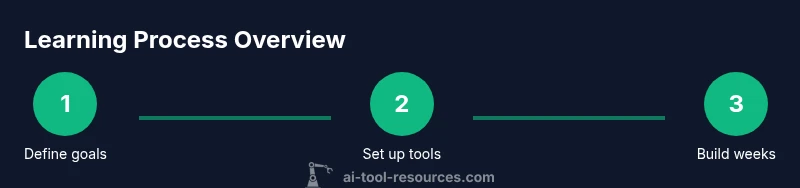
- 1
Define your goals and baseline
Clarify which AI tool domains you want to master and assess your starting point with a quick, practical check of data handling, basic scripting, and notebook use.
Tip: Write down 3 concrete outcomes you want to achieve by day 30. - 2
Set up your workspace and tools
Install Python, a notebook environment, and your editor. Create a dedicated project folder with a clean repository and a simple README.
Tip: Automate setup with a small script to ensure reproducibility. - 3
Choose a learning path and schedule
Select a weekly plan aligned with your goals and block 1–2 hours daily for focused study plus 2–3 hours for hands-on coding.
Tip: Keep the schedule visible and adjust only after a weekly review. - 4
Study core concepts daily
Read concise tutorials, watch watch-ahead videos, and practice with small datasets to reinforce concepts.
Tip: Always pair theory with a quick, runnable notebook. - 5
Build weekly mini-projects
Complete compact projects that demonstrate data handling, modeling, evaluation, and basic deployment.
Tip: Document every step with clear inputs and outputs. - 6
Document progress and reflect
Maintain a learning journal; summarize what works, what doesn’t, and why.
Tip: End each day with a 2-sentence takeaway. - 7
Review and adjust the plan
At week boundaries, evaluate outcomes and re-prioritize topics or tools based on results.
Tip: Don’t be afraid to pivot toward more impactful areas. - 8
Showcase and seek feedback
Publish notebooks or demos and solicit feedback from peers or mentors to improve.
Tip: Constructive feedback accelerates learning and confidence.
FAQ
What should I learn first when starting to learn AI tools?
Start with data handling basics, Python scripting, and notebook workflows. Build a simple data pipeline to gain confidence before moving to modeling.
Begin with data handling and Python basics, then create a simple data pipeline to build confidence.
How much time should I invest daily to stay on track?
Aim for a consistent daily block of 60–90 minutes, plus a longer weekly session for hands-on projects and reflection.
Plan about an hour a day, with extra time on weekends for projects.
Do I need Python experience before starting?
Some Python familiarity helps, but you can learn Python basics in parallel while tackling data tasks and notebooks.
You don’t need to be an expert—start with basic Python as you go.
Are there free resources to learn AI tools?
Yes. Many official docs, open datasets, and community tutorials are freely available. Use a structured plan to navigate them effectively.
There are plenty of free docs and tutorials; pair them with hands-on practice.
Can I customize the 30-day plan for other domains (NLP, CV)?
Absolutely. The framework adapts to domains by swapping in domain-specific datasets, tasks, and evaluation criteria.
Yes—adapt the plan by choosing domain-relevant data and goals.
How do I measure progress after 30 days?
Use a simple rubric: data handling, model iteration, evaluation interpretation, and quality of documentation. Compare end results to your initial goals.
Assess against your goals with a clear rubric and reviewed notebooks.
Watch Video
Key Takeaways
- Set clear weekly milestones and outcomes.
- Balance theory with hands-on practice.
- Document progress and adjust plans regularly.
- Seek feedback to improve and stay motivated.