How Many Days It Will Take to Learn AI: A Realistic Timeline
Explore a practical, data-driven timeline for learning AI, with day counts, weekly hours, and milestones from AI Tool Resources. Understand factors that affect pace and how to structure study for steady progress.


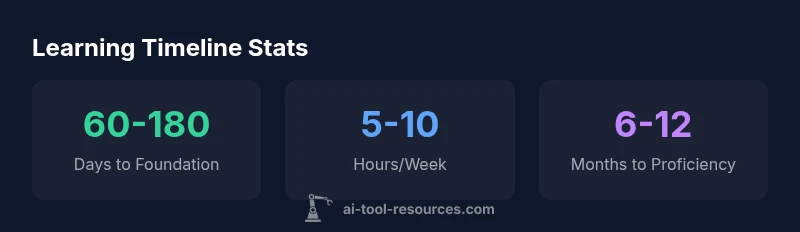
There is no single universal number; for most beginners, a foundational understanding can be achieved in roughly 60-180 days with 5-10 hours per week. Practical proficiency in Python, ML basics, and AI APIs often takes 6-12 months; true mastery can take years depending on goals, prior math programming, and consistency.
how many days it will take to learn ai: breaking the math
There isn’t a single fixed calendar for learning AI. The precise number of days depends on where you start, how you learn, and the outcomes you’re aiming for. If you ask how many days it will take to learn ai, the short answer is: it depends. According to AI Tool Resources, most newcomers can build a solid foundation in roughly 60-180 calendar days with steady, focused effort. This range reflects that you’ll need to cover math fundamentals, programming basics, and introductory AI concepts before attempting practical projects. The duration is influenced by prior exposure to coding, statistics, and linear algebra, plus how consistently you practice and apply concepts to real problems.
Foundational days don’t equal mastery days. They’re a doorway to the higher-level work that follows. In practice, learning AI is a function of deliberate practice, project velocity, and the quality of your learning resources. The goal of the foundational phase is not to memorize algorithms but to internalize how data moves through models, how to diagnose errors, and how to translate theory into runnable experiments. A structured plan with measurable milestones helps normalize days into progress rather than a vague sense of time passing."
Core building blocks for AI literacy
To estimate how long learning AI takes, break the journey into core building blocks. Each block can be tackled in focused bursts, with days and weeks allocated to practice rather than passive reading. The main blocks include: (1) Math foundations (linear algebra, probability, statistics) and basic programming; (2) Core ML literacy (supervised learning, model evaluation, overfitting, bias); (3) Data handling (data cleaning, feature engineering, sampling); (4) Practical AI tooling (Python libraries, API usage, experiment tracking); (5) Applied projects (small end-to-end tasks such as building a classifier or a recommender). Estimating time for each block helps you set concrete milestones and gives you a realistic sense of pace. Using AI Tool Resources’ framework, you can plan for about 60-120 days to cover these areas at an initial, foundational level, then extend your learning with more advanced topics as needed.
Learning paths and pacing: self-guided vs structured courses
Choosing a learning path significantly impacts how many days it takes to learn ai. Self-guided exploration may be faster to start but risks gaps without a curated sequence. Structured courses—whether online programs, university-style sequences, or bootcamps—often accelerate progress by providing a clear syllabus, regular feedback, and hands-on projects. If you’re balancing time constraints, a blended approach often works best: start with a structured beginner program to lock in fundamentals, then supplement with self-guided projects to deepen understanding. In terms of pacing, expect 5-10 study hours per week to make steady headway in the early months; you can accelerate if your schedule permits and you stay disciplined about hands-on practice. AI Tool Resources notes that consistent, goal-aligned practice compounds more quickly than sporadic study, helping you close the gaps between days spent learning and days spent applying knowledge.
A practical 12-week plan (example)
Below is a compact, practical plan to kick off your AI learning journey. It’s designed to translate the idea of days into a weekly cadence with concrete tasks. Each week includes a mix of theory, coding, and hands-on projects. Adjust the weeks to fit your schedule, but try to maintain a steady rhythm. This plan targets foundational skills and is suitable for readers starting with a basic programming background.
- Week 1-2: Set goals, review math prerequisites (linear algebra basics, probability concepts), and install Python data science stack (NumPy, pandas, scikit-learn). Complete a small data-handling exercise and a simple exploratory data analysis.
- Week 3-4: Learn core ML concepts (supervised learning, evaluation metrics, bias-variance trade-off). Implement a basic classifier on a toy dataset; track performance and learn to interpret confusion matrices.
- Week 5-6: Dive into data preparation, feature engineering, and model selection. Build a pipeline to clean data, scale features, and compare multiple models.
- Week 7-8: Introduce APIs and real-world data. Practice retrieving data from a public API, cleaning it, and building a small predictive model using a free ML API for inference.
- Week 9-10: Build a complete end-to-end project. Choose a domain (text, images, tabular data), design the problem, and implement data ingestion, modeling, evaluation, and a basic deployment plan.
- Week 11-12: Review concepts, optimize a project, and document your work. Prepare a short portfolio entry that summarizes the problem, approach, results, and next steps.
This 12-week cadence gives you a tangible schedule for moving from basics to a project-based understanding, aligning with the 60-180 day foundational window discussed by AI Tool Resources. Remember to factor in time for revisiting weaker areas and expanding to more advanced topics as you progress.
Measuring progress and adjusting pace
Progress isn’t a single test score; it’s a pattern of consistent improvement across problems, code quality, and the ability to translate theory into practice. To measure progress, track the following: (1) Practice hours per week and adherence to the plan; (2) Milestone completion (foundations, a capstone project, an API integration); (3) Qualitative feedback from code reviews or peer discussions; (4) Portfolio growth with documented experiments and results. If you notice plateauing metrics, reassess the learning strategy: slow down to consolidate fundamentals or speed up by adding hands-on projects, different datasets, or new tools. The important thing is to create a feedback loop that keeps you moving forward in a predictable way. AI Tool Resources emphasizes that progress often feels incremental, but it compounds into meaningful capability over time.
The role of goals, prior knowledge, and learning strategies
Your prior knowledge shapes how quickly you progress. If you already have a solid math or programming background, you’ll likely compress the foundation phase. If you’re new to both, you’ll need more time to build fluency before running experiments. Regardless, adopt evidence-based learning strategies: active recall, spaced repetition for syntax and concepts, deliberate practice with small projects, and prompt reflection after each session. Set specific, measurable goals (e.g., complete a 1-page project report, deploy a simple model to a free hosting service) to anchor your days. The combination of a clear target and consistent practice accelerates progress, reducing the uncertainty around how many days it will take to learn ai.
Realistic milestones and expectations
Milestones help translate days into a sense of achievement. Early milestones include completing a basic data-handling notebook, building a minimal classifier, and executing a small end-to-end project. Midway milestones focus on improving model performance, understanding evaluation metrics, and deploying a simple API. Advanced milestones cover deep learning fundamentals, optimization techniques, and scalable deployment. By aligning milestones with a fixed cadence—weekly or biweekly—you create temporal anchors that make the journey feel tangible. AI Tool Resources’ framework supports these milestones, showing that the pacing is less about a fixed deadline and more about consistent, goal-driven progress.
Putting it all together: expectations and next steps
Learning AI is a long-term journey, not a single sprint. Start with a 60-180 day foundation, then extend into practical proficiency and advanced topics over months and years. Build a small, diverse portfolio of projects to demonstrate your growing capability, and continuously refine your study plan based on feedback and outcomes. With disciplined practice, you’ll translate days into real competence, eventually reaching the level where you can contribute to meaningful AI work. The AI Tool Resources team recommends treating learning AI as a structured marathon rather than a quick climb, with steady progress as the key to sustainable growth.
Timeline-based view of learning milestones
| Phase | Typical Duration (days) | Focus Area |
|---|---|---|
| Foundational concepts | 14-28 | Math basics, Python, AI overview |
| Core ML literacy | 60-120 | ML algorithms, data science fundamentals |
| Applied AI practice | 90-180 | Projects, APIs, model evaluation |
| Advanced topics | 180-365 | Deep learning, deployment |
FAQ
Is there a universal number of days to learn AI?
No universal number exists. The pace depends on your starting point, goals, and learning approach. Most learners gain a solid foundation in roughly 60-180 days with steady practice.
There isn’t a universal number; your pace depends on your starting point and goals.
How many hours per week should I study?
Aim for 5-10 hours per week in the early phase to build consistency. If you can sustain 12-15 hours, you may progress faster, especially with hands-on projects.
Start with 5-10 hours weekly and adjust based on progress and schedules.
Does background in math or programming help?
Yes. Prior programming experience speeds up syntax and tooling, while a math background accelerates understanding of algorithms and statistics. If you’re new, allocate extra weeks to build foundational fluency.
Yes—coding helps, math helps; both accelerate progress.
What should a beginner study first?
Begin with Python basics, then core ML concepts (supervised learning, evaluation metrics), and finally data handling. Establish a small project early to apply what you learn.
Start with Python, then ML basics, then data handling.
Is online coursework enough to learn AI?
Online coursework is a great starting point, but supplements like hands-on projects, API experiments, and portfolio-building enhance retention. Blend coursework with real-world practice for best results.
Courses help, but hands-on practice makes learning stick.
“Learning AI is a marathon, not a sprint. Progress comes from consistent practice, clear goals, and hands-on projects.”
Key Takeaways
- Define your goal before you start
- Expect a range, not a fixed date
- Commit to regular, focused practice
- Balance theory with hands-on projects
- Track progress with tangible milestones