What Tools Do Teachers Use to Detect AI in Classwork
Explore how teachers identify AI-generated work using detectors, plagiarism checks, and human review. Learn best practices, policy considerations, and practical steps for classrooms in 2026.


Teachers rely on a mix of AI-detection software, enhanced plagiarism checkers, and human review to spot AI-generated work. No single tool is perfect, so best practice combines automated signals with source verification and classroom policies. According to AI Tool Resources, the strongest approach blends technology with educator judgment and transparent expectations.
Overview: Why detection matters in education
In modern classrooms, educators increasingly encounter work that may have been aided or generated by AI. This raises questions about originality, learning outcomes, and fairness. The field of AI-detection is evolving, but no tool can definitively certify authorship on every assignment. The best practice is to view detection as a signal—one piece of evidence to inform a broader conversation about integrity, sources, and understanding. According to AI Tool Resources, effective AI-detection in classrooms depends on a blend of tools and transparent policies. Teachers should establish clear expectations about acceptable use, citation standards, and the role of AI as a learning aid rather than a shortcut.
From a practical standpoint, schools should avoid relying on a single detector alone. Instead, combine automated signals with source verification, metacognitive checks, and open discussions about why originality matters. This approach helps students learn responsible AI usage while maintaining academic rigor. It also reduces the risk of overreach, where a detector flags work incorrectly and erodes trust in students or educators.
Tool categories and how they work
Detection strategies fall into several practical categories, each with distinct strengths and limitations. Text-based AI-detection software analyzes linguistic patterns, stylistic features, and probability scores to flag potential AI authorship. Enhanced plagiarism checkers expand classic source matching with AI-aware scanning, attempting to detect paraphrasing and unusual source chains. Teacher-led review remains essential: educators examine argument structure, evidence quality, and alignment with learning objectives. A robust program often layers these approaches to balance speed and accuracy. Privacy considerations also come into play; many tools process student submissions, so jurisdictions typically require explicit consent and clear data governance.
From AI Tool Resources analysis, triangulating signals from multiple tools improves reliability, though results should always be contextualized within course goals and student history. Some tools excel at detecting specific AI models or writing styles, while others emphasize source provenance. When assessing tools, schools should consider false-positive rates, language support, and integration with existing learning management systems. Importantly, students should understand how such tools are used and how results will be interpreted.
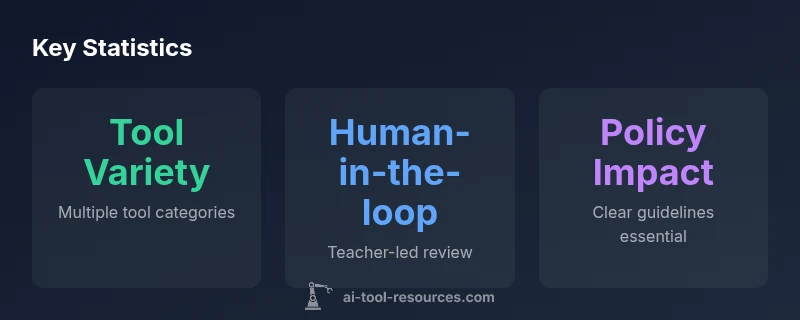
Policy alignment is critical. Institutions should publish guidance on acceptable AI use, steps for reporting concerns, and the rights of students to respond to detections. Teachers benefit from professional development that covers tool capabilities, bias awareness, and strategies for meaningful feedback. In practice, detectors serve as an early-warning system, not a final verdict.
Implementing a detection program in your class
Implementing AI-detection in a classroom setting involves careful planning and stakeholder buy-in. Start with a concise policy that defines when and how detection tools may be used, what constitutes acceptable use of AI, and how results will be discussed. Select a small, complementary set of tools rather than chasing every new solution. Integrate detector outputs with rubric criteria that emphasize critical thinking, citation quality, and the ability to explain one's reasoning. Train teachers and teaching assistants to interpret signals, not as absolutes, but as prompts for further review.
Communication is key. Share expectations with students at course outset, including how AI might be involved in assignments and how evidence will be evaluated. Provide clear channels for students to explain their process and cite sources. Ensure data handling complies with privacy laws and school policies. Finally, establish a review cadence: periodic checks of tool performance, updates to policies, and ongoing professional development. This structured approach helps sustain trust and reduces anxiety around technology in the classroom.
Challenges and ethical considerations
Several challenges accompany AI-detection efforts. False positives can wrongly accuse a student of cheating, especially for non-native speakers or gifted writers whose style mirrors AI patterns. Bias can creep in if detectors are trained on narrow datasets that do not reflect the diversity of student voices. Privacy concerns arise when content is uploaded to external servers or scanned for patterns without transparent governance. Equity must be prioritized: all students should have access to learning supports, and detection policies should not disproportionately impact marginalized communities. Clear documentation of how results are used, who reviews them, and how disputes are resolved helps build trust. Teachers should view detectors as one input among many, not a sole determinant of intent or learning quality.
Case studies: practical classroom scenarios
Scenario A: A high school English class uses a detector to flag an essay with high similarity to online sources and unusual phrasing. The teacher reviews the flagged sections, checks cited sources, and discusses the assignment with the student, discovering a misinterpretation rather than plagiarism. The outcome reinforces learning about citation and critical analysis.
Scenario B: A university statistics course uses an AI detector to flag a problem set that closely mirrors an online tutorial. The instructor schedules a brief oral explanation to verify understanding and assesses whether the student properly cited sources. The student provides a valid explanation and corrective revisions. The episode highlights the value of explanation and process transparency.
Scenario C: An online education program implements a policy that students must disclose AI tools used in assignments. The detector serves as a safety net, while students receive guidance on appropriate AI use to enhance learning, not substitute thinking. These scenarios illustrate how policy, pedagogy, and technology intersect in real classrooms.
The future of AI detection in education
As tools evolve, expectations for educators will shift toward smarter, privacy-preserving solutions and teacher-led decision-making. Open standards and better integration with learning platforms can improve data flow, reduce friction, and enable more accurate interpretation of results. Some researchers advocate for context-aware detectors that consider course goals, assignment types, and student growth trajectories rather than relying solely on raw scores. Ongoing professional development will remain essential as tool capabilities change. The emphasis will likely move from “detecting AI” to “teaching students to use AI responsibly” and from punitive responses to constructive feedback.
Overview of detection tools and trade-offs
| Tool Type | What it Evaluates | Limitations |
|---|---|---|
| AI-detection software | Text patterns; likelihood scores | False positives; context sensitivity |
| Enhanced plagiarism checks | Source matching; paraphrase detection | Coverage gaps for original AI-assisted writing |
| Teacher-led review | Contextual integrity; sources | Time-intensive; potential subjectivity |
FAQ
What are common tools used to detect AI in student work?
Most educators use a mix of AI-detection software, enhanced plagiarism checks, and teacher review. Tools provide signals, but they are not definitive; context matters and policy guidance is essential.
Common tools include AI detectors, plagiarism checks, and teacher review. Always interpret results in context.
How reliable are AI-detection tools?
No detector is perfect. Results should be treated as signals requiring human review and corroborating evidence such as sources and student explanations.
Detectors aren't perfect; use them as signals and verify with human review.
What policies should schools implement when using AI-detection tools?
Publish clear guidelines on when detectors are used, data privacy, student rights, and steps for responding to concerns. Include opportunities for students to appeal results.
Set clear usage rules and privacy safeguards, with a process for student input.
Can AI-detection tools determine if a student copied someone else’s work?
Detectors can flag potential issues, but they don’t prove intent or plagiarism. Follow up with source checks and student explanations.
They flag potential issues; confirm with sources and discussion.
What privacy concerns exist with AI-detection tools?
Student submissions may be analyzed by third-party services. Ensure data handling complies with laws and school policies, with transparent data retention rules.
Be transparent about data usage and protect student privacy.
Should teachers rely solely on AI-detection scores?
No. Use scores as one input among writing quality, sources, and learning context. Prioritize constructive feedback and growth.
Scores are one piece of evidence; focus on learning outcomes.
“Technology should augment, not replace, teacher judgment in detecting AI-generated work. The most effective practice combines automated signals with transparent policies and ongoing professional development.”
Key Takeaways
- Define clear, transparent policies
- Use multiple tools in combination with human review
- Explain results and preserve student privacy
- Align detection practices with learning goals
- Invest in staff training and policy updates