How to Make a Video AI: A Complete How-To
Learn to build an end-to-end AI-powered video workflow, from planning and scripting to visuals, narration, editing, and publishing. This educational HowTo covers tooling, data flow, quality checks, and safeguards for responsible AI video production.


You will learn how to make a video AI workflow: plan, gather data, choose tools, generate scripts, assemble visuals and narration, and render a publish-ready result. This quick guide shows an end-to-end approach with practical steps, input requirements, and quality checks. You’ll need a script generator, image or video assets, a text-to-speech option, and a rendering or editing tool.
What does it mean to make a video AI?
In this guide, we explore how to make a video AI by orchestrating script generation, visual synthesis, voice narration, and editing into a cohesive production pipeline. A well-designed AI-powered video project starts with a clear goal, a target audience, and a plan for how AI will contribute at each stage. According to AI Tool Resources, the most successful workflows treat AI as a collaborator rather than a black box, enabling rapid iteration and safer output. The AI Tool Resources team found that teams who map inputs, outputs, and quality checks early tend to produce more reliable results and faster turnarounds. This article adopts a practical, hands-on approach suitable for developers, researchers, and students building AI-assisted video projects in 2026. We’ll cover planning, tool selection, data inputs, execution, safety considerations, and how to measure impact when you finally publish.
The core idea is to treat make a video ai as a modular, auditable process where each stage has clear inputs, outputs, and acceptance criteria. You’ll learn how to design prompts that yield consistent visuals, how to combine AI-generated content with human oversight, and how to iterate quickly without sacrificing quality. This mindset helps you stay aligned with your objective and audience while leveraging AI to accelerate production.
Define objectives and audience before you start
Before touching any tools, articulate the objective. Are you creating a short explainer, a product demonstration, or an educational lesson? Defining the audience, their baseline knowledge, and the desired takeaway keeps the AI workflow focused and reduces rework. Write a one-sentence success metric (for example, “viewers understand X by the end”). This clarity informs tool choices, prompt styles, and narration tone, and it makes later testing more meaningful. When you make a video AI, you should also consider accessibility, language options, and target platforms to tailor outputs from the outset.
Gather inputs and plan data flow
Collect the script, prompts for visuals, and narration requirements. Decide what assets will be AI-generated and what will come from licensed media. Outline the data flow: script → prompts → generated visuals/audio → stitched timeline → render. Document constraints (length, language, pacing) and create fallback plans for assets that fail to generate. If your objective is to make a video ai, frame the plan around the end deliverable and the expected playback environment. This planning minimizes surprises during rendering and editing.
Build an end-to-end AI video pipeline
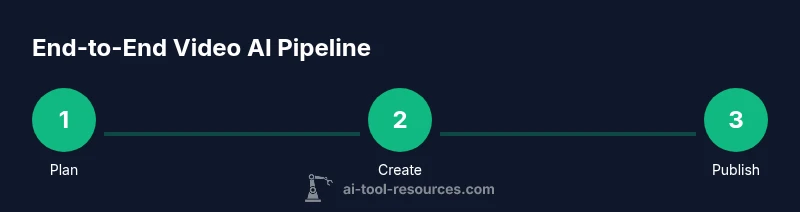
Design a modular pipeline: a script generator drafts the copy, prompts feed a visual generator for scenes, a text-to-speech engine provides narration, and an editor composes the timeline. Decide whether to use synthesized voices or human voiceovers and plan transitions that support readability. A modular pipeline makes swapping components easy and safer for experimentation. Include versioning, intermediate saves, and validation checks at each stage to catch issues early.
Create visuals and narration
Turn the script into visuals with well-structured prompts: describe scenes, camera angles, mood, and color. Produce narration with a consistent voice, pacing, and language. If visuals are AI-generated, enforce a cohesive visual style aligned with your brand. Ensure assets support the narrative and reinforce the key message—make a video ai—without distracting from it. Synchronize visuals with the narration to preserve coherence and viewer comprehension.
Editing, QA, and iteration
Import all assets into your editor, align timing, adjust pacing, and apply color correction and sound design. Check for clarity, factual accuracy, and accessibility; add captions and transcripts. Gather feedback from teammates and run iterative prompts to refine visuals, audio, and timing. Maintain a changelog so you can reproduce decisions and defend creative choices. Small prompt tweaks often yield outsized improvements in the final video.
Publish, distribution, and impact measurement
Export your video in standard formats suitable for your target platforms and audience. Publish to chosen channels and monitor engagement metrics like watch time and retention. Experiment with thumbnail and intro variations to improve click-through rates. Build a feedback loop: use analytics to refine future videos and establish a sustainable publishing cadence. This is where you turn a plan into a repeatable, scalable process for make a video ai.
Common pitfalls and safeguards
Avoid over-reliance on AI assets without licensing or consent; respect copyright and privacy. Clearly disclose AI involvement where required and ensure the output does not mislead viewers. Use licensed media or AI-generated content with clear licensing terms. Protect viewer privacy when using synthesized voices or generated faces. Finally, ensure your workflow is auditable and reproducible to support accountability and ongoing improvement.
Tools & Materials
- Computer with reliable internet(Adequate processing power for running AI tools and editing software)
- Script generation tool(Web-based or local AI writing tool for draft scripts)
- Text-to-speech or narration tool(Option for desired voice and language; ensure licensing for usage)
- Video editing/rendering software(Software capable of timeline editing and final export)
- Stock assets or license-compliant media (optional)(Inventory of visuals, music, and sound effects if not AI-generated)
- Project brief or outline(A clear objective, audience, and success metrics)
Steps
Estimated time: 2-3 hours
- 1
Define objective and audience
articulated objective, audience, and success metric. This aligns every subsequent step with the intended outcome and helps you choose appropriate AI techniques for script, visuals, and narration.
Tip: Write a one-line success metric before proceeding to tool selection. - 2
Gather inputs and plan data flow
Collect script, prompts, and narration needs. Map the flow: script → prompts → visuals/audio → timeline → render. Document constraints and licensing upfront to avoid rework.
Tip: Create a simple data map showing inputs, outputs, and responsible components. - 3
Choose tools and architect pipeline
Select modular AI components and editing tools that fit your objective. Design the pipeline so each stage is replaceable without reworking the entire project.
Tip: Favor interchangeable components and keep a versioned prompts library. - 4
Generate script and storyboard
Use the script tool to draft the copy and outline scene-by-scene prompts for visuals. Build a lightweight storyboard that sequence aligns with narration.
Tip: Keep prompts deterministic enough to reproduce the same visuals for testing. - 5
Create visuals and narration
Generate scenes from prompts and record narration with a consistent tone. Ensure alignment between on-screen visuals and spoken words.
Tip: Institute a visual theme guide and a narration style sheet for consistency. - 6
Assemble, render, and edit
Import assets into the editor, align the timeline, and apply color and audio adjustments. Validate pacing and coherence with a quick quality pass.
Tip: Save iterative versions and timestamp notes for traceability. - 7
QA and iterate
Perform a structured review focusing on clarity, accuracy, accessibility, and licensing. Update prompts/assets based on feedback and re-test.
Tip: Use a checklist to ensure no step is skipped in iteration. - 8
Publish, distribute, and measure
Export formats for your platforms, publish, and monitor analytics like watch time and retention. Use insights to improve future videos.
Tip: Set up dashboards to track the impact of changes over time.
FAQ
What does it mean to make a video AI and how does it work?
Video AI refers to using AI tools to assist in creating videos from scripts, prompts, and assets. It combines scriptwriting, visual generation, narration, and editing to produce a cohesive final product. This approach emphasizes modular components and iterative refinement to achieve desired outcomes.
Video AI means using AI to help write, generate visuals, and narrate a video, then stitch everything together.
Do I need programming to make a video AI?
Not necessarily. Many workflows rely on no-code AI tools and drag-and-drop editors. More complex automations can use scripting, but you can start with a visual pipeline and grow it gradually.
You can start with no-code tools and add scripting later if you need advanced automation.
What are common risks with AI video creation?
Ethical concerns, copyright, and misinformation are key risks. Use licensed assets, disclose AI involvement when required, and implement safeguards like fact-checking and bias checks.
Be mindful of copyright, consent, and false representations when using AI video tools.
How long does it take to complete a video AI project?
Duration varies by length and complexity. Short explainers may take hours, while longer educational videos require more planning, asset generation, and editing time.
Time depends on length and complexity, but planning and iteration are the main drivers.
What should I measure after publishing?
Track watch time, retention, engagement, and shares. Analytics help inform future videos and guide improvements in prompts, visuals, and narration.
Look at how long people watch and how they engage to improve future videos.
Watch Video
Key Takeaways
- Define objectives and audience before starting.
- Design a modular AI pipeline for easy updates.
- Keep visuals and narration synchronized for coherence.
- Document inputs, prompts, and decisions for reproducibility.
- Publish with measurement in mind to improve future videos.