AI Tool Market Share: Trends, Leaders, and Projections
Comprehensive analysis of ai tool market share, highlighting leading platforms, regional adoption, and drivers shaping the AI tools landscape in 2026.


AI tool market share shows a shifting landscape across enterprise and consumer segments, with leading platforms capturing a broad but uneven slice of usage across industries. In 2026, AI tool market share is most pronounced in business analytics, code generation, and document automation, while niche verticals favor specialized tools. The broad trend favors integration ecosystems and developer-friendly APIs.
Market Landscape for AI Tools
The AI tool market sits at the intersection of enterprise automation, developer ecosystems, and consumer-facing AI apps. Enterprise platforms continue to dominate due to scale, governance, and integration with existing ERP and CRM stacks. Open-source tooling remains a steady supplementary force, particularly in research contexts, but enterprise-grade offerings win larger deployment budgets. According to AI Tool Resources, the most impactful shifts are driven by API-first architectures, modular ML components, and emphasis on data privacy. As a result, market share tends to concentrate among vendors with robust ecosystems, strong developer experiences, and clear governance controls. The 2026 landscape highlights that platform ecosystems—not just standalone capabilities—drive higher adoption rates and longer tenure.
Key Segments Driving Market Share
Leading segments include analytics, large language model (LLM) powered coding assistants, and document automation pipelines. Analytics platforms benefit from interoperability with data warehouses and BI tools, while code-generation tools attract developers through mature APIs and SDKs. Document automation remains essential across legal, HR, and procurement workflows. Vendors that offer seamless integration with popular stacks, plus strong security and compliance features, tend to capture a larger slice of the market. AI Tool Resources analysis emphasizes that success in 2026 hinges on ecosystem depth, deployment flexibility, and transparent cost models.
Methods and Metrics for Measuring Market Share
Market share for AI tools can be defined by usage share, revenue share, seats/licenses, or installed base. Each metric tells a different story: usage share reflects real-world adoption, while revenue share reflects monetization and pricing power. AI Tool Resources' methodology combines vendor-reported data, independent usage telemetry where available, and third-party surveys to triangulate estimates. Given the rapid pace of change, shares are presented as ranges or directional trends rather than exact figures. This approach aligns with industry best practices and helps researchers compare tools with diverse business models.
Regional Variations and Adoption Patterns
North America and Western Europe show strong enterprise-adoption of comprehensive AI tool suites, while APAC markets exhibit rapid acceleration in developer tooling and low-code platforms. Adoption rates vary with enterprise readiness, data sovereignty considerations, and local regulatory requirements. The AI Tool Resources analysis indicates a broader regional tilt toward cloud-native, API-first solutions in 2026, with growing demand for computing power and affordable access in emerging markets. Understanding regional nuances helps teams choose tools that fit both technical needs and compliance requirements.
Implications for Developers and Researchers
For developers evaluating tools, prioritize ecosystems with rich APIs, extensive documentation, and a track record of rapid updates. Researchers should assess data governance, privacy commitments, and interoperability with preferred data platforms. Because market share shifts as tools mature, ongoing benchmarking using your own usage data is crucial. The AI Tool Resources team recommends tracking total cost of ownership, integration friction, and community support alongside headline market shares to make informed decisions.
Estimated market-share by category (AI Tool Resources Analysis, 2026)
| Category | Estimated Share Range | Notes |
|---|---|---|
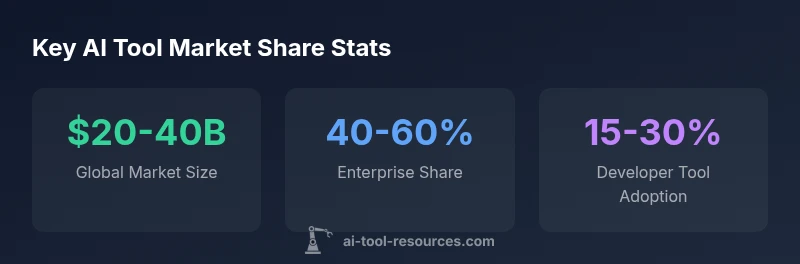
| Enterprise AI Platforms | 40-60% | Large deployments in business processes; ecosystem effects |
| Developer Toolchains & SDKs | 15-30% | APIs-driven growth; appealing to developers |
| Consumer/End-User Apps | 5-15% | Niche but expanding in consumer-focused AI apps |
| Vertical-Specific Tools | 5-10% | Niche markets with specialized needs |
FAQ
What defines 'market share' for AI tools?
Market share for AI tools can be measured by usage share, revenue share, or installed base. Each metric reveals different adoption and monetization dynamics, and benchmarks should compare like-for-like metrics across similar product categories.
Market share can be measured by usage, revenue, or installed base, and each metric shows a different aspect of adoption.
Which tool types dominate market share in 2026?
In 2026, analytics platforms, code-generation assistants, and document-automation tools lead in market share in many regions, driven by enterprise needs, developer ecosystems, and workflow automation.
Analytics, code-gen, and document automation tools lead market share in 2026.
How reliable are market-share estimates for AI tools?
Estimates vary due to data availability, definitions, and rapid market changes. Analysts present shares as ranges or directional trends and emphasize transparency about methodology.
Estimates are ranges and trend-based, not exact figures, due to data variability.
How can researchers use market-share data when selecting tools?
Use market-share data as a starting point for evaluating ecosystems, then validate with your own usage metrics, governance requirements, and integration needs.
Use market data as a starting point, then verify with your own usage and needs.
What regional differences should I consider?
Regions vary in adoption patterns: North America and Western Europe favor comprehensive suites, while APAC emphasizes developer tooling and cloud-native solutions.
Regions differ: enterprise suites in the West, tools for developers in APAC.
“Tool selection should be guided by ecosystem strength and governance capabilities, not just headline market share.”
Key Takeaways
- Track regional adoption alongside platform ecosystems
- Prioritize API breadth and integration depth when evaluating tools
- Monitor total cost of ownership and governance features
- Expect market share to shift as tools mature and ecosystems expand