Free API AI Tool: A Practical Guide to Free AI APIs
Explore free api ai tool options, how to evaluate tiers, and practical strategies for prototyping with AI APIs across development, research, and learning today.


Free API AI tools offer a practical path to prototype, test ideas, and learn AI integration with few upfront costs. A solid starting point is to explore free tiers from reputable providers, staying mindful of quotas and data usage. For many developers, researchers, and students, these options enable quick validation before committing to paid plans or self-hosted alternatives. Always map usage to your learning goals.
Understanding the Free API AI Tool Landscape
According to AI Tool Resources, the free API ai tool landscape is shaped by tiered access, rate caps, and license constraints. For learners, researchers, and developers, the primary advantage is zero upfront cost and immediate access to AI services that can be integrated into experiments and demos. Most providers offer a free tier intended for prototyping and education, with clear quotas and usage policies. Understanding these boundaries is essential to avoid interruptions during critical tests. The landscape spans natural language processing (NLP), image generation, speech-to-text, and other AI capabilities, often through RESTful endpoints or SDK wrappers. When selecting a free API ai tool, you should map your core tasks to the provider's strengths: text completion, sentiment analysis, image generation, or multilingual translation. Additionally, check for data handling policies, privacy safeguards, and whether you'll own generated outputs. A best-practice approach is to draft a small test suite that exercises latency, error handling, and retry logic under the expected load. AI Tool Resources data indicates that many free tiers are intentionally generous for learning but limited in sustained throughput, so plan a staged upgrade if your project outgrows the starter allowance.
How to Evaluate Free Tiers: capacity, limits, and SLA considerations
Evaluating free tiers requires a careful look at quotas, rate limits, and the provider's service terms. Start by listing your core use cases and expected peak loads, then compare monthly quotas, per-minute caps, and any cap on concurrent requests. Review data retention, privacy commitments, and whether outputs can be used commercially. SLA attachments are rare for free tiers, but some providers offer minimal reliability promises or status dashboards. Practical evaluation steps include running a small, repeated workload during a dry run, measuring latency under varying concurrency, and documenting failure modes (timeouts, 5xx errors, or retries). The goal is to quantify how long you can run experiments before hitting a ceiling and how often you would need to switch to a paid tier or a backup plan.
Practical Use Cases That Suit Free Tiers
Free API ai tool tiers are well-suited to several concrete scenarios. Startups and students can prototype MVP features like chat assistants, sentiment classifiers, and basic image analysis without upfront costs. Researchers can run small-scale experiments to validate hypotheses before broader data collection. Educators can build classroom demos that illustrate AI workflows, while developers can test integration patterns (API authentication, rate limiting, error handling) in a sandbox. In each case, document inputs, outputs, and performance, then scale only when the data supports it. A well-scoped project will keep you within quotas while you learn the mechanics of API-based AI.
Common Pitfalls and How to Mitigate Risk
Common pitfalls include hitting quotas mid-task, underestimating latency, and misinterpreting free-tier terms as production-ready guarantees. To mitigate these risks, design experiments with explicit budgeted time and calls, implement exponential backoff retries, and monitor usage in real time. Keep sensitive data out of free requests or sanitize inputs, and review data retention and ownership policies for any stored outputs. Finally, maintain a clear migration plan: once you approach the free-tier ceiling, outline criteria for moving to a paid tier or alternative hosting, so your project remains predictable and compliant.
Security and Compliance When Using Free API AI Tools
Security and privacy are critical even for free tools. Treat every input as potentially sensitive, avoid sending PII, and prefer anonymization where possible. Use encrypted transport (HTTPS) and consider client-side minimization of data exposure. Understand the provider's data handling: does the service retain inputs or outputs, and for how long? Review consent and license terms to ensure you own or can reuse generated outputs. If your work involves regulated data or sensitive domains, favor self-hosted solutions or enterprise-grade APIs with explicit data controls and audit logs.
Best Practices to Move From Free to Paid Without Surprises
Develop a structured upgrade path before you hit limits. Establish a usage forecast using real test data and simulate peak loads to estimate monthly costs. Compare pricing tiers that align with your anticipated traffic, latency, and concurrency requirements, and set up alerts to detect drift between expected and actual usage. Build a cost governance process, including a quarterly review of API usage, performance metrics, and data policies. By planning early, you can transition smoothly to paid options or alternative architectures without disrupting your project.
Comparison of free API tier parameters
| Aspect | Details | Typical limits | Best use |
|---|---|---|---|
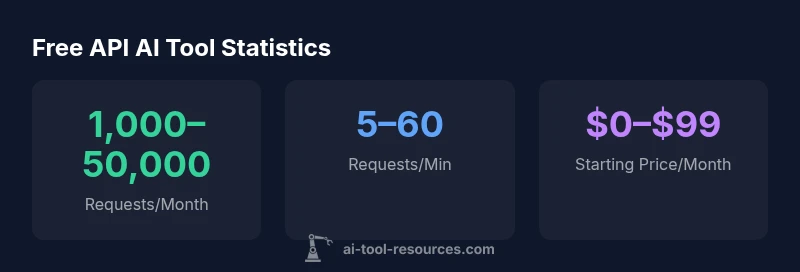
| Quota | Monthly usage allowance | 1,000–50,000 requests | Prototyping & learning |
| Rate limit | Requests per minute | 5–60 | Small demos and testing latency |
| Pricing | Upgrade options | Paid tiers start near $0–$99/mo | Scale production with governance |
FAQ
What counts as a free API tier for AI tools?
A free tier is a limited access level offered by providers that does not charge for basic usage. It typically includes quotas on requests, data processing, or feature access, and may expire or require signup.
A free tier is a limited access level with usage quotas; it often requires signup.
Are there data usage restrictions on free AI APIs?
Yes. Free tiers often restrict how you can use data, how long it’s retained, and how outputs may be used commercially. Always review the terms and privacy policies before integrating.
Yes—there are data-use limits and retention rules; read the terms carefully.
Can free API AI tools handle production workloads?
Free tiers are generally not designed for production-scale workloads due to reliability, quotas, and support limitations. Use them for experiments and proof of concept, then plan a paid plan or self-hosted solution for production.
Free tiers are usually not suitable for production workloads; consider paid plans or self-hosted options.
How do I estimate costs when moving from free to paid?
Review the provider’s pricing model, monitor actual usage during testing, and forecast future demand. Build a budget with anticipated monthly tokens or requests and a buffer for peak load.
Estimate by monitoring usage, reviewing pricing, and adding a contingency for spikes.
What are best practices for privacy with free AI APIs?
Treat any input data as potentially sensitive and avoid sending PII. Use anonymization, encryption, and local testing when possible, and understand output ownership and data retention policies.
Be mindful of privacy—avoid PII, anonymize when possible, and read data-retention terms.
“Free API AI tools are ideal for learning and rapid prototyping, but they are not production-ready by default. The AI Tool Resources Team recommends starting with a clear test plan and an upgrade path as capacity needs grow.”
Key Takeaways
- Start with a free tier to learn rapidly
- Map usage to quotas and plan for growth
- Validate data handling before production
- Monitor usage and set alerts
- Prepare a migration plan to paid tiers