Guide to AI in Accounting: Trends, Tools, and Stats
Comprehensive guide to AI in accounting, covering trends, tools, governance, and interpretable stats for developers, researchers, and students.


This guide to ai in accounting trends tools and stats explains how AI is reshaping finance workflows, from automation to forecasting, and how to interpret key metrics. It covers trends, practical tools, and strategies for responsible adoption. According to AI Tool Resources, organizations can start with clear objectives, robust governance, and phased pilots to maximize value.
What AI in accounting is today
Artificial intelligence in accounting combines machine learning, natural language processing, and automation to improve financial data processing, decision support, and risk control. Teams use AI to classify transactions, extract data from invoices, detect anomalies, forecast cash flows, and automate repetitive journal entries. Importantly, AI does not replace human judgment; it augments it by handling tedious tasks, surfacing insights, and enabling faster, more consistent decision-making. According to AI Tool Resources, modern accounting teams aim to integrate AI gradually with strong data governance and clear ownership, ensuring that models align with policy and regulatory requirements. Understanding the current landscape helps organizations distinguish between hype and practical value and sets the stage for a responsible deployment plan.
Core trends driving adoption
AI adoption in accounting is propelled by several converging trends. First, automation of routine tasks, such as data capture and reconciliation, frees time for higher-value analysis. Second, predictive analytics and forecasting use historical data to project revenues, expenses, and cash flow, supporting budgeting and scenario planning. Third, natural language interfaces and chat-based assistants help teams query dashboards and generate reports without deep technical knowledge. Fourth, continuous auditing and anomaly detection provide ongoing risk monitoring, reducing the window for errors. Fifth, explainable AI and governance frameworks are becoming essential as regulators demand transparency and accountability around automated decisions. For practitioners, the combination of these trends offers the potential to improve accuracy, speed, and compliance while maintaining appropriate controls. AI Tool Resources analysis shows that success hinges on data quality, stakeholder alignment, and an iterative testing mindset.
Data readiness and governance
Data readiness is the foundation of reliable AI in accounting. Clean, well-structured data reduces model drift and misclassifications. Establish a data lineage map to track how data flows from source systems to AI outputs; document data quality rules and data stewardship responsibilities. Before you train models, harmonize chart of accounts, supplier and customer IDs, and transactional fields. Implement privacy-preserving techniques such as access controls, data minimization, and encryption for data at rest and in transit. Create a data governance board with clear escalation paths for data issues. Without a robust governance framework, AI initiatives will struggle with compliance, bias, and operational risk.
Popular AI tools and platforms for accounting
Tools span three layers: data capture (OCR for invoices, receipts, and receipts), AI modeling (ML libraries, AutoML, and anomaly detection pipelines), and decision-support dashboards (BI tools with AI features). Seamless ERP integration and robust data lineage are essential for reliable outputs. For newcomers, cloud SaaS offerings with built-in governance, access controls, and audit logs can accelerate pilots; developers can leverage open-source ML frameworks for custom models when needed. When selecting tools, prioritize interoperability, explainability, and security over flashy features, and ensure your vendor supports compliant data handling.
Use cases by function: what AI can automate in accounting
Accounts payable (AP) automation reduces manual data entry by extracting invoice data, validating against purchase orders, and routing for approval. Accounts receivable (AR) forecasting and cash flow predictions improve collections planning. General ledger reconciliation and anomaly detection help catch errors early. Audit and compliance use AI for continuous monitoring, policy enforcement, and evidence gathering. Tax planning and scenario analysis benefit from scenario modeling and risk assessment. Across all functions, AI contributes to faster close cycles, improved accuracy, and better visibility into financial health.
Accuracy, explainability, and risk management
Explainable AI (XAI) is increasingly required in finance to understand why a model made a particular decision. Implement model monitoring that tracks data drift, performance metrics, and alert thresholds. Maintain a robust review process with human-in-the-loop approvals for high-stakes outputs. Bias mitigation practices, diverse training data, and governance controls help reduce unfair or erroneous decisions. Document limitations and provide clear channels for audit and compliance teams to challenge results. By integrating explainability and governance from the start, organizations reduce risk and build trust in automated financial processes.
Implementation patterns: pilots to production
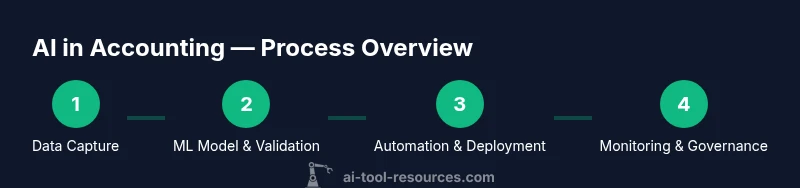
Start with a narrow, well-scoped pilot that targets a single process with clearly defined success metrics. Build a lightweight data pipeline, select a tool with governance features, and involve end users early for feedback. Iterate on model performance with incremental data, expanding scope only after achieving reliable results and stakeholder buy-in. Transition from pilot to production with a structured change management plan, including rollback procedures, monitoring dashboards, and regular audits. Establish a documented decision log to capture rationale for model choices and adjustments.
Data privacy, security, and ethics
Protecting client and company data is non-negotiable when applying AI in accounting. Enforce strict access controls, encrypt data in transit and at rest, and minimize data exposure by using synthetic or de-identified data where possible. Establish clear privacy impact assessments and ensure compliance with regulatory requirements across jurisdictions. Develop ethical guidelines for AI use, addressing bias, transparency, and accountability. Regularly train staff on data handling best practices and adopt a culture of responsible AI use to maintain stakeholder trust.
Measuring impact: ROI and metrics you can track
ROI in AI accounting hinges on measurable outcomes such as cycle-time reductions, error-rate declines, and improved forecast accuracy. Track start-to-close times for key processes, the volume of transactions processed automatically, and the percentage of exceptions resolved without manual intervention. Use a balanced scorecard approach that includes efficiency, quality, and risk metrics, and regularly review dashboards with leadership. Remember that ROI is context-dependent and grows with governance, data quality, and user adoption.
Roadmap for practitioners: getting started
Begin with a clear objective and a small, manageable use case. Assemble a cross-functional team with domain experts, IT, and governance leads. Create a data readiness plan, define success criteria, and select pilot tools that align with your data strategy. Formalize a rollout plan with milestones, risk assessments, and training for users. Finally, establish an ongoing review cadence to refine models, expand scope, and sustain value over time.
Tools & Materials
- Access to clean, structured accounting data (ERP/exported datasets)(Baseline data in a writable format (CSV/Parquet).)
- AI platform or software (custom ML pipelines, RPA tools, or SaaS AI for accounting)(Select a platform with governance features and data lineage.)
- Data governance and privacy policy(Document data handling, consent, and regional compliance.)
- Data labeling resources(If supervised models are planned, annotated datasets help.)
- Accounting domain expert or cross-functional team(Essential for aligning AI outputs with practical controls.)
- Stakeholder buy-in and risk assessment(Executive sponsorship and risk register to manage change.)
- Project timeline and milestones(Defined success criteria and governance checkpoints.)
- Security and access controls(Role-based access and monitoring for data protection.)
- Ethics and compliance guidelines(Bias mitigation and responsible AI practices.)
Steps
Estimated time: 4-8 weeks
- 1
Define objective and success criteria
Articulate a precise objective for the AI initiative and define measurable success criteria. Align with finance leadership and data governance. Document expected benefits and potential risks to guide the pilot.
Tip: Capture a single, constrained objective to avoid scope creep. - 2
Prepare data and establish governance
Inventory data sources, assess data quality, and establish data ownership. Create data lineage maps and data quality rules to ensure reliable inputs for modeling.
Tip: Prioritize data cleanliness over fancy modeling. - 3
Select and configure tools
Choose tools with governance, auditing, and security features. Ensure compatibility with existing ERP and BI systems, and plan for integration testing.
Tip: Favor platforms that support explainability and audit logs. - 4
Build a minimal viable pilot
Develop a small-scale model or automation for a single process (e.g., invoice data capture). Define success metrics and use a restricted dataset to limit risk.
Tip: Start with a deterministic rule-based baseline before ML. - 5
Validate models and address risk
Evaluate accuracy, bias risk, and control effectiveness. Run parallel checks with manual review and document edge cases for transparency.
Tip: Establish a human-in-the-loop process for critical outputs. - 6
Deploy, monitor, and scale
Move to production with monitoring dashboards, anomaly alerts, and a rollback plan. Prepare to scale gradually to other processes as metrics improve.
Tip: Implement a staged rollout with clear rollback criteria.
FAQ
What is AI in accounting?
AI in accounting uses machine learning, NLP, and automation to handle repetitive tasks, analyze data, and support decision-making, while maintaining controls.
AI in accounting uses ML, NLP, and automation to speed up tasks and improve accuracy, while keeping control.
What are common AI tools for accounting?
Common tools include OCR for data capture, anomaly detection for controls, forecasting dashboards, and automated journal entries using rules.
AI tools range from data capture to forecasting dashboards and automated entries.
How can AI improve compliance and auditing?
AI can monitor transactions for anomalies, enforce policy, and provide continuous audit trails, helping auditors focus on exception handling.
AI helps with continuous auditing and policy enforcement.
What should I consider regarding data privacy?
Data privacy requires minimizing data exposure, applying access controls, and using synthetic data or de-identification where possible.
Protecting privacy means using access controls and data minimization.
What is the expected ROI from AI in accounting?
ROI varies by use case; look for cycle-time reductions, accuracy gains, and risk mitigation, then calculate payback period.
ROI depends on the use case and measurable outcomes.
How do I start a pilot in my organization?
Begin with a narrow scope, secured sponsorship, and defined success metrics; iterate based on feedback.
Start small with a defined sponsor and clear goals.
What are the risks of AI in accounting?
Risks include data bias, privacy concerns, and over-reliance on automated decisions without human oversight.
There are biases and privacy risks; keep human oversight.
Watch Video
Key Takeaways
- Define clear objectives before deploying AI.
- Prioritize data quality and governance.
- Pilot with a small scope and measure impact.
- Balance automation with explainability and ethics.
- Invest in people, processes, and governance.