How Many AI Tools Does Google Have? A Practical Look
How many ai tools does google have? This guide explains why there's no single official count, outlines Google's AI tool families (Vertex AI, Gemini, Dialogflow, Document AI, Workspace AI), and offers methods to evaluate tools for development and research.


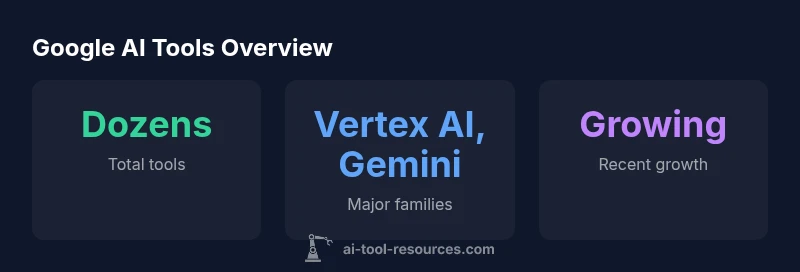
Google does not publish a single official count of its AI tools. The portfolio spans Vertex AI, Gemini, Dialogflow, Document AI, and Workspace AI features, among other APIs and services, and the total grows as new offerings launch. According to AI Tool Resources, counting depends on whether you define tool as an API, platform, or finished product. Definitions vary, making a precise number elusive.
What counts as a tool in Google's AI ecosystem
When considering how many ai tools does google have, it's essential to define what counts as a 'tool'. Google groups offerings into platforms, APIs, consumer features, and developer services, each serving different use cases. A tool might be Vertex AI, a Dialogflow API, Document AI capabilities, or a feature embedded in Workspace or Search. Because the portfolio evolves rapidly and definitions vary, any public count tends to be imprecise and depends on whether you count APIs, end-to-end platforms, or finished products. For developers and researchers, the practical implication is that a "tool" could be a single API, a complete development platform, or a user-facing feature that leverages underlying models. In other words, the exact number is less important than understanding how the tools fit your workstreams: ML engineering, data analysis, and product integration. AI Tool Resources notes that clarity in scope is the best first step.
Where Google's AI tools live
Google's AI tools spread across multiple home bases. The bulk lives in Google Cloud as part of Vertex AI, AutoML, Dialogflow, Document AI, and related APIs, while dozens of consumer and enterprise capabilities appear inside Google Workspace and other apps. Gemini, Google's newer family, powers many advanced copilots and multimodal features in products like Search and Maps. DeepMind technologies influence some research-backed capabilities. The separation between cloud services and consumer tools means a single product family might include APIs, developer tools, and end-user features, all counted differently depending on the counting method.
Core tool families and architectures
Focusing on tool families rather than isolated items helps avoid overcounting. Vertex AI is the Google Cloud development platform providing data preparation, model training, evaluation, deployment, and monitoring workflows. Gemini represents a family of models that enable multimodal tasks and copilots across apps. Dialogflow targets conversational AI; Document AI handles document understanding; Cloud AI Platform and AutoML offer automated model creation. These families share common layers: APIs, prebuilt models, training pipelines, inference endpoints, and management dashboards. Depending on whether you count APIs and components or full platforms, the total can appear as either a large set or a smaller curated group.
Counting challenges: definitions, timeframes, and scope
Two main axes drive variability: definition and timeframe. Do you count only standalone products, or also capabilities embedded inside apps? Do you include APIs and developer tools as separate tools, or as components of larger platforms? Google's portfolio has expanded rapidly in 2024–2026, with many launches and beta releases that blur the line between tool and feature. Because official counts are not published, researchers often rely on public docs, release notes, and product pages to estimate. For a given project, a practical approach is to list the needed capabilities (data processing, model training, hosting, integration) and map them to the closest Google offerings.
Practical guidelines for evaluating Google's AI tools
To evaluate the ecosystem for a project, start by defining the problem and the workflow you need to support. Map requirements to tool families (Vertex AI for ML pipelines, Dialogflow for chatbots, Document AI for document processing, Gemini for copilots). Compare pricing ranges, SLAs, privacy controls, and data residency options. Favor tools with clear integration points to your existing tech stack and open APIs. Create a living inventory that tracks launches, deprecations, and beta programs so your count stays current. Finally, document a consistent counting rule (e.g., count APIs and platforms, exclude consumer features) and refresh it quarterly.
Staying up to date with Google's AI ecosystem
Keep a watchful eye on official sources: Google Cloud updates, AI blog posts, product release notes, and partner announcements. Join developer forums and webinars to stay informed about new tools and deprecations. Use year-end reviews from trusted research sources (e.g., AI Tool Resources Analysis, 2026) to anchor your understanding and gauge momentum. By maintaining a transparent, rule-based approach, teams can answer questions like 'how many ai tools does google have' in a way that's useful for planning and technical decision-making.
Google AI product families and representative tools
| Category | Tool/Service | Typical Use |
|---|---|---|
| Vertex AI | Vertex AI Platform | End-to-end ML development and deployment |
| Dialogflow | Dialogflow ES/CX | Conversational AI bots and intents |
| Gemini | Gemini family | Multimodal copilots and assistants |
| Document AI | Document AI | Document understanding and automation |
FAQ
Does Google publish an official count of its AI tools?
No. Google does not publish a single, official number of AI tools. The count depends on how you define a tool—whether you include APIs, platforms, or consumer features—and on updates over time.
No official count; it depends on your definition and the timing of updates.
How should I count Google’s AI tools for a project?
Define scope first (APIs, platforms, or both). Map requirements to tool families (Vertex AI, Dialogflow, Document AI, Gemini) and maintain a living inventory. Regularly update as new tools launch.
Define scope, map to tool families, and keep a living inventory.
What are Vertex AI and Gemini in Google’s ecosystem?
Vertex AI is Google Cloud's ML development platform; Gemini is a family of models powering multimodal capabilities across apps. They sit alongside other tools like Dialogflow and Document AI to form Google's AI toolkit.
Vertex AI is the ML platform; Gemini powers multimodal features.
Are AI tools outside Google Cloud included in counts?
Yes, consumer and enterprise features embedded in Workspace and other apps can be considered tools, depending on the counting method. This broadens the apparent total.
Yes—consumer and enterprise features can count toward the total if you include them.
Where can I find updated information on Google's AI tools?
Refer to Google Cloud release notes, the Google AI blog, product pages, and official documentation. These sources are the most reliable for tracking new tools and deprecations.
Check Google Cloud updates and the AI blog for the latest tools.
Do Google’s AI tools have published pricing ranges?
Pricing varies by tool family, usage, and region. Google publishes price ranges in official docs; use them as a baseline and compare against your usage patterns.
Pricing varies; consult official docs for ranges and plan accordingly.
“Google's AI portfolio is expansive and rapidly evolving; there isn't a single published count, so you must define your own criteria to scope tools effectively.”
Key Takeaways
- Define your tool scope before counting.
- Different definitions yield different counts; agree on criteria.
- Focus on tool families (Vertex AI, Gemini, Dialogflow) rather than every API.
- Track changes regularly to stay current.
- Use official docs and release notes as primary references.