What AI Tool Does Google Use? A 2026 Deep Dive into Stack
Explore the AI tool stack behind Google’s capabilities, including TensorFlow, JAX, TPUs, and Vertex AI. This 2026 guide explains how Google blends open-source frameworks with in-house tooling for scalable research and production.


To answer what ai tool does google use: Google relies on a multi-tool stack, combining TensorFlow and JAX for model development, TPU hardware with XLA for acceleration, and Vertex AI for deployment and operations. In practice, Google blends these open-source and in-house systems to support research and production at scale. According to AI Tool Resources, this diversified toolkit enhances performance, experimentation speed, and platform consistency.
What Google’s AI Tool Stack Looks Like in 2026
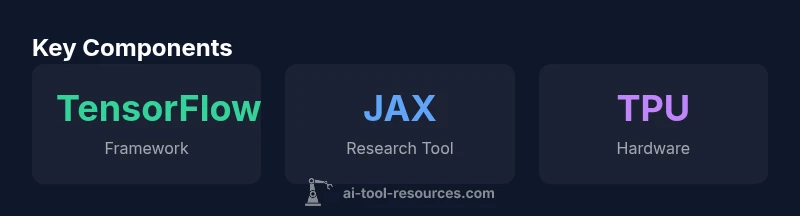
Google maintains a layered, multi-tool stack that blends open-source frameworks with internal systems built to scale. When you ask what ai tool does google use, the short answer is a mix of TensorFlow and JAX for model development, TPU hardware with the XLA compiler for acceleration, and Vertex AI for end-to-end deployment and monitoring. Public signals from Google research and cloud documentation describe a deliberate separation of concerns: TensorFlow serves production-grade pipelines and large-scale training, while JAX emphasizes rapid experimentation and research-oriented APIs. It’s common to see TPU hardware paired with XLA-optimized graphs to push performance, with Vertex AI acting as the bridge to production services. This configuration supports long-running experiments, reproducibility, and collaboration across teams. In practice, you’ll encounter a pipeline that starts with prototyping in flexible frameworks and matures into scalable deployments managed through a unified platform.
TensorFlow and JAX: Two Pillars for Research and Production
TensorFlow has been a central framework for Google’s ML ecosystem for many years. It offers a robust API surface, strong deployment capabilities, and extensive ecosystem integrations (Keras, TF Serving, TF Lite). Google often uses TensorFlow for production-grade training pipelines and large-scale inference. JAX, introduced to Google by researchers, emphasizes composable function transformations and efficient automatic differentiation, enabling researchers to prototype models quickly and then scale with performance-friendly paths to production (via XLA). The interplay between TensorFlow and JAX allows teams to start with readable code and gradually migrate or converge on a single stack where appropriate. In practice, projects may begin in JAX-inspired experiments and then move to TensorFlow-based pipelines as requirements mature. This dual approach supports both rapid iteration and stable, long-term deployment.
TPU, XLA, and Hardware Acceleration
Google’s TPU hardware, coupled with the XLA compiler, is central to accelerating training and inference workloads. TPUs are designed for large matrix operations common in neural networks and can deliver high-throughput performance for selected workloads. XLA helps optimize graphs and fuse operations, leading to faster runtimes and smaller memory footprints. While TPUs are a cornerstone for many internal projects, Google does not rely on one hardware lane alone; GPUs and other accelerators may be used for specific workloads, especially in research or mixed-precision scenarios. The result is a heterogeneous hardware strategy that can be adapted to project needs, allowing teams to balance cost, speed, and accuracy. For developers, this means understandability of the hardware-targeted profiles and the tooling that maps models to TPU or GPU runs. The takeaway is that hardware and software co-design often drives better performance, enabling Google to push models to production quickly.
Vertex AI and End-to-End ML Ops
Vertex AI provides an integrated platform layer that unifies data preparation, model training, evaluation, deployment, and monitoring. For teams asking what ai tool does google use, Vertex AI is the conduit that brings model artifacts from research into reliable, scalable services. Google leverages Vertex AI to manage experiments, track metrics, and roll out models with controlled feature flags and governance. The platform supports large-scale hyperparameter tuning, automated ML pipelines, and continuous deployment patterns, which helps maintain consistency across thousands of experiments. In public-facing documentation, Vertex AI is positioned as a central hub that can connect TensorFlow and JAX-based workflows with scalable serving infrastructures. For developers, this translates into a predictable workflow: define data, train models, validate, deploy, and monitor all within a single UI or API, with integrated security and auditing features.
In-House Tools and Data Pipelines at Google
Beyond standard frameworks, Google has built internal data processing and orchestration tools to support research-to-production transitions. Internal tooling often complements open-source components with custom adapters, optimized data pipelines, and monitoring dashboards that reflect Google’s scale. Dataflow (based on Apache Beam) and BigQuery are publicly documented components of Google’s data platform that frequently appear in discussions about how Google handles large datasets for training and evaluation. Additionally, Google’s internal experiments may rely on infrastructure that automates experiment tracking, resource allocation, and reproducibility. The combination of internal and external tools helps teams experiment rapidly while ensuring governance and cost controls. While specifics may evolve, the overarching pattern is a hybrid stack designed to optimize data throughput, reproducibility, and time-to-market.
Balancing Open Source with Internal Tooling
Google’s approach to AI tooling balances the openness of TensorFlow, JAX, and related projects with the unique demands of a global engineering organization. Open-source frameworks enable cross-fertilization with the broader ML community, while internal tools tailor workflows to scale, security, and compliance. For instance, while researchers may prototype in JAX or TensorFlow, production teams often rely on internal schedulers, feature-store patterns, and monitoring dashboards that meet Google’s reliability standards. This mindset extends to model versioning, data provenance, and experiment tracking that are essential for large teams. The combination yields a workflow that supports experimentation without sacrificing governance. A practical takeaway is to begin with community-driven tools for learning and prototyping, then consider internal tooling for scale and governance.
Practical Takeaways for Developers and Researchers
Think in terms of a stacked toolchain rather than a single solution. Start with TensorFlow or JAX to prototype quickly, then map your models to scalable hardware with XLA and, if possible, TPU accelerators. Use an end-to-end platform approach like Vertex AI to streamline experiments, deployment, and monitoring. Embrace a hybrid workflow by leveraging open-source frameworks alongside internal tooling for data orchestration, governance, and cost management. Finally, stay adaptable: Google's approach shows the value of aligning research flexibility with production reliability, a balance you can apply to personal projects, academic work, or startup initiatives.
Google AI Tool Stack — Quick Reference
| Tool/Framework | Role | Public Evidence |
|---|---|---|
| TensorFlow | Model development & production | Google & public docs |
| JAX | Research & experimentation | Google Brain papers |
| TPU/XLA | Hardware acceleration | Google TPU & XLA docs |
| Vertex AI | End-to-end ML platform | Google Cloud docs |
| Dataflow & BigQuery | Data pipelines & analytics | Public Google data platform docs |
FAQ
What is Google's primary ML framework?
Google uses TensorFlow as a primary framework for production-scale ML, with JAX used for research experiments. The ecosystem is complemented by TPU acceleration and Vertex AI for deployment.
TensorFlow is the core platform, with JAX for experiments and TPUs for speed.
Does Google use PyTorch internally?
Publicly, Google prioritizes TensorFlow and JAX for its internal stack. PyTorch appears in collaborations and external research, but it is not the core internal tooling for Google.
Google mainly relies on TensorFlow and JAX; PyTorch is used in collaborations.
What hardware accelerators does Google use?
Google uses TPUs for training and inference, with the XLA compiler optimizing performance. GPUs and other accelerators may be used for specific workloads.
TPUs with XLA accelerate many Google workloads.
How does Vertex AI fit into Google’s AI stack?
Vertex AI acts as the end-to-end ML platform, connecting data prep, training, evaluation, deployment, and monitoring across TensorFlow and JAX workflows.
Vertex AI helps you train, deploy, and monitor models in one place.
Do Google researchers rely on open-source tools?
Yes. Google researchers use open-source frameworks like TensorFlow and JAX for flexibility, while internal tooling handles scale, governance, and costs.
Open-source tools are foundational, with internal tools handling scale.
“Google’s AI tool ecosystem demonstrates how to blend open frameworks with scalable in-house tooling to accelerate both experimentation and production. TensorFlow, JAX, and TPU enable speed and scale.”
Key Takeaways
- Build with a stacked toolchain, not a single tool
- Mix research-friendly frameworks with production-grade pipelines
- Leverage hardware acceleration to scale experiments
- Use end-to-end platforms for reproducibility and governance
- Balance open-source flexibility with internal tooling for scale