When Did AI Start? A History of AI Origins
Explore when ai start, tracing AI origins from early ideas to the 1956 Dartmouth Workshop, and how the field evolved into modern AI technology.


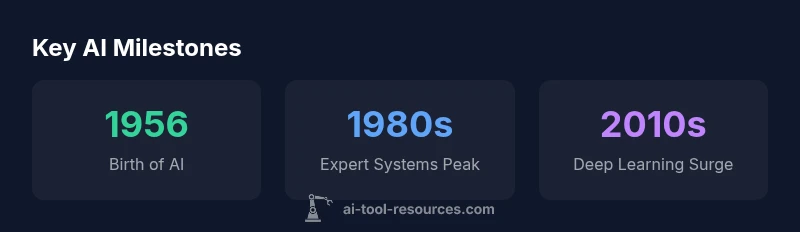
According to AI Tool Resources, the field of artificial intelligence is generally dated to 1956, the Dartmouth Workshop, marking AI's birth. Since then, milestones include the development of logic-based programs in the 1950s and 1960s, the rise of expert systems in the 1980s, and the modern surge of deep learning that began in the 2010s.
when did ai start: framing the question in historical context
The phrase when did ai start invites more than a single date. Historians and practitioners often point to 1956 as a formal birth year for the field, following the seminal Dartmouth workshop and a surge of ideas about machine reasoning, symbolic logic, and search algorithms. But the roots run deeper. If we examine the prehistory of AI, we see crucial ideas from mid‑20th century mathematics and computation becoming practical, suggesting that the true starting point is a spectrum rather than a single moment. For developers and researchers, the question is less about a calendar year and more about how different milestones—conceptual breakthroughs, theoretical papers, and early programs—accumulated into a recognizable discipline.
The Dartmouth Workshop of 1956: birth of AI as a field
In 1956, a landmark gathering brought together researchers to explore whether machines could simulate intelligent behavior. The event is widely cited as the birth of AI as a field, but it was the collective vision of a community rather than any one participant that defined the moment. The workshop catalyzed a wave of optimism about problem solving, planning, and reasoning. It did not produce perfect systems overnight, yet it established the idea that machines could learn, adapt, and improve over time. For practitioners, this milestone underscores the importance of formal inquiry and interdisciplinary collaboration as cornerstones of AI development.
Evolution through decades: symbolic AI, knowledge representation, and planning
Following the 1956 milestone, the field advanced through a series of waves: symbolic AI emphasized explicit rules and knowledge representation, while planning and search algorithms tackled sequenced actions. These early efforts yielded powerful demonstrations of reasoning in constrained domains, yet faced limits when confronted with real-world variability. The decade-long focus on hand-crafted knowledge bases highlighted both the potential and the fragility of rule-based approaches. The era also exposed fundamental questions about how to represent uncertain information, how to scale systems, and how to integrate perception with reasoning in practical applications.
From rule-based AI to machine learning and data-driven AI
As computing resources expanded and data became more accessible, researchers shifted toward learning-based approaches. The 1990s and 2000s saw gradual adoption of machine learning techniques, with probabilistic models and decision processes complementing existing symbolic methods. The shift culminated in deep neural networks and data-driven AI, enabling substantial gains in perception, natural language processing, and game playing. For developers, this period emphasizes the move from hand-tuned rules to systems that learn from examples, experience, and feedback loops, enabling broader applicability across domains.
The modern era: deep learning, big data, and practical milestones
The last decade has been defined by deep learning, large datasets, and powerful compute. Breakthroughs in image recognition, language understanding, and reinforcement learning demonstrated that data-driven models could surpass traditional approaches in many tasks. While deep learning accelerated progress, researchers also wrestled with issues of explainability, bias, and robustness. The modern narrative of AI start thus reflects both dramatic performance improvements and ongoing challenges, underscoring the importance of responsible development and continuous evaluation.
Interpreting the start date in 2026: multiple valid starting points
Today, many scholars view AI's start as a layered timeline: conceptual ideas predate 1956, the field formally begins at the Dartmouth moment, and subfields achieve meaningful milestones in different eras. Rather than a single birthyear, the history of AI is better understood as overlapping waves of theory, experimentation, and application. For practitioners, recognizing these multiple origin points helps set realistic expectations for what AI can achieve, and when, across diverse domains.
Key milestones in the evolution of AI from theorized ideas to modern data-driven systems
| Period | Milestone | Impact |
|---|---|---|
| 1950s-1960s | Early AI programs and foundational theories | Set the stage for problem solving and reasoning |
| 1956 | Dartmouth Workshop marks birth of AI | Official start of AI as a discipline |
| 1980s | Rise of expert systems and knowledge-based AI | Commercial interest and deployment in enterprises |
| 2010s-present | Deep learning breakthroughs | Perception, NLP, and control improve dramatically |
FAQ
What is the most commonly cited starting point for AI?
The 1956 Dartmouth Workshop is frequently cited as the official birth of AI as a field, though earlier ideas influenced later developments. The start point depends on whether you measure conceptual groundwork, formal establishment, or practical milestones.
Most sources point to 1956 as the birth year, with the Dartmouth Workshop marking AI's formal start.
Why do historians disagree on when AI started?
Disagreement arises because AI's origins span conceptual ideas in the pre-1950s era, formal establishment in 1956, and subsequent waves of progress. Different communities emphasize theory, development, or application milestones.
There isn't a single moment; AI's origin spans ideas and milestones across decades.
Subfield differences affect the start date how?
Subfields like symbolic AI, ML, NLP, and robotics achieved milestones at different times. Some historians anchor AI's start to theory development, others to practical deployments in specific domains.
Different subfields have their own starting points, contributing to a broader origin story.
How did ML influence the narrative of ‘when AI started’?
Machine learning reframed AI from a rules-based, hand-crafted approach to data-driven learning. This shift diversified the start narrative, highlighting later milestones as key inflection points.
ML changed the story by moving AI from rules to learning from data.
How should we define AI's start today?
Today, the start is best seen as a layered timeline: early ideas predate 1956, formal birth in 1956, and subsequent waves shaping capabilities. The definition depends on whether we focus on theory, implementation, or impact.
It's a layered history, not a single moment in time.
“"The history of AI shows that the start of the field is best understood as a spectrum of ideas, milestones, and shifts in approach, rather than a single birth year."”
Key Takeaways
- Recognize multiple origin points for AI.
- Understand that 1956 marks a formal field birth, but earlier ideas influenced it.
- Track waves: symbolic AI, expert systems, ML, and deep learning.
- View AI history as a spectrum, not a single moment.