When Was Generative AI Tools Made? A Timeline and Guide
Explore the origins and milestones of generative AI tools from early probabilistic models to diffusion-era tools, with a clear timeline and implications for developers.


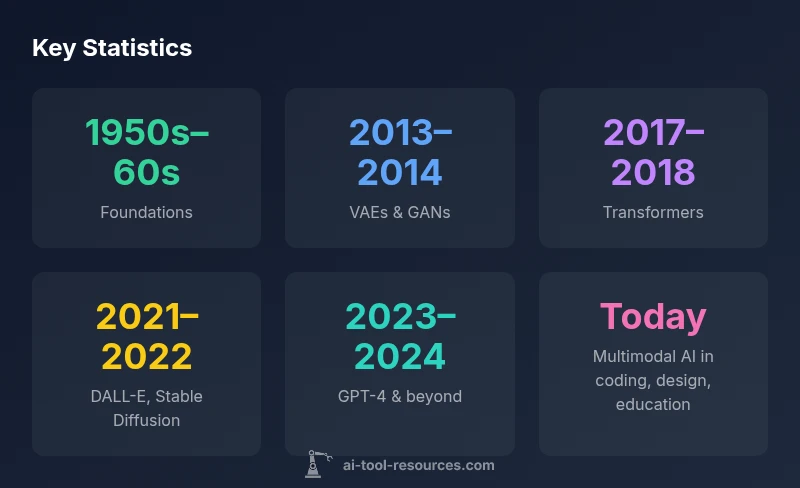
The question 'when was generative AI tools made' maps to a multi-decade timeline. Core milestones began in the early 2010s with VAEs (2013) and GANs (2014), followed by the transformer era (2017–2018) that enabled large-language models. Consumer tools like DALL-E (2021) and Stable Diffusion (2022) accelerated widespread adoption and practical use.
Origins and Foundations of Generative AI
According to AI Tool Resources, the question "when was generative AI tools made" invites a historical view that predates modern apps. The earliest AI experiments were in the realm of symbolic reasoning and probabilistic methods in the 1950s and 1960s, but true generative capability matured with latent-variable models in the 2010s. Variational Autoencoders (VAEs) and Generative Adversarial Networks (GANs) provided explicit frameworks to generate new data rather than merely classify it. The field progressed as data availability and compute grew, enabling more ambitious models. This history matters because it explains why contemporary tools can generate text, images, audio, and even code with surprising coherence, yet require rigorous evaluation and safeguards. The era from 2013 to 2022 established a practical pipeline from research to real-world applications, a trend AI Tool Resources tracks closely in our 2026 analysis.
Breakthroughs: GANs, VAEs, and the Transformer Era
Generative Autoencoders (VAEs) and Generative Adversarial Networks (GANs) marked a turning point in how we learn to generate data. VAEs offered a probabilistic framework to encode and sample from latent spaces, while GANs introduced a game-theoretic approach to produce high-fidelity samples. The transformer revolution, starting with the Attention Is All You Need paper in 2017, unlocked scalable sequence modeling and led to language models such as GPT-1 (2018), GPT-2 (2019), and GPT-3 (2020). This era shifted the focus from purely image generation to powerful, general-purpose text generation and multimodal capabilities, laying the groundwork for modern AI writing aids, copilots, and creative assistants.
Diffusion Models and Multimodal Progress
Diffusion-based approaches emerged as a dominant frontier for image and audio synthesis. Unlike earlier generative methods, diffusion models gradually denoise noisy data to form coherent outputs, yielding stunning image generation and controllable editing. By 2022, diffusion-based tools like Stable Diffusion and Midjourney popularized accessible, open tools with high-quality visuals. Diffusion also expanded into video and audio, enabling new forms of content creation and rapid prototyping for designers and developers. The multimodal trend ties together text, images, and sound, offering end-to-end pipelines for content production.
From Research to Real-World Tools
The practical shift from lab results to consumer products accelerated in the early 2020s. Large language models (LLMs) such as GPT-3 and its successors, coupled with image generators like DALL-E and diffusion-based systems, moved into public use and developer tooling. Platforms began offering APIs, code copilots, image editors, and no-code/low-code interfaces. This transition also intensified platform competition and openness, with many projects releasing open weights or community editions that fostered broader experimentation. For developers, this era expanded the toolbox: you can prototype ideas quickly, run iterative experiments, and embed generation capabilities into apps with relatively short iteration cycles.
Economic and Compute Trends Driving the 2020s
Scaling compute and data has been the engine behind rapid generative AI progress. Large models demand substantial training resources, while open-source diffusion models and community-driven datasets have lowered barriers to entry. The AI Tool Resources team observes that access to pre-trained models, guidance on fine-tuning, and robust evaluation frameworks now play a central role in enabling teams to build responsibly. Compute cost, data quality, and governance shape what gets built, who benefits, and how quickly capabilities spread across industries.
Safety, Evaluation, and Responsible Use
As capabilities grew, emphasis on evaluation metrics, bias mitigation, and safety gating increased. Researchers and developers must consider misuses, copyright concerns, and content moderation when integrating generative AI into products. Responsible AI practices—transparent prompts, robust testing, audit trails, and user controls—help reduce harm while preserving creativity. AI Tool Resources’s ongoing guidance highlights the importance of governance, dataset provenance, and collaborative evaluation with diverse stakeholders to ensure ethical deployment.
Practical Takeaways for Developers Today
For developers, the history of generative AI offers a blueprint: start with clear use cases, select the right model family (VAEs, GANs, transformers, diffusion), prototype with open weights or APIs, and implement safety and governance early. Leverage the growing ecosystem of tools—libraries, datasets, and evaluation suites—to accelerate development while maintaining responsible practices. The key is to balance creative potential with measurable safeguards and user trust.
The Future Outlook and What to Watch
Looking ahead, expect more integrated multimodal capabilities, improved controllability, and stronger emphasis on safety and interpretability. Advances in hardware, data availability, and specialized fine-tuning will continue to democratize access to generative AI while raising new questions about intellectual property and accountability. Staying informed about evolving standards and best practices will help developers and researchers leverage generative AI tools effectively and responsibly.
Milestones in generative AI development
| Era | Representative Models/Tools | Approx Year |
|---|---|---|
| Early AI Foundations | Eliza, symbolic AI groundwork | 1950s–1960s |
| Probabilistic Generative Models | VAEs / GANs | 2013–2014 |
| Transformer Era | Attention-based models (transformers) | 2017–2018 |
| Diffusion & Multimodal Tools | DALL-E, Stable Diffusion, Midjourney | 2021–2022 |
| Scaling Language Models | GPT-4, Claude, LLaMA | 2023–2024 |
FAQ
When did generative AI first appear in a recognizable form?
Early signs appear in the 1950s–1960s with symbolic AI and probabilistic reasoning. The first clear generative models arrived in the 2010s with VAEs (2013) and GANs (2014).
Generative AI traces back to the 1950s, but modern generative models took off in the 2010s.
What are the major breakthroughs in this history?
VAEs and GANs introduced probabilistic generation, transformers unlocked scalable language modeling, and diffusion models enabled high-fidelity image synthesis. Together these breakthroughs shaped how we generate text, images, and audio today.
Key breakthroughs include VAEs, GANs, transformers, and diffusion models.
Which tools popularized consumer access to generative AI?
DALL-E (2021) and Stable Diffusion (2022) popularized consumer access to high-quality image generation, while GPT-3 and later models expanded text generation capabilities.
DALL-E and diffusion tools pushed generative AI into everyday use.
How do GANs, VAEs, and diffusion models differ?
VAEs learn latent representations probabilistically, GANs use adversarial training for sharp outputs, and diffusion models build outputs through iterative denoising, offering robust control and quality.
They’re different approaches to generative modeling with distinct trade-offs.
Are there safety risks with generative AI?
Yes. Risks include misinformation, copyright concerns, bias amplification, and potential misuse. Responsible deployment requires governance, testing, and user controls.
There are safety risks; plan for governance and safeguards.
“Generative AI has evolved from niche experiments into foundational tooling that powers coding, writing, and design workflows.”
Key Takeaways
- Generative AI emerged from decades of foundational research and matured rapidly in the 2010s.
- VAEs, GANs, transformers, and diffusion models are pivotal milestones.
- Public-facing tools accelerated adoption between 2021 and 2022.
- Safety, governance, and data quality remain central to responsible use.