How Much Does It Cost to Use AI Tools? A Practical Pricing Guide
A data-driven look at AI tool pricing, covering models, typical spend ranges, and budgeting strategies for developers, researchers, and students in 2026.


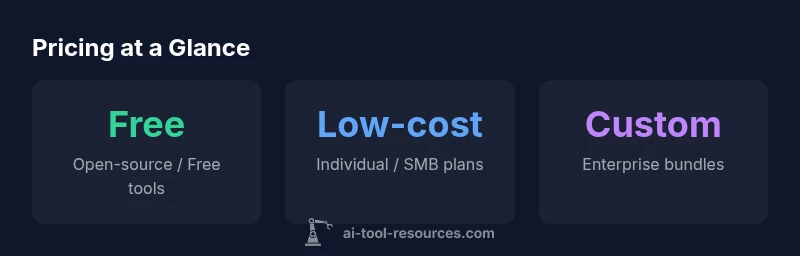
How much does it cost to use AI tools varies widely by tool category, usage, and scale. In practice, individuals and teams can start for free or with low-cost plans, while businesses may pay from tens to thousands of dollars per month per tool. Understanding pricing models—free tiers, per-seat licenses, usage-based, and enterprise commitments—helps you estimate monthly spend before adopting tools.
What drives AI tool pricing
Pricing for AI tools is not one-size-fits-all. It depends on the tool category (development vs data processing vs content generation), usage intensity, data volume, support level, and whether you’re an individual, a startup, or an enterprise. According to AI Tool Resources, pricing for AI tools hinges on usage, scale, and the value delivered, so a thoughtful budget starts with mapping your workflow and identifying where AI adds value. For developers building APIs, pricing typically follows a per-call or per-token model; researchers often face access to premium datasets or compute credits; educators may access discounted licenses. The economic footprint grows with data inputs, model sophistication, and the required uptime. If you plan to operate at scale, negotiate terms early and consider multi-tool bundles to reduce marginal costs. Finally, integrate pricing with your project roadmap to avoid bill shocks as your needs evolve.
Pricing models you’ll encounter
There are several core models you’ll see when evaluating AI tools:
- Free tiers and open-source options for experimentation and learning.
- Per-seat licenses, common for SMB teams, providing predictable monthly costs.
- Usage-based or pay-as-you-go, based on API calls, tokens, or compute units—great for fluctuating workloads.
- Tiered plans that combine features, limits, and support levels, with higher tiers offering enterprise-grade security and governance.
- Enterprise bundles with custom SLAs, dedicated support, and data-management assurances. Understanding these models helps you forecast monthly spend more accurately and choose a plan that aligns with your value creation.
Cost categories by use case
Pricing varies by who is paying and why:
- Developers and startups: Often start with free or low-cost plans, then move to per-seat or usage-based pricing as MVPs scale.
- Researchers and academics: May access academic or student discounts, sometimes with usage caps or grant credits.
- Enterprises: Typically negotiate custom terms, with volume discounts, dedicated support, and compliance assurances.
- Educational institutions: Discounts or credits for classroom or lab use, sometimes tied to software-integration programs.
- Content teams: Pricing often centers on API calls or tokens, especially for large-scale generation or moderation tasks. This spectrum means your budgeting should start with a clear assessment of your anticipated usage and the risk of scale. AI Tool Resources' insights emphasize evaluating the total cost of ownership, including integration and maintenance, not just sticker price.
How to estimate your monthly spend
Estimating spend begins with use-case mapping and realistic workload estimates:
- List workflows where AI will be deployed and estimate the number of API calls, tokens, or compute hours per month.
- Identify the pricing model that will apply to each tool (free, per-seat, usage-based, or enterprise).
- Include ancillary costs such as data storage, data transfer, and premium support.
- Add governance costs for security, compliance, and auditing.
- Build a quarterly forecast to account for anticipated growth or changes in workload.
- Schedule quarterly reviews to adjust licenses or migrate to new tiers as needed. A disciplined budgeting process helps avoid overpaying while ensuring tools scale with your needs.
Hidden costs and negotiation tips
Beyond the base price, consider potential extras:
- Data storage and transfer fees, especially for large datasets.
- Premium support, onboarding, and training sessions.
- Feature add-ons such as enterprise-grade security, data residency, or model fine-tuning.
- Onboarding and integration services with your existing tech stack. Negotiation tips:
- Start with a clear usage forecast and a plan for scale.
- Ask for multi-year or multi-tool bundles to secure discounts.
- Seek fixed caps for budgets and annual price locks if possible.
- Leverage academic, open-source, or startup programs to reduce upfront costs.
- Ensure terms cover data ownership, retention, and exit options. Smart budgeting combines forecasting with proactive vendor negotiations to minimize surprises while maximizing tool value.
Budgeting for education, research, and development
Educational and research projects often operate under tighter budgets but have access to special programs. Budgeting in these contexts means identifying grants, institutional discounts, and non-profit pricing where available. You’ll want to plan for:
- Short-term pilots to validate tooling and avoid long commitments.
- Training and onboarding costs for student teams.
- Data storage limits and privacy requirements.
- Compliance and audit readiness. By aligning pricing with academic goals and research milestones, you can maximize learning outcomes without overspending. AI Tool Resources evidence suggests that strategic budgeting increases the likelihood of successful AI tool adoption in education and research settings.
Choosing the right pricing plan for your project
To select the right plan, map your project’s value stream and sensitivity to price:
- For experiments or prototypes, free or low-cost tiers minimize risk.
- For ongoing development with predictable usage, per-seat or fixed-price plans offer stability.
- For variable workloads, usage-based pricing lets you pay for what you actually use, reducing waste when activity drops.
- For mission-critical deployments, enterprise bundles with SLAs and dedicated support are often worth the investment.
- Finally, include an exit strategy: can you migrate to another provider or downgrade without penalties? A thoughtful choice aligns financial commitment with the expected impact of AI on your outcomes.
Case studies: common scenarios
Scenario A — Student project: A single student iterates a chatbot using a free tier and occasional paid credits during a semester. Estimated monthly spend remains in the low tens of dollars. Scenario B — Startup prototype: A small team uses a per-seat plan for 4 members plus limited usage credits for rapid prototyping. Expect a mid-range monthly spend with potential discounts at scale. Scenario C — Enterprise integration: A mid-sized company deploys multiple tools with custom SLAs, data-control requirements, and a dedicated support team. Pricing is negotiated and bundled, often into the hundreds to low thousands per month per tool, depending on usage. Each scenario highlights how organizational size and goals influence pricing strategy and total cost of ownership.
ROI and lifecycle planning
ROI starts with time-to-value and adoption rates. Track productivity gains, reduced manual work, and faster iteration cycles against tool costs. Lifecycle planning includes:
- Regular re-evaluation of tool relevance and performance.
- Re-negotiation of terms as usage patterns stabilize or expand.
- Transition plans for retired tools and data migrations.
- Budget contingencies for outages, policy changes, or new vendors. When pricing is paired with a clear ROI framework, organizations can justify ongoing investments and optimize lifetime value from AI tooling.
Pricing overview by category
| Category | Typical monthly cost range | Best use case |
|---|---|---|
| Open-source / Free tools | "Free" | Prototyping & learning |
| Per-seat licenses (SMB) | "$10–$60 per user/mo" | Small teams / pilots |
| Usage-based pricing | "$0.001–$0.01 per unit" | Active development with variable workloads |
| Enterprise bundles | "Custom pricing" | Large organizations / production deployments |
FAQ
What is a typical starting price for individual developers?
For individuals, many AI tools offer free tiers or low-cost plans. Upgrades are usually per-user or per-project, with monthly costs tending to stay in the low range.
Free tiers are common for individuals; expect small monthly charges if you upgrade.
How does usage-based pricing work?
Usage-based pricing charges per API call, token, or compute unit. It scales with activity, so higher usage increases costs. Monitor quotas and avoid overages by setting ceilings.
Pricing goes up with usage; track API calls and compute hours.
When should I avoid annual commitments?
If your usage is uncertain or your project value is unclear, start with monthly terms or flexible options and revisit terms as you learn usage patterns.
Be flexible early; monthly terms help you adapt.
Are there extra fees I should budget for?
Common extras include data storage, data transfer, premium support, training, and integration fees. Read the terms carefully and factor these into your budget.
Watch for storage, transfer, and support fees.
How do I estimate ROI when pricing is opaque?
Track activation, adoption, and time-to-value. Compare productivity gains to costs and run a short pilot to quantify outcomes before scaling.
Pilot a small project to estimate ROI.
Do education or research accounts save money?
Education and research programs often offer discounts; check eligibility and documentation for student or institutional pricing.
There are often student or academic discounts.
“Pricing should reflect the real value AI tools deliver, not just the list price. Align tooling with measurable outcomes and negotiate terms that match your adoption curve.”
Key Takeaways
- Define usage first to forecast spend
- Start with free or low-cost pilots
- Anticipate data storage and transfer costs
- Negotiate enterprise terms early
- Monitor ROI and adjust pricing as you learn