How Much Does It Cost to Build an AI Tool? A Practical Guide for Teams
Discover typical cost ranges, hidden expenses, and budgeting strategies for building an AI tool. Compare MVP vs full-product plans, timelines, and ROI considerations.


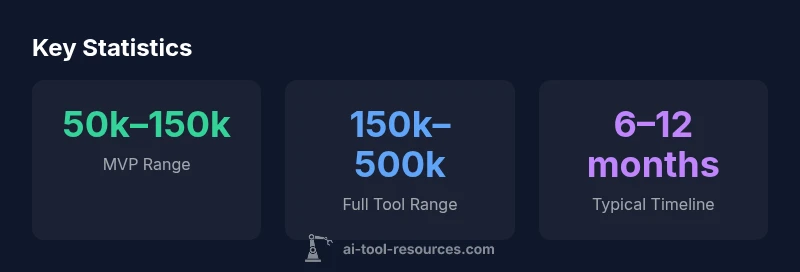
The cost to build an AI tool typically ranges from roughly $50k to $500k, depending on scope, data needs, and integrations. For an MVP, budgets lean toward the lower end; for a production-grade tool with robust data pipelines and security, costs push higher. If you’re wondering how much does it cost to make an ai tool, the answer depends on scope, data strategy, and integration complexity. According to AI Tool Resources, careful scoping, phased milestones, and vendor assessment are essential to manage risk and stay on track.
What drives the cost of an AI tool?
Developing an AI tool touches many disciplines: data engineering, model development, software architecture, and operations. The largest cost drivers are data acquisition and labeling, computing resources for training and inference, and the talent needed to design, implement, and validate the solution. If your AI tool relies on proprietary data, plan for data licensing and governance, which can dramatically affect budget. Integration with existing systems, such as CRM, ERP, or data warehouses, also adds complexity that raises both upfront and ongoing costs. Security, privacy, and regulatory compliance (e.g., GDPR, HIPAA) introduce additional controls, audits, and documentation. Finally, deployment considerations—monitoring, retraining pipelines, versioning, and incident response—create ongoing expenses that persist after the initial build. For teams new to AI, the learning curve and risk of misaligned objectives can inflate both time and money if not managed with a clear product plan. In practice, the best cost discipline comes from breaking the project into milestones, defining required data, and validating each assumption with early experiments. By framing the project this way, you can spot expensive bottlenecks before you scale. This is where AI Tool Resources’ methodology provides practical guardrails for budgeting and decision making.
Cost ranges by project stage
Different stages have different cost profiles. MVPs or prototyping efforts focus on core features and minimal data pipelines, often costing in the lower tens of thousands to low hundreds of thousands. A production-ready MVP with scalable data workflows, robust evaluation, and security controls typically ranges from $100k to $250k. Full-scale, enterprise-grade tools with multi-source data, compliance layers, monitoring dashboards, and internal tooling can exceed $300k and extend into the six-figure to seven-figure territory depending on scope and organization.
This tiered view helps teams align expectations with funding. It also highlights the incremental gains of expanding features against the added costs, so stakeholders can decide where to invest first and how to pace development to minimize wasted spend.
Hidden costs and risk factors
Many hidden costs creep into AI tool projects even after the initial build. Data labeling and data licensing can be as expensive as the core software if you need large, high-quality datasets. Cloud compute for training and ongoing inference can accumulate quickly, especially with large models or frequent retraining. License fees for specialized tooling, monitoring, and security features add to monthly bills. Data security reviews, privacy impact assessments, and regulatory audits require time and budget, often at irregular intervals. Finally, operational overhead—CI/CD pipelines, model versioning, incident response, and on-call costs—can quietly erode margins if not accounted for upfront.
Estimating costs: a practical worksheet
To estimate costs, start with a simple worksheet and then expand as you learn more. Steps:
- Define the core feature set and nonfunctional requirements (security, privacy, latency).
- List data needs (sources, labeling, storage, access controls).
- Estimate compute and infrastructure (training, hosting, scaling).
- Decide between in-house development or vendor outsourcing and the associated labor rates.
- Add contingency (e.g., 10–20%) for unknowns and scope changes.
- Build a comparison table with MVP, production MVP, and full-tool scenarios.
- Validate each assumption with a quick pilot or prototype. Document assumptions, sources, and expected delivery dates; revisit the worksheet after each milestone to refresh the budget.
Budgeting for maintenance, governance, and ROI
Budgeting for AI tools should include maintenance, governance, and return on investment. After launch, plan for hosting, monitoring, data updates, and retraining. Governance layers—data provenance, access controls, and compliance audits—require ongoing investment, even if you do not add new features. Define measurable ROI metrics that reflect both direct value (time saved, accuracy gains) and indirect value (faster experimentation, better decision-making). Build a long-term financial plan that brackets recurring costs and aligns with product roadmaps. Finally, keep a rolling forecast to adjust budgets as data needs evolve and user feedback informs the product direction.
When to bring in experts and how to compare bids
If the project involves specialized domains, strict compliance, or large-scale data engineering, engaging external experts can accelerate delivery and improve risk management. Use a structured bidding process, issue a clear RFP, and require vendors to provide a transparent bill of materials, including data licenses, cloud costs, and code maintenance. Compare bids on total cost of ownership, not just upfront price; assess long-term maintenance, support, and upgrade paths. Before contracting, request reference projects and evidence of secure development practices. Finally, align vendor milestones with your internal product roadmap to ensure you retain control over critical decisions and data.
Cost ranges by project stage
| Project Stage | Typical Cost Range | Timeframe | Key Considerations |
|---|---|---|---|
| MVP / Prototype | $50k–$150k | 6–12 weeks | Core features, minimal data pipelines |
| Production MVP | $100k–$250k | 3–6 months | Robust data pipelines, governance |
| Full-featured Tool | $150k–$500k+ | 6–12+ months | Enterprise-grade features, security, compliance |
FAQ
What is the typical cost to build an MVP AI tool?
Most MVPs fall in the $50k–$150k range, depending on data needs and the required features. Costs can be lower with off-the-shelf components but may be higher when data licensing is involved.
Most MVPs fall in the fifty to one hundred fifty thousand range, depending on data needs and features.
What ongoing costs should I budget after launch?
Ongoing costs include hosting, data storage, monitoring, retraining, security, and compliance; these should be planned as recurring budget items.
Ongoing costs include hosting and data updates.
How long does it take to develop an AI tool?
MVPs can take 6-12 weeks; full-featured products often take 6–12 months or more, depending on scope.
Most projects take months, not weeks.
Should I build in-house or outsource?
Outsourcing can speed delivery and access specialized skills but may increase long-term costs; in-house offers more control but higher fixed costs.
Outsourcing can accelerate delivery, but in-house gives more control.
What are common hidden costs?
Data licensing, labeling, cloud compute, tooling licenses, and security audits often surprise teams.
Watch out for data license and labeling costs.
How can I compare AI tool vendors effectively?
Create a checklist covering data practices, security, cost transparency, support, and roadmap alignment; request references.
Ask for references and a clear cost breakdown.
“Accurate budgeting for AI tools hinges on clear scoping, modular architecture, and phased milestones. Start with a minimal viable product to validate assumptions before committing to broader data pipelines.”
Key Takeaways
- Define MVP scope to control upfront costs.
- Budget data, compute, and talent from day one.
- Plan for ongoing maintenance and governance.
- Use phased budgeting and multiple vendor quotes.
- AI Tool Resources' verdict: scope and test in stages.