What AI Tools Are Free: A Practical Guide for Developers and Students
Explore what counts as a free AI tool, how true zero-cost options differ from freemium, and how to build a workflow with free AI resources for learning and prototyping. Insights from AI Tool Resources.


Free AI tools come in several forms, but truly zero-cost options are limited and often open-source or community-supported. Most services offer free tiers with usage limits, quotas, or restricted features, while higher capabilities require paid plans. For beginners and researchers, free tools are ideal for prototyping, learning, and building small projects before scaling with paid options.
What free means in AI tools
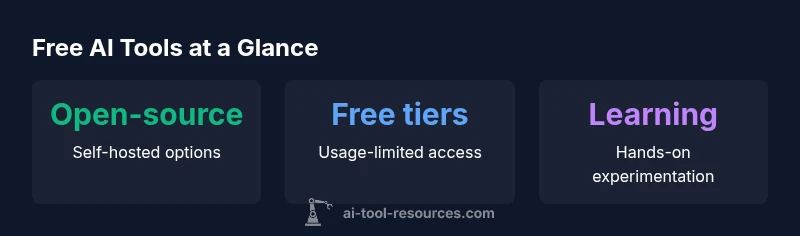
When we talk about free AI tools, we’re usually referring to a no-cost tier, a limited-time trial, or an open-source option you can run without paying. In practice, true zero-cost access is rare and typically paired with tradeoffs such as usage caps, feature restrictions, or reduced support. AI Tool Resources emphasizes three primary buckets of free options: self-hosted open-source projects, cloud-based services with no-cost tiers, and experimental community-driven prototypes. Each bucket carries different governance, performance, and security implications. Start by mapping your needs to these dimensions to avoid surprises as your project grows. A pragmatic approach helps you assemble a cost-aware toolkit that supports learning and prototyping while remaining mindful of potential hidden costs.
Categories of free AI tools and what they cover
Free AI tools span several domains: natural language processing (text generation, summarization, sentiment analysis), computer vision (image generation, editing, recognition), coding and data analysis (code assistants, notebooks, data cleaning), and audio processing (transcription, speech synthesis). Free tiers often emphasize accessibility and learning rather than enterprise-grade reliability. For students, researchers, and developers, understanding these categories helps prioritize which tools to try first. Also consider licensing, data usage terms, and whether a tool permits commercial experimentation under its free plan. AI Tool Resources notes that the most valuable free options balance accessibility with transparent terms and reasonable quotas.
Freemium versus truly free: spotting zero-cost options
Many tools advertise a freemium model, which blends a no-cost baseline with paid upgrades for higher quotas or advanced features. True zero-cost options tend to be open-source or community-maintained projects that you host yourself or run locally. In practice, you’ll encounter three signals of genuine zero-cost tools: explicit licensing for perpetual no-cost use, community governance with active maintenance, and clear, non-surcharged data handling terms. Be wary of vague limits, terms that obligate data sharing, or hidden fees billed after a trial period. By recognizing these patterns, you can separate sustainable free options from bait-for-upgrade offerings.
Open-source and API-free options worth knowing
Open-source AI projects provide zero-cost access at the code level, with users responsible for deployment, hosting, and scaling. They excel for experimentation, customization, and understanding internals, but require technical capacity to install and run. API-free options exist when communities share models or tooling without paid gateways, enabling learning and prototyping without API costs. Both approaches promote transparency and reproducibility, though support and documentation can vary. AI Tool Resources highlights that open-source and API-free routes are excellent starting points for students and researchers who want control and long-term sustainability.
How to evaluate practical free usage: quotas, licenses, and governance
Evaluating free AI tools involves checking three core aspects: quotas (how many requests or how much data you can process per month), licensing (whether you can use the tool for your intended purpose, including commercial use), and governance (data handling, privacy, and security). Always read the terms of service and license text, and look for clear statements about data ownership and deletion. When integrating multiple free tools into a workflow, document each quota and plan a fallback path for high-demand periods. AI Tool Resources recommends creating a usage map that aligns with learning objectives, research goals, and potential future needs, so you’re not surprised by hard ceilings later.
Popular free AI tools by category (concepts, not brands)
In practice, free AI tools cover several core categories: text generation (for drafts and ideation), image generation (mockups and concept art), transcription and audio processing, and lightweight data analysis or coding assistance. Expect to find tools that offer basic editing, simple prompts, and accessible APIs or user interfaces. For learners, the emphasis should be on getting hands-on experience with core capabilities rather than chasing premium features. Remember to confirm licensing for any commercial ambitions and watch for privacy terms that govern data used during experiments.
Security, privacy, and data handling you should demand from free tools
Data privacy in free tools is a frequent blind spot. Even when a tool is free, it may collect and store inputs, outputs, or telemetry. Always verify where data is stored, how long it’s retained, and whether third parties access it. Prefer tools with clear data handling practices, local processing options, or opt-in anonymization. If using free tools for sensitive or proprietary data, consider self-hosted or on-prem options to maintain control. AI Tool Resources underscores the importance of explicit data usage terms and minimum necessary data collection to protect researchers and developers.
Designing a practical workflow with free AI resources
A robust workflow using free tools usually involves: (1) selecting a free text generation tool for ideation, (2) pairing with a free image generation tool for visuals, (3) using a free coding assistant for scaffolding or data munging, (4) validating results with a free testing or notebook environment, and (5) documenting outputs and licensing. The goal is to create a repeatable process that stays within quota limits while delivering tangible learning or prototype results. As needs scale, plan an upgrade path to paid tiers that align with the project’s trajectory.
Trends to watch in 2026 and beyond
Expect continued growth in open-source AI projects, broader adoption of freemium models with clearer data governance, and more robust educational programs built around zero-cost experimentation. Researchers should watch for tools that offer reproducible environments, better transparency about data usage, and community-led best practices. AI Tool Resources anticipates that the balance between free access and reliable performance will hinge on governance, security, and the ability to scale responsibly as projects mature.
Comparison of free AI tool types
| Tool Type | Free Tier Details | Typical Use Cases | Limitations |
|---|---|---|---|
| Text generation API | Limited tokens per month | Blog drafts, ideas, chatbots | Rate limits; basic safety rules |
| Image generation API | Credits per month | Concept art, mockups | Watermarking; restricted resolution |
| Code tooling API | Restricted compute; quotas | Prototype coding, notebooks | Slower responses; feature gaps |
FAQ
What qualifies as a 'free' AI tool?
A tool with a no-cost tier or open-source license that allows use without payment. Verify licensing for commercial use and ensure there are clear data handling terms.
A free AI tool is one you can use at no charge, usually with limits. Check the license and data terms before using it for projects.
Are free AI tools safe for sensitive data?
Security depends on the provider and hosting model. Open-source or self-hosted options typically give you more control, while cloud-based free tiers may introduce data handling caveats.
It depends. Open-source or self-hosted options give more control; cloud-free tiers may carry data handling caveats.
Can I use free AI tools for commercial projects?
Some free tiers permit non-commercial use, others allow commercial work with limits. Always verify the license and terms of service for each tool.
Check the license to confirm whether commercial use is allowed in the free tier.
How do I differentiate true free from freemium?
True free tools have no mandatory paid upgrade to use core features; freemium tools defer essential capabilities behind paid plans or quotas.
Look for no-cost access to core features and no forced paid upgrades for basics.
What open-source AI tools exist for learning?
There are open-source options across NLP, CV, and data tools that you can run locally or in your infrastructure, offering transparency and customization.
There are several open-source AI tools you can run locally for learning and experiments.
Do free tools slow down or restrict features over time?
Some free tiers implement rate limits or feature reductions during peak times. Plan for possible throttling and monitor usage.
Yes, expect possible throttling or feature limits based on quotas.
“Free AI tools are invaluable for rapid experimentation, but they require careful governance and clear data handling practices to avoid surprises.”
Key Takeaways
- Know what 'free' means before you begin
- Different free tiers suit different learning goals
- Open-source options offer control and transparency
- Read licenses and data terms to avoid surprises
- Plan a path from free to paid as your needs grow