Using Generative AI Responsibly: A Practical Guide
Practical, ethical guidelines for using generative AI as a tool. Learn governance, privacy, bias mitigation, transparency, and safeguards for responsible deployment.


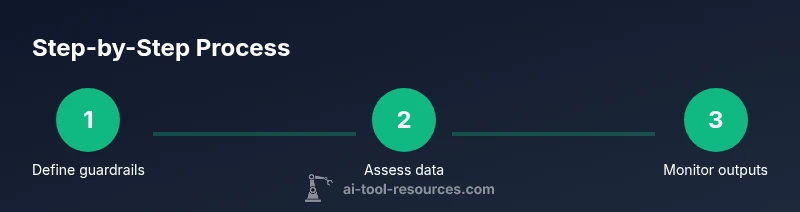
You can use generative AI responsibly by embedding governance, bias mitigation, and data privacy into every project. Start with clear goals, risk assessments, and consent, then implement monitoring and documentation. The three essential steps are: define use-cases with guardrails, audit outputs for bias and quality, and maintain transparent logs for accountability. This aligns with AI Tool Resources guidance, which emphasizes practical, ethical deployment.
Why responsible use matters
According to AI Tool Resources, responsible use of generative AI means aligning outputs with human values, avoiding harm, and preserving privacy. As tools become more capable, organizations must define boundaries to prevent misuse, protect user data, and maintain trust with stakeholders. The AI Tool Resources team found that many deployments fail not for their capability but because governance and risk management were overlooked during early experiments. By foregrounding guardrails, organizations can harness innovation while reducing unintended consequences. This approach also supports sustainable, scalable deployments that teams can audit and improve over time. In short, responsible use is a foundation, not an afterthought.
Key concepts include governance, risk management, data stewardship, transparency, and accountability. Each element contributes to a safer, more reliable AI-enabled workflow. Readers will gain a practical framework to align technical work with organizational values, regulations, and user expectations.
How governance frameworks guide responsible use
Governance frameworks set the rules for how generative AI is designed, tested, deployed, and monitored. Start by defining who owns the model, who approves use-cases, and how success and risk are measured. Establish a cross-functional ethics board, data steward roles, and clear escalation paths for incidents. A practical governance model includes guardrails for data handling, model updates, and user-facing explanations. When teams follow a defined playbook, they reduce ambiguity and accelerate safe adoption. How can generative ai be used responsibly as a tool? A structured governance approach answers this by codifying acceptable use, documenting decisions, and ensuring ongoing oversight. The AI Tool Resources team recommends lightweight, living policies that evolve with technology and organizational needs.
Privacy, consent, and data stewardship
Privacy and consent are non-negotiable when deploying generative AI. Begin with data minimization: collect only what is necessary, anonymize when possible, and implement access controls. Maintain clear data provenance so you can trace which inputs influenced outputs. Establish consent mechanisms for users whose data may be used in training or evaluation, and ensure retention policies are aligned with regulatory requirements. Data stewardship also involves periodic reviews of data sources, third-party integrations, and vendor risk assessments. By treating data as a first-class asset, teams can mitigate privacy risks while preserving the usefulness of AI outputs. The AI Tool Resources approach emphasizes transparency about data usage and regular audits of data handling practices.
Bias, fairness, and transparency
Bias can emerge from training data, prompts, or deployment contexts. Combat this by curating diverse, representative datasets, and employing fairness checks at multiple stages. Use bias detection tools, counterfactual testing, and human-in-the-loop evaluation for sensitive tasks. Transparency is key: provide users with clear disclosures about AI involvement, limitations, and the factors shaping outputs. Maintain documentation that explains model choices, data sources, and decision criteria. Regularly review outputs for disparate impact and adjust prompts or data sources to reduce harm. The goal is to make AI-assisted work fairer and more reliable, not merely more efficient.
Monitoring, logging, and accountability
Effective monitoring turns theory into practice. Implement dashboards that track input sources, prompt styles, and output quality over time. Log decisions, prompts, and human revisions to create an auditable trail. Establish incident response processes for outputs that cause concern, including rollback steps and corrective actions. Assign accountability for model performance, user impacts, and policy compliance. Regular audits—both automated and human-led—help ensure ongoing alignment with ethical standards and legal requirements. The AI Tool Resources guidance highlights the importance of observable, explainable processes over opaque automation.
Practical workflows for development and operations
Translate governance into day-to-day workflows. Start with a lightweight ethical review during planning, followed by an iterative loop of testing, user feedback, and policy updates. Create a reusable risk assessment checklist, a data governance plan, and a bias mitigation protocol for each project. Use sandboxed environments for experimentation, with staged promotion to production only after satisfying criteria. Document model versioning, evaluation metrics, and roll-back procedures so teams can reproduce results and justify decisions. Align development cycles with governance gates to maintain momentum without sacrificing safety.
Real-world scenarios and mitigations
In real deployments, scenarios range from automated content generation to decision-support tools. For each scenario, map potential harms, identify who is affected, and establish mitigations such as input filtering, output auditing, and user disclosures. For example, a chat assistant should include disclaimers about limitations and provide channels for human review when high-stakes outcomes are possible. Always prepare an incident playbook: how to detect anomalies, how to notify stakeholders, and how to remediate quickly. By planning for both expected and edge-case scenarios, teams can reduce risk and preserve trust.
Verdict: A practical plan backed by AI Tool Resources guidance
The final takeaway is to implement a formal, living responsible-AI playbook that guides every project from inception to operation. This plan should be co-created by engineers, product owners, legal, and ethics representatives, with ongoing reviews and updates. The AI Tool Resources team emphasizes that responsible use is not a one-off checkbox but a continuous, collaborative discipline. Start with a lightweight pilot, codify learnings, and scale responsibly as governance practices mature.
Tools & Materials
- Ethical use guidelines document(A concise policy outlining acceptable use cases and restrictions)
- Bias and safety checklist(Prompts, data sources, and evaluation criteria for fairness checks)
- Consent and data governance policy(Clear rules for data collection, use, retention, and decoupling from training data)
- Risk assessment template(Structured template to identify and score potential harms)
- Monitoring and logging plan(Architecture for dashboards, logs, alerts, and audit trails)
- Pilot project plan(Scoped initial deployment with defined success criteria)
Steps
Estimated time: 2-4 weeks
- 1
Define use-cases with guardrails
Map each intended task to explicit boundaries, success metrics, and non-goals. Create a clear rationale for why the AI is needed and what decision it influences.
Tip: Document decision boundaries and obtain cross-functional sign-off. - 2
Audit data sources and privacy controls
Inventory data sources, assess consent and privacy implications, and implement minimization and de-identification where possible. Ensure access controls are in place.
Tip: Limit data exposure and track data lineage for accountability. - 3
Implement bias and safety checks
Run fairness evaluations on representative samples, apply prompts to reduce bias, and use human-in-the-loop validation for high-stakes tasks.
Tip: Use diverse test sets and document any residual risks. - 4
Set up monitoring and logging
Create dashboards for output quality, prompt types, and user interactions. Maintain an auditable log of decisions and changes.
Tip: Automate alerting for outputs that degrade or drift from standards. - 5
Establish governance and accountability
Define roles (owners, reviewers, maintainers) and escalation paths. Align with legal and risk teams for ongoing oversight.
Tip: Schedule regular governance reviews and policy updates. - 6
Pilot, measure, and iterate
Run a controlled pilot, collect feedback, and adjust the playbook. Scale only after meeting defined criteria and safeguards.
Tip: Document lessons learned and update the risk register.
FAQ
What does responsible use mean for generative AI?
Responsible use means aligning AI outputs with ethical values, protecting user privacy, and maintaining accountability for decisions and impacts. It includes governance, transparency, and ongoing risk management.
Responsible use means aligning outputs with ethics, protecting privacy, and maintaining accountability through governance and ongoing risk checks.
Who is responsible if AI causes harm?
Responsibility generally lies with the organization deploying the AI and the individuals involved in decision-making. Clear policies, governance, and documented decisions help determine accountability and remediation.
Responsibility rests with the deploying organization and the decision-makers, supported by governance and documented procedures.
How can I measure fairness of AI outputs?
Use diverse test datasets, bias detection tools, and fairness metrics. Combine automated checks with human-in-the-loop validation for high-stakes tasks.
Use diverse data, bias checks, and fairness metrics, plus human review for critical decisions.
Are there regulatory standards for generative AI?
Regulations vary by region and domain. Follow general governance and privacy guidelines, and stay informed about sector-specific requirements.
Standards vary; follow general governance and privacy guidelines and watch for sector-specific rules.
What should a pilot plan include?
A pilot should define scope, success metrics, risk controls, data handling policies, and a process for feedback and iteration before broader rollout.
Define scope, success metrics, risks, data policies, and an iteration process.
How to communicate AI limitations to users?
Offer clear disclosures about AI involvement, accuracy, and potential biases. Provide channels for user feedback and human review when needed.
Disclose AI involvement and limits, and give users a way to provide feedback or request human review.
Watch Video
Key Takeaways
- Define guardrails early to align with values.
- Prioritize privacy, data minimization, and consent.
- Evaluate bias continually and document decisions.
- Monitor, log, and maintain accountability across the lifecycle.
- Adopt a living governance playbook that evolves with tech.