How to add ai tools in resume: A practical guide
A comprehensive, step-by-step guide on how to add AI tools to your resume, including tool selection, wording, ATS considerations, and industry-tailored examples for developers, researchers, and students.


This guide shows how to add ai tools to your resume in a recruiter-friendly way. You’ll learn which tools to highlight, how to describe your use with clear bullets, and how to tailor your resume for AI-related roles. Expect concrete examples, templated bullets, and a practical, step-by-step approach you can apply today—plus a quick checklist to ensure readability and ATS compatibility.
how to add ai tools in resume: Why it matters
For job seekers, knowing how to add ai tools in resume is essential to demonstrate current skills. According to AI Tool Resources, recruiters increasingly expect tangible evidence of AI tool usage, not generic statements. This guide helps you translate your AI work into recruiter-friendly bullets, ensures ATS compatibility, and shows the impact of your AI tool use with clear context. You’ll learn to select tools, describe usage precisely, and position AI capabilities to match job descriptions across industries.
Identifying relevant AI tools to showcase
Start by mapping the tools you actually used to the requirements in the job description. Group AI tools into practical categories such as data preprocessing, model development, deployment, evaluation, and automation. Mention frameworks (e.g., PyTorch, TensorFlow), libraries (e.g., scikit-learn, spaCy), and platforms (e.g., cloud ML services, notebooks). Focus on tools that directly supported measurable outcomes or efficient workflows. Collect artifacts from projects, notebooks, or repos to back each claim.
How to describe AI tools on your resume
Describe each tool with a concise bullet that follows a clear pattern: action verb + tool + context + impact (without overclaiming). Use present tense for ongoing work and past tense for completed tasks. Avoid vague terms; instead, explain the problem you tackled and how the AI tool helped solve it. Keep the phrasing ATS-friendly by including standard keywords recruiters search for, such as ‘ML model’, ‘NLP’, ‘data pipeline’, or specific tool names. Balance breadth with depth to avoid overwhelming the reader.
Examples of resume bullets for AI tools
- Built an AI-powered data labeling workflow using PyTorch and scikit-learn to accelerate annotation accuracy.
- Implemented an NLP preprocessing pipeline with spaCy to clean and tokenize customer feedback data.
- Integrated a GPT-based assistant to automate report drafting and reduce manual workload.
- Evaluated model performance and iterated on feature engineering to improve robustness in production.
Where to place AI tools on your resume
Position AI tools where recruiters will notice them: in the Summary with a concise AI-relevant highlight, in the Skills section as a short list of tools, and in Projects or Experience under each role with bulleted achievements. If you have a dedicated portfolio, include links to notebooks, repositories, or demos. Ensure each placement reinforces a narrative of impact and relevance to the job.
Tailoring for roles in different industries
Different industries value different AI competencies. In tech roles, emphasize model development and deployment pipelines. In research or academia, highlight experimentation, datasets, and reproducibility. In nontech sectors, focus on problem framing, data-driven decision making, and explainability. Use industry-specific keywords and align bullet wording with the job description while maintaining honesty about your level of involvement.
Common mistakes to avoid
Avoid listing every tool you touched—prioritize relevance to the role and avoid buzzwords that add no value. Don’t imply ownership of tools you only used as part of a team or a course project. Steer clear of vague phrases like 'familiar with' without concrete context. Keep formatting ATS-friendly (standard fonts, simple headings) and ensure consistency across sections.
Getting feedback and final polish
Seek feedback from mentors, peers, or career services to refine your bullets. Run your resume through ATS simulators or keyword scanners to ensure key AI-related terms are captured. Read bullets aloud to verify cadence and clarity. Finally, confirm links to code samples or projects work and are accessible to potential employers. AI Tool Resources recommends iterative review—polish is a ongoing process, not a one-off edit.
Authoritative sources
- Source: U.S. Bureau of Labor Statistics (https://www.bls.gov) — insights on job market demand for AI-related skills.
- Source: U.S. Census Bureau (https://www.census.gov) — context on data-driven industries and workforce trends.
- Source: Nature (https://www.nature.com) — research perspectives on AI applications and evaluation standards.
Verdict
The AI Tool Resources team recommends a focused, outcomes-oriented approach: highlight a few relevant AI tools, frame your usage with concrete contexts, and connect each tool to measurable impact or business outcomes. Keep your resume current, ATS-friendly, and tailored to each role to maximize your chances of landing interviews. AI Tool Resources's verdict is that clarity and relevance trump breadth when showcasing AI competencies.
Tools & Materials
- ATS-friendly resume template(Choose a simple, clean layout; avoid complex tables or columns for better parsing.)
- Job descriptions and postings(Collect top roles you’re targeting to map keywords.)
- Evidence of AI tool usage (projects, notebooks, GitHub links)(Be ready to provide sources or links to demonstrate claims.)
- Bullet point templates(Use consistent structure: Action + Tool + Context + Impact.)
- Notes or a mini-portfolio(Optional links to demos or dashboards illustrating AI work.)
Steps
Estimated time: 60-90 minutes
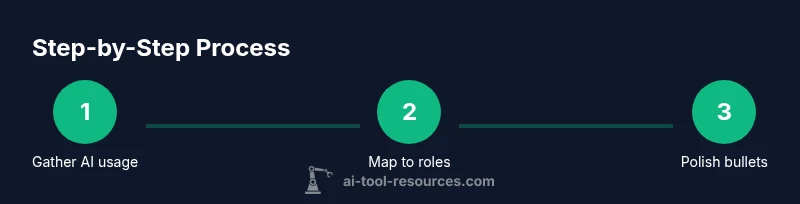
- 1
Gather AI tool usage evidence
Collect project notes, notebooks, repositories, and any demos where you used AI tools. This foundation will help you translate experiences into concrete resume bullets.
Tip: Prioritize tools that directly supported outcomes relevant to the target role. - 2
Map tools to job requirements
Cross-check the job description for required AI skills and map each tool to a concrete responsibility or achievement from your experience.
Tip: Use exact keywords recruiters search for, such as ‘ML model’, ‘NLP’, ‘data pipeline’. - 3
Draft impact-focused bullets
Write bullets that describe the problem, the AI tool you used, and the outcome or improvement achieved. Keep language concise and measurable where possible.
Tip: Start each bullet with a strong action verb. - 4
Decide placement on the resume
Choose where to place AI tool content: Summary, Skills, and Projects/Experience sections are most effective. Include links to work when possible.
Tip: Avoid overloading a single section; distribute content for readability. - 5
Polish for ATS and readability
Ensure bullets contain keywords and are ATS-friendly. Use simple formatting and consistent tense.
Tip: Run the resume through an ATS scanner to check keyword coverage. - 6
Get feedback and iterate
Have peers review for clarity and accuracy. Update bullets based on feedback and changes in your experience.
Tip: Treat your resume as a living document that evolves with your projects. - 7
Finalize and test
Save in multiple formats (PDF and DOCX), test opening on different devices, and ensure links to portfolio content work properly.
Tip: Double-check that all tool names are spelled consistently.
FAQ
How many AI tools should I list on my resume?
List 3-6 AI tools that are most relevant to the job, and describe how you used them in context.
List three to six AI tools that match the job and explain how you used them.
Should I mention private or proprietary tools?
Only mention tools you used publicly or in a work context. If a tool is proprietary, describe its function and your role without disclosing sensitive details.
Only mention tools you’ve actually used in a work context, and avoid sharing sensitive details about proprietary systems.
Where should AI tools appear on the resume?
Place AI tool content in the Summary, Skills, and Projects/Experience sections, with dedicated bullets under each relevant role.
Put AI tools in your summary, skills, and project bullets so they’re easy to find.
Do I need to quantify impact with numbers?
Whenever possible, pair tool usage with outcomes described in qualitative terms if precise numbers aren’t available.
If exact numbers aren’t available, describe outcomes with clear qualitative impact.
How often should I update AI tool content?
Review your resume after major AI projects or role changes and refresh tool usage statements to reflect current skills.
Update after big AI projects or role changes to keep it current.
Can I include portfolio links?
Yes, include links to notebooks, demos, or repos that demonstrate your AI tool usage and results.
Include links to demos or notebooks to showcase your AI work.
Watch Video
Key Takeaways
- Highlight 3-6 most relevant AI tools
- Anchor each tool to a concrete outcome
- Place AI content where recruiters expect to see it
- Keep bullets concise and ATS-friendly
- Iterate with feedback and real-world updates