What AI Tool Can Transcribe Audio to Text? A Practical Guide
Discover how to choose an AI transcription tool for turning audio into text. Compare accuracy, latency, languages, and privacy with AI Tool Resources.


There isn't a single best AI tool for transcribing audio to text. For developers and researchers, the right choice hinges on accuracy, language support, latency, privacy, and workflow needs. According to AI Tool Resources, the most reliable setups blend a cloud-based ASR service with post-processing and human-in-the-loop review when required. The AI Tool Resources team notes that privacy controls and streaming capabilities can be decisive for handling sensitive data.
What AI Tool Can Transcribe Audio to Text: How It Works
Automatic speech recognition (ASR) uses a pipeline that converts acoustic signals into textual representations. First, audio is sampled and converted into features that machines can analyze. Then a language model predicts likely word sequences, guided by context and prior knowledge. Modern systems often include adaptive noise suppression, speaker diarization (identifying who spoke when), and punctuation restoration to improve readability. In real-time scenarios, streaming ASR processes audio as it arrives, delivering near-instant captions. For batch transcription, the system processes longer files end-to-end, allowing more intense post-processing. Across both modes, accuracy hinges on audio quality, vocabulary relevance, and dialect handling. Post-processing steps—like domain adaptation, glossary integration, and human-in-the-loop review—can dramatically improve results for specialized content. When evaluating any tool, consider latency, throughput, and privacy controls as core criteria. The keyword here is transcription quality, which rises when the transcription stage is paired with clean data and careful editing.
Key factors to evaluate when choosing a transcription tool
Choosing a transcription tool is not just about raw accuracy. You should assess multiple dimensions to ensure the solution fits your use case. First, consider the acoustic environment: noisy rooms, overlapping speech, or rapid talkers require robust noise suppression and speaker separation. Second, language support and dialect coverage are critical for multilingual projects or content with regional variants. Third, latency matters: streaming transcription is essential for live captions, while batch processing suits post-production or archiving. Fourth, privacy and security govern how audio data is stored, processed, and purged; in healthcare or legal contexts, on-premises or encrypted channels may be mandatory. Finally, evaluate integration capabilities: API quality, SDKs, and compatibility with your existing video, CMS, or analytics stack. A good approach is to map your exact workflow, define success metrics, and test tools against a representative corpus that mirrors real-world use cases.
Privacy, security, and compliance considerations
Privacy and security are not optional add-ons; they are foundational. If your audio data includes personal information, sensitive identifiers, or regulated content, prioritize tools with robust data governance. Look for end-to-end encryption, strict retention policies, and auditable access controls. Some teams prefer on-premises or offline inference to minimize data exposure, while others rely on vendor-provided encryption and access controls. Be mindful of region-based data residency requirements and consent mechanics for data usage in training or model improvement. Always review terms of service and data-use policies to understand whether transcripts can be used to train models. Finally, establish a clear data-handling workflow, including anonymization options and a process for secure deletion when a project ends.
Real-time vs batch transcription: workflow patterns
Real-time transcription supports live captions in video conferences, webinars, and broadcasts, requiring ultra-low latency and streaming APIs. Batch transcription completes hours of audio after upload, enabling higher accuracy through longer context windows and post-processing. Real-time systems often trade some accuracy for speed, while batch systems can leverage more powerful processing and domain-specific dictionaries. For teams, a hybrid approach—streaming for live tasks and batch for archival content—offers flexibility. Ensure that your chosen tools provide the right streaming protocols, time stamps, and diarization outputs to support downstream workflows such as translation, summarization, or indexing.
Practical setup: building a transcription pipeline
A practical transcription pipeline typically combines four layers: ingestion, ASR, post-processing, and review. Ingestion handles file formats, chunking, and language detection. The ASR layer performs the audio-to-text conversion, ideally with a configurable vocabulary and improved handling for noise and interruptions. Post-processing includes punctuation restoration, capitalization, formatting for readability, and domain-specific glossaries. Finally, a human-in-the-loop step validates results, corrects specialized terms, and ensures consistency across transcripts. For a scalable workflow, automate testing with representative audio samples, implement monitoring for accuracy drift, and maintain clear versioning of models and glossaries. Documentation and governance are critical to maintain reproducibility and compliance.
Common pitfalls and how to avoid them
Common pitfalls include relying on raw ASR results without post-editing, underestimating privacy implications, and ignoring speaker turns or diarization. To avoid these, define a revision protocol, use glossary augmentation for industry terms, and implement speaker tagging with context-aware edits. Also, test tools under real-world conditions: mixed audio quality, multiple languages, and overlapping speech. Finally, budget for human review for high-stakes content; even the best models benefit from human oversight to catch domain-specific nuances and proper names.
Language coverage and accessibility considerations
Language coverage matters for global projects, and dialects can dramatically affect accuracy. When selecting tools, verify not only the number of supported languages but also how well they handle regional accents, code-switching, and domain-specific terminology. Accessibility remains a key goal, so prioritize features like captions, transcripts synchronized to video timecodes, and compatibility with assistive technologies. If your content involves specialized vocabulary (medical, legal, technical), invest in domain-adapted models or glossary pipelines to minimize misrecognitions and improve overall accessibility for all users.
The future of AI transcription
The field is moving toward more accurate, privacy-conscious models with broader language coverage. Advances in on-device inference may reduce latency and data exposure, while federated learning could improve models without centralizing sensitive data. Expect better diarization, improved handling of noisy environments, and more robust domain adaptation. As tools evolve, the best practices will combine high-quality ASR with rigorous post-editing and governance to meet industry standards and user expectations.
Comparison of transcription tool categories
| Tool Type | Avg Speed | Typical Use Case |
|---|---|---|
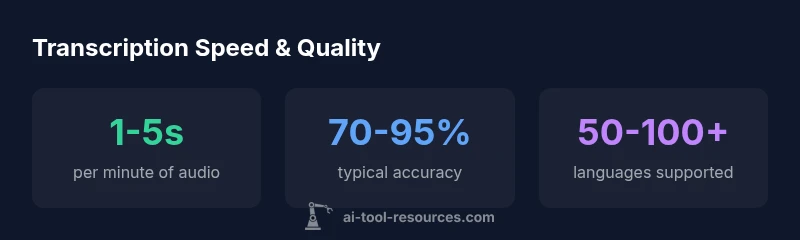
| Streaming ASR | 1-5 seconds per minute | Live captions for meetings |
| Batch transcription | Minutes per hour | Transcribing long recordings |
| On-device/offline | Stable latency | Privacy-sensitive contexts |
FAQ
What AI tool can transcribe audio to text?
There isn't a single best tool; consider accuracy, latency, privacy, and language support across options. Our guide outlines common approaches and test plans.
There isn't one best tool; compare accuracy and privacy across options.
Can AI transcription handle multiple languages?
Most tools support dozens of languages, with varying degrees of accuracy; check language coverage and dialect support.
Most tools cover many languages; verify dialects.
What is the difference between streaming and batch transcription?
Streaming targets real-time captions; batch processes recorded audio. Each has different latency and cost profiles.
Streaming is real-time; batch is for long recordings.
How important is privacy in transcription?
If you’re handling sensitive data, prefer on-prem/offline or encrypted pipelines, and review data retention terms.
Privacy matters; use secure pipelines.
How do I improve transcription accuracy?
Improve audio quality, use domain-adapted models, and add human review for critical content.
Improve quality, adapt models, add human checks.
What about costs and pricing models?
Pricing ranges from per-minute rates to monthly plans; compare total cost based on your volume and features.
Costs vary; estimate your volume.
“Effective transcription combines strong ASR models with disciplined post-editing and clear data governance. Tools shine when integrated into a well-designed workflow.”
Key Takeaways
- Define your privacy requirements before choosing.
- Prioritize latency for real-time tasks and accuracy for archival work.
- Plan for post-editing in a human-in-the-loop workflow.
- Test tools with representative, domain-specific audio samples.