AI Tool Guide: A Practical, Step-by-Step Resource
A practical AI tool guide from AI Tool Resources that explains how to identify, evaluate, and apply AI tools responsibly for development, research, and education.


According to AI Tool Resources, this article provides a practical, step-by-step AI tool guide to help developers, researchers, and students identify, evaluate, and integrate AI tools effectively. You’ll learn how to define objectives, compare options, assess safety and ethics, and implement a workflow from discovery to deployment. Use this guide to accelerate responsible tool adoption in real projects.
What is an AI tool guide?
An AI tool guide is a structured resource that helps you identify, evaluate, and adopt AI tools in a systematic way. It serves developers, researchers, and students by outlining categories of tools, evaluation criteria, and practical workflows. At its core, an AI tool guide translates complex vendor claims into actionable steps, so you can align tool choices with your project's data, ethics, and governance requirements. According to AI Tool Resources, an effective guide reduces tool overload and accelerates responsible adoption. The guide you’re reading is designed to be agnostic about specific vendors, focusing instead on principles you can apply across contexts. You’ll find definitions, checklists, and examples that illuminate how to structure your discovery phase, run short PoCs, and document decisions for reproducibility. Throughout, keep your objectives front and center and remember that the goal is not to chase the latest feature, but to solve real problems with measurable impact.
The human side of AI tool selection
Beyond technical specs, a good AI tool guide emphasizes governance, team alignment, and long-term sustainability. It invites stakeholders from data science, product, security, and ethics to co-create selection criteria. By framing decisions around business value, risk, and user needs, teams reduce wasted effort and avoid ad-hoc tool hopping. The AI Tool Resources team notes that structured guides improve collaboration and traceability, making it easier to justify choices during audits or reviews. Readers should view the guide as a living document, updated as new requirements emerge or as tools evolve.
Core categories of AI tools
A comprehensive guide organizes tools into functional families. Typical categories include data preparation and labeling tools, machine learning platforms, NLP and language models, computer vision and video analysis, automation and RPA, safety and compliance modules, and evaluation and monitoring utilities. Within each category, you’ll encounter decision factors such as data locality, model access, latency, scalability, and cost. Recognizing these categories helps you map your project’s needs to suitable tool kinds and prevents misalignment between objectives and capabilities.
How to select AI tools for your project
Start with a clear problem statement and success criteria. List must-have features, nice-to-have enhancements, and hard constraints like data privacy, on-premise requirements, or budget caps. Create a comparison matrix that scores each tool against criteria, then validate with a small, representative PoC. Consider data compatibility (input formats, data governance laws), integration feasibility (APIs, SDKs, or no-code connectors), and vendor support. A robust selection process also accounts for ethics, bias mitigation, and verification of third-party risk management plans. As you narrow options, document why each tool was kept or rejected to preserve reproducibility and accountability.
Evaluating safety, ethics, and compliance
Ethical and safety considerations are essential in an AI tool guide. Assess data privacy implications, model biases, explainability, and potential downstream harms. Check for governance controls such as access management, audit trails, and data retention policies. Security reviews should cover API token handling, encryption in transit and at rest, and incident response planning. Compliance checks should align with applicable regulations (e.g., data protection rules, industry standards) and organizational policies. The guide encourages a cautious approach: pilot with de-identified or synthetic data when possible and escalate risks to governance teams before broader usage. The AI Tool Resources team emphasizes documenting risk assessments to support responsible deployment.
Practical workflow: from discovery to deployment
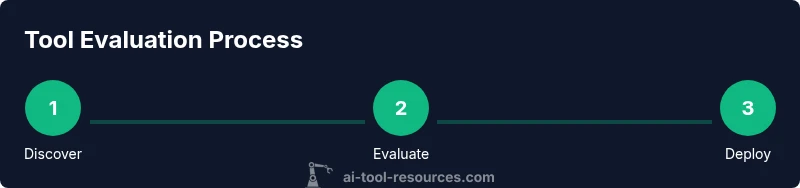
A practical workflow begins with discovery, where you scour catalogs, community reviews, and vendor docs. Next comes shortlisting, where you compare features against criteria using a standardized evaluation matrix. Then comes a PoC (proof of concept) to test key hypotheses on a small scale. If results are favorable, plan deployment with governance, monitoring, and roll-out milestones. Finally, establish ongoing evaluation and retirement criteria to ensure tools remain fit for purpose. This workflow should be iterative, with feedback loops that inform future selections and optimizations.
Measuring impact: evaluation metrics
Measuring impact requires concrete metrics that align with project goals. Common metrics include task accuracy, inference latency, throughput, and user adoption rates. Balance quantitative measures with qualitative feedback from stakeholders to capture usefulness and user experience. Establish baselines before testing tools and maintain a simple dashboard to monitor performance over time. The guide suggests annual or semi-annual reviews to revalidate tool choices as requirements evolve or as new versions are released.
Common pitfalls and how to avoid them
Popular pitfalls include chasing novelty over utility, vendor lock-in, and underestimating data governance requirements. Another risk is under-scoping PoCs, which yields inconclusive results. To avoid these, set explicit success criteria, limit PoC scope, require reproducible artifact logging, and ensure cross-functional representation on evaluation teams. Don’t neglect risk management and compliance from day one, and avoid assuming a tool’s claims without independent testing. Documentation and version control are your safety nets for audits and future maintenance.
Case studies: hypothetical examples
Case Study A: A research group needs a literature-review assistant. They define a narrow objective, evaluate three NLP tools on a fixed dataset, and pilot with a small cohort of researchers. The PoC reveals improvements in speed and citation accuracy, prompting a staged deployment with monitoring dashboards. Case Study B: A design team explores AI-generated visuals. They test multiple image-generation tools using synthetic prompts, assess output diversity, and implement governance constraints to avoid copyright issues. Both cases illustrate the value of a structured approach and careful documentation.
Getting started: a 7-day plan
Day 1–2: Define objective, success metrics, and constraints. Gather initial tool candidates from catalogs and peers. Day 3–4: Build a shortlisting matrix, identify integration points, and prepare a PoC plan. Day 5–6: Run PoCs with a small dataset, collect feedback, and quantify early results. Day 7: Decide on deployment strategy, assign governance roles, and document outcomes for reproducibility. The AI Tool Resources team recommends keeping a living checklist updated as you progress.
Tools & Materials
- Computer with internet access(Current OS, up-to-date browser)
- Note-taking and citation tool(e.g., Notion, Obsidian; keep a running log of criteria and decisions)
- Access to AI tool catalogs or marketplaces(Accounts or trial access for multiple tools; document usage terms)
- Ethics checklist + risk assessment template(Template covering privacy, bias, governance, and auditability)
- Test data (sanitized) or synthetic dataset(Use only non-sensitive data; helps safe PoC testing)
Steps
Estimated time: Total time: 6-10 hours
- 1
Define your objective
State the problem you want the AI tool to solve and articulate the expected impact. Establish success criteria and boundaries to prevent scope creep. Frame the objective in measurable terms so you can evaluate outcomes later.
Tip: Be specific about the task and the expected success criteria. - 2
Gather requirements and constraints
List data needs, privacy requirements, latency targets, and budget limits. Include organizational policies on data handling and model deployment. This step ensures tool choices align with governance and technical constraints.
Tip: Document must-haves versus nice-to-haves before testing tools. - 3
Inventory potential tools
Scan catalogs, marketplaces, and peer recommendations to assemble a broad candidate list. Capture basic attributes such as data formats, APIs, and compatibility with existing systems.
Tip: Use a standardized evaluation matrix to keep comparisons fair. - 4
Shortlist and compare
Filter candidates against criteria and rank them. Prioritize tools that meet core requirements and offer robust vendor support and security features.
Tip: Must-have features should drive the initial shortlist. - 5
Check data compatibility and privacy
Validate data input/output formats, data processing flows, and privacy controls. Confirm compliance with relevant regulations and internal policies before the PoC.
Tip: Avoid assumptions about data behavior; verify with tests. - 6
Pilot with a small PoC
Run a focused PoC on a representative task using sanitized data. Collect objective results and stakeholder feedback for a quick reality check.
Tip: Limit the PoC scope to produce decisive results. - 7
Evaluate results and iterate
Compare PoC outcomes against success criteria. Iterate with adjustments to data, prompts, or configurations as needed.
Tip: Document lessons learned and decisions for future reuse. - 8
Plan deployment and governance
Draft deployment steps, ownership, monitoring plans, and risk controls. Define rollback procedures and audit trails.
Tip: Clarify responsibilities to avoid ownership gaps. - 9
Monitor and measure impact
Establish dashboards tracking key metrics. Schedule periodic reviews to ensure continued alignment with objectives.
Tip: Keep monitoring lightweight to avoid alert fatigue. - 10
Document decisions for reproducibility
Store artifacts, versions, and rationale in a centralized repository. Ensure steps can be repeated or audited later.
Tip: Version control your PoC data, prompts, and configurations.
FAQ
What is an AI tool guide and who should use it?
An AI tool guide is a structured resource that helps teams identify, evaluate, and adopt AI tools in a systematic way. It targets developers, researchers, and students who need a repeatable process for tool selection, testing, and deployment.
An AI tool guide helps teams pick, test, and deploy AI tools in a repeatable way.
How do I start evaluating AI tools for a project?
Begin with a clear objective and success criteria. Build a comparison matrix, conduct a small PoC, and iterate based on results. Include governance and data privacy checks from the start.
Start with clear objectives, compare options, run a small PoC, and iterate with governance in mind.
What are common pitfalls in AI tool adoption?
Common pitfalls include chasing novelty, vendor lock-in, and neglecting data governance. To avoid them, test claims independently, limit PoC scope, and document decisions for future reuse.
Pitfalls include chasing novelty and vendor lock-in; test claims independently and document decisions.
How important is data privacy in tool selection?
Data privacy is critical. Verify data handling practices, access controls, and whether the tool processes data on-premises or in the cloud. Align with organizational and legal requirements.
Data privacy is critical; verify handling, access, and where data is processed.
Can this guide be used for education and research?
Yes. The guide is designed for educational and research contexts, with emphasis on reproducibility, ethics, and governance to support responsible experimentation.
Absolutely—this guide supports education and research with emphasis on responsible use.
How long does deployment usually take after a PoC?
Deployment timelines vary by scope and risk. A typical path includes planning, governance setup, pilot expansion, and monitoring, with milestones aligned to business goals.
Timelines vary, but follow a phased plan with governance and monitoring.
Watch Video
Key Takeaways
- Define objectives and success metrics before tool selection.
- Assess data compatibility and governance early.
- Pilot with a focused PoC before full deployment.
- Document decisions for reproducibility and auditability.
- Follow a structured, humane approach to adopt AI tools.