How to Create an AI Tool: A Step-by-Step Guide
Learn a step-by-step approach to create an AI tool, from problem framing and data strategy to deployment, with governance and practical tips for developers, researchers, and students.


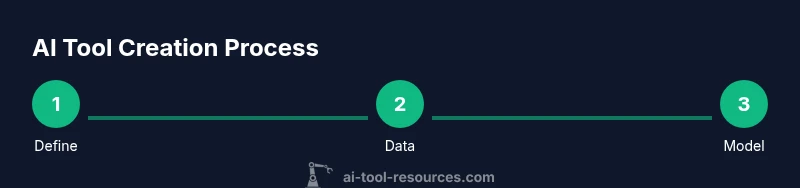
You can create ai tool by following a practical, end-to-end workflow that starts with a clear user problem and ends with a deployable prototype. This quick answer outlines the essential steps: define the use case, select data sources, design a minimal viable model, implement evaluation metrics, build a simple interface, and establish monitoring and maintenance plans. It’s a starter roadmap for developers, researchers, and students exploring AI tool creation.
Framing the problem and success criteria for a new AI tool
To successfully create ai tool, start by articulating a real user problem and translating it into measurable outcomes. Frame the use case around concrete tasks the tool will perform and define what success looks like in terms of accuracy, latency, or user impact. According to AI Tool Resources, a tight problem statement reduces scope creep and sets the stage for a focused data plan and evaluation strategy. This approach helps teams avoid building features users won’t adopt. When writing your success criteria, consider both functional goals (what the tool does) and non-functional goals (reliability, security, maintainability). For example, a document summarization tool should achieve a target performance on typical inputs within a reasonable latency budget and handle varying document lengths without failure. By documenting expected inputs, outputs, and failure modes early, you create a shared contract that guides all later decisions. The AI Tool Resources team emphasizes alignment with real user needs and clear, testable outcomes as the cornerstone of any successful AI tool project.
Data strategy and architecture: what you need to collect and how to structure it
A robust AI tool starts with clean data and a scalable architecture. Define data sources, collection frequency, labeling needs, and privacy safeguards. AI Tool Resources analysis shows that data provenance and versioning are critical for reproducibility and trust. Decide on a data schema that supports the target tasks (e.g., text, images, or tabular data) and plan preprocessing steps such as normalization, deduplication, and augmentation. Outline a lightweight, human-in-the-loop workflow where humans review edge cases during early iterations. Structure a modular architecture with a core inference engine, a data pipeline, and a service layer that can evolve independently. This block should also address data retention policies and compliance requirements to prevent future legal issues. Consider infrastructure choices early: use local development sandboxes for experiments and cloud-based compute for heavier workloads. A well-planned data strategy aligns model capability with user expectations and keeps governance manageable. AI Tool Resources recommends starting with a data map and an auditable lineage to support future audits and improvements.
Selecting models and building a baseline MVP
Choose an approachable baseline that matches the use case and risk profile. For many practical AI tools, a rule-based or small supervised model can provide a usable MVP while you gauge real user feedback. Define baseline metrics such as accuracy, precision, recall, latency, and user satisfaction. Build an end-to-end pipeline: data ingestion, preprocessing, model inference, and result delivery. The MVP should be implementable in days, not weeks, to validate core assumptions quickly. Plan for extension with few-shot learning or transfer learning if warranted by user feedback. Document the training regime and evaluation setup so teammates can reproduce results and learn from early experiments. This stage keeps risk manageable while delivering tangible value fast.
Evaluation, metrics, and iteration loops
Define evaluation protocols early: split data into train, validation, and test sets; use cross-validation if appropriate. Use both quantitative metrics (accuracy, F1, ROC-AUC) and qualitative feedback from users. Establish a fast iteration loop: run experiments, compare results, and decide on changes within 1-2 weeks. Use lightweight A/B testing for UI-driven features and feature flags for gradual rollouts. Maintain a changelog and experiment ledger so you can trace decisions and revert if needed. AI Tool Resources's guideline emphasizes clear, testable hypotheses and transparent reporting to avoid misinterpretation of results.
User interface, API, and integration considerations
Design a minimal yet functional UI or API for demonstrating the tool's capability. Start with essential inputs, intuitive controls, and clear output visualization. Build a simple REST or GraphQL API, with consistent error handling and meaningful status codes. Document API endpoints and data formats, so downstream systems and teammates can integrate easily. Include thorough input validation and rate limiting to guard against abuse. This stage also considers accessibility and internationalization from the start to reach a broader audience. The UI should be responsive and provide actionable feedback, including progress indicators for long-running tasks.
Compliance, privacy, and governance for AI tools
Address privacy, data security, and governance early in development. Implement data minimization, encryption at rest and in transit, and secure authentication. Create a lightweight risk assessment covering biases, safety, and misuse potential. Establish governance processes, including audit trails, versioning of data and models, and a plan for decommissioning in case of failure or policy changes. Ensure compliance with relevant laws and guidelines, such as data protection regulations and industry-specific standards. Training data sources should be documented and auditable, with clear licenses. Encourage responsible disclosure of model limitations to users. AI Tool Resources highlights that governance, transparency, and responsible design are as important as raw performance.
Deployment, monitoring, and maintenance plan
Prepare your platform for deployment with a simple, robust pipeline. Use containerization to ensure consistent environments and adopt continuous integration and deployment practices. Set up monitoring dashboards for model drift, latency, error rates, and data quality signals. Establish alerting and runbooks for incident response. Plan maintenance windows, model re-training schedules, and a rollback strategy in case of failures. Collect user feedback to guide future iterations and keep the tool aligned with user needs. The AI Tool Resources team recommends starting with a small, sandboxed deployment to validate behavior before broad rollout, and to maintain ongoing experimentation even after launch.
Common mistakes and practical best-practices
Avoid scope creep by starting with a narrow, well-defined use case and expanding only after validation. Do not skip data governance or privacy considerations; incorporate them into design from day one. Keep the MVP simple, then iterate; complexity grows costs and risk. Document decisions, experiment results, and assumptions to maintain transparency. Invest in basic monitoring and observability early to catch issues before users are affected. Finally, seek feedback from real users and learners; it accelerates learning and reduces misalignment.AI Tool Resources's guidance emphasizes staying user-centric and governance-forward to ensure sustainable impact.
Tools & Materials
- Development workstation with modern CPU and 16 GB RAM (GPU recommended for training)(Adequate single-machine capacity for prototyping; consider a dedicated GPU for larger models.)
- Python 3.x environment (virtualenv/conda)(Create isolated environments to manage dependencies.)
- Git and a cloud repository (GitHub/GitLab/Bitbucket)(Version control for code, data schemas, and experiments.)
- GPU-enabled cloud compute or local GPU(Needed for training, experimentation, and model evaluation at scale.)
- Data sources / datasets and API access(Licensing and access rights must be clear before use.)
- Experiment tracking tool (e.g., MLflow, Weights & Biases)(Optional but highly recommended for reproducibility.)
Steps
Estimated time: 6-12 weeks
- 1
Define the problem and success criteria
Articulate a real user need and translate it into measurable outcomes. Specify what the tool should achieve, including functional goals and non-functional constraints like latency and reliability. Create a one-page problem statement and list three concrete success metrics to guide development.
Tip: Write a problem statement that a non-technical stakeholder can understand; it anchors your entire project. - 2
Map data requirements and acquire data
Identify data sources, licensing, and labeling needs. Plan preprocessing steps and establish data provenance. Ensure privacy safeguards and compliance considerations are baked in from the start.
Tip: Verify licenses and data quality early to prevent downstream roadblocks. - 3
Choose model approach and baseline
Select a safe, appropriate baseline (rule-based or small supervised model) that enables quick MVP validation. Define baseline metrics and establish a simple evaluation protocol to compare against future iterations.
Tip: Aim for a baseline that is explainable and easy to reproduce. - 4
Build a minimal viable product (MVP)
Implement the core data flow, preprocessing, inference, and result delivery. Keep scope limited to validate assumptions rapidly, then plan incremental enhancements based on user feedback.
Tip: Keep the MVP deployable in days, not weeks. - 5
Implement evaluation and iteration
Set up an evaluation pipeline with train/validation/test splits and clear success criteria. Run small experiments, record results, and iterate weekly.
Tip: Maintain a running log of experiments and decisions for traceability. - 6
Create UI/API for demonstration
Provide a simple, intuitive interface and a robust API for downstream integrations. Ensure input validation, error handling, and clear results presentation.
Tip: Include sample data and a quick-start guide for testers. - 7
Plan deployment and monitoring
Prepare a cloud-ready deployment with CI/CD, containerization, and monitoring for drift, latency, and errors. Establish alerting and a rollback plan.
Tip: Start with a sandboxed deployment to minimize risk. - 8
Document governance and compliance
Record data sources, licenses, model choices, and evaluation outcomes. Create procedures for audits, versioning, and future retraining.
Tip: Documentation reduces risk and accelerates team alignment. - 9
Plan for scaling and future improvements
Outline a roadmap for enhancing capabilities, expanding data sources, and addressing user feedback. Define milestones and a resourcing plan.
Tip: Validate each scaling step with user-driven metrics.
FAQ
What is the first step to create ai tool?
Define the use case and success metrics. Without a clear scope, development can drift. Establish who benefits and what success looks like before coding.
Start by defining who benefits and what success looks like.
How do you evaluate an AI tool's performance?
Use a combination of quantitative metrics and qualitative user feedback. Run controlled experiments and keep a detailed log of results.
Use metrics and user feedback to judge performance.
What data do I need to build an AI tool?
You need representative, licensed data with a clear labeling schema. Ensure you have a proper test set to measure generalization.
Representative, licensed data with a test set.
What are common risks when deploying AI tools?
Bias, privacy, security, and model drift are common risks. Plan governance and continuous monitoring to mitigate them.
Watch for bias and drift; have governance.
How long does it take to build a basic AI tool?
Timeline depends on scope, but a focused MVP can be developed within weeks by a small team. Plan for iterative expansion.
It depends on scope, but you can build a basic MVP in weeks.
Watch Video
Key Takeaways
- Define a clear problem and success metrics.
- Prioritize data governance from day one.
- Validate with a fast MVP before adding complexity.
- Establish measurable monitoring and transparent reporting.
- Document decisions to enable future iterations.