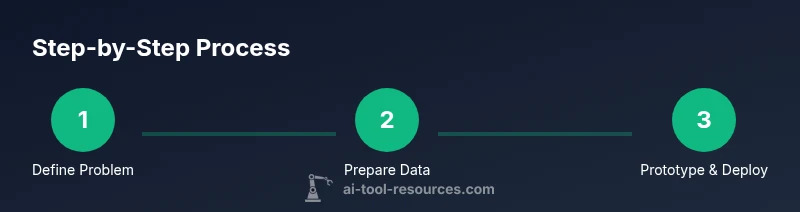
Develop AI Tool: A Practical Step-by-Step Guide
Learn how to develop an AI tool from problem definition to deployment. This comprehensive guide covers data strategy, model selection, experimentation, governance, and MLOps to help developers, researchers, and students build robust AI tools.


According to AI Tool Resources, developing an AI tool starts with a clearly defined problem, followed by data preparation, model selection, and an iterative development cycle. You’ll prototype, evaluate with meaningful metrics, and deploy with monitoring to ensure reliability. This guide outlines a practical workflow that suits developers, researchers, and students working in AI tool development.
Defining the problem and success criteria
The first and most critical step in developing an AI tool is to articulate the problem you want the tool to solve and specify what successful operation looks like. Start with a concrete task description, the stakeholders involved, and the measurable outcomes that will prove value. Translate these outcomes into concrete success criteria, such as accuracy thresholds, latency targets, or user adoption rates. AI Tool Resources emphasizes that a well-scoped problem reduces scope creep and guides every subsequent decision. Create a problem statement that is testable, observable, and reproducible, and align your team around it.
Data strategy for an AI tool
Data quality and governance set the ceiling for performance. Define data sources, labeling standards, privacy considerations, and data versioning plans before you collect. Build a data catalog that records provenance, transformations, and quality metrics. Consider augmentation strategies to fill gaps while avoiding bias or leakage. A robust data strategy includes plans for data deletion, retention periods, and compliance with applicable policies. AI Tool Resources notes that clear data governance accelerates validation and trust among users.
Choosing a model paradigm and baseline
Choose a model approach that matches your problem: supervised learning for labeled prediction, unsupervised or semi-supervised for discovery, or reinforcement learning for sequential decisions. Establish a simple baseline model to set a performance floor and create a learning curve to track improvements. Early baselines keep teams grounded and prevent scope creep into overly ambitious architectures. Document assumptions about inputs, outputs, and failure modes to aid reproducibility.
Designing a robust data pipeline and infrastructure
A clean, scalable data pipeline is essential. Define ingestion, cleansing, feature engineering, and storage steps. Use modular components so you can swap models without reworking the entire stack. Prioritize reproducibility by versioning datasets and features, and implement access controls to protect sensitive information. A well-architected pipeline reduces bottlenecks during experimentation and deployment, enabling faster iteration cycles.
Building a minimal viable prototype (MVP)
The MVP should demonstrate core functionality with the smallest feasible dataset and model complexity. Focus on a single use case that delivers tangible value and a straightforward user interface. Keep the MVP modular so you can add features without reworking the entire system. Record every decision tied to architecture and data choices to support later audits and iteration. An MVP built with a clear scope keeps risk manageable and accelerates learning.
Evaluation metrics, experiments, and ablation studies
Define evaluation metrics that reflect real-world success, not just academic accuracy. Use held-out validation data, cross-validation, and calibration checks where appropriate. Implement an experimentation framework to compare models and features while maintaining reproducibility. Ablation studies help you understand the contribution of each component. AI Tool Resources advises documenting experiment results and hypotheses to build a decision log for future iterations.
MLOps: deployment, monitoring, and governance
Move from prototype to production with an automated training and deployment pipeline. Use version control for code, models, and datasets; track experiments; and implement continuous integration for model updates. Establish monitoring for latency, drift, and failure modes; set up alerting and rollback procedures. Enforce governance policies to ensure compliance, explainability, and user safety. A robust MLOps setup reduces downtime and increases user trust.
Ethical, safety, and regulatory considerations
Ethics cannot be an afterthought. Evaluate bias, fairness, and adverse impact on diverse user groups. Implement privacy protections such as data minimization and anonymization where possible. Stay informed about regulatory requirements relevant to your domain and region. Documenting ethical considerations and mitigation strategies helps build responsible, user-centric AI tools.
Scaling from prototype to product
When ready to scale, refactor for performance, reliability, and maintainability. Consider microservices, containerization, and cloud-native deployment to handle increasing traffic. Plan for horizontal scaling, automated testing, and robust incident response. Your architecture should support feature flagging so you can roll out improvements safely without disrupting users.
Team roles, governance, and collaboration
A successful AI tool project requires clear roles: data engineers, ML engineers, product managers, researchers, and UX designers. Establish collaboration rituals, documentation standards, and decision logs. Regular code reviews and design reviews help keep quality high and knowledge shared. AI Tool Resources highlights that alignment on goals and transparent decision-making are as important as technical skill.
Common pitfalls and how to avoid them
Common traps include scope creep, underestimating data needs, and insufficient evaluation. Avoid these by starting with a well-scoped problem, defining measurable success, and building an iterative feedback loop with users. Plan for data quality issues, model drift, and deployment challenges early, and maintain clear documentation throughout the lifecycle.
Tools & Materials
- Computing environment (GPU-enabled if needed)(Cloud or on-premise; ensure proper isolation for experiments.)
- Data sources and licenses(Curate diverse, representative datasets with permission and documentation.)
- ML framework (e.g., PyTorch, TensorFlow)(Choose based on team proficiency and project needs.)
- Experiment tracking tool(Capture hyperparameters, metrics, and results.)
- Version control system(Git-based workflow for code and configuration.)
- Data labeling and annotation tools(If supervision is used, ensure labeling guidelines are clear.)
- Model registry and deployment tooling(Track model versions and deployment configurations.)
- Privacy and compliance review(Assess data handling, retention, and consent.)
Steps
Estimated time: 6-12 weeks
- 1
Define problem and success criteria
Formulate a precise problem statement and identify the metrics that matter in production. Align stakeholders on what ‘success’ looks like and the minimum viable outcome to demonstrate impact.
Tip: Write a one-sentence success criterion for quick reference during development. - 2
Collect and curate data
Assemble the dataset with representativeness and quality in mind. Document provenance, labeling standards, and consent. Start with a small, validated data subset for the MVP.
Tip: Avoid data leakage by separating training and validation data from the outset. - 3
Choose model approach and baseline
Select a modeling paradigm that fits the task and establish a simple baseline model. This baseline acts as a reference point for all future improvements.
Tip: Document assumptions about inputs, outputs, and failure modes to aid reproducibility. - 4
Build the MVP
Assemble an MVP architecture with modular components. Keep interfaces simple and ensure the MVP demonstrates core value to users.
Tip: Aim for a single, well-scoped use case to accelerate learning. - 5
Set up evaluation framework
Define metrics, create a validation protocol, and plan ablation studies to understand component impact.
Tip: Predefine acceptance criteria to avoid post-hoc tuning. - 6
Establish MLOps foundations
Create a lightweight training pipeline, model registry, and deployment plan. Implement versioning for data and code.
Tip: Automate reproducibility with scripts and configuration files. - 7
Deploy MVP and monitor
Release the MVP to a controlled user group and monitor latency, accuracy, and safety signals. Collect feedback for rapid iteration.
Tip: Set up alerts for degraded performance and drift. - 8
Iterate and improve
Use feedback and new data to refine features, model choices, and UI. Maintain a backlog of enhancements tied to measurable outcomes.
Tip: Prioritize changes that directly improve user value. - 9
Plan for scaling and governance
Design for scale, establish governance policies, and prepare for compliance reviews as the product grows.
Tip: Document decisions about data, models, and responsibilities.
FAQ
What is the first step to develop an AI tool?
Start with a clearly defined problem and success criteria. Gather stakeholder input and translate goals into measurable outcomes that will guide data collection and model development.
Begin with a well-defined problem and goals to guide your data and modeling decisions.
What data do I need and how do I obtain it?
Identify data sources that reflect real-world use, ensure proper consent and licensing, and document provenance. Implement labeling guidelines if supervision is required and plan for data quality monitoring.
Find representative data with clear permissions and guidelines for labeling if you plan to supervise the model.
How do I measure success for an AI tool?
Choose metrics aligned with user value and business goals (e.g., accuracy, latency, user engagement). Use held-out data and, where possible, live user feedback to validate performance.
Use metrics that matter to users and validate with unseen data and real feedback.
What challenges should I expect during development?
Data quality, bias, model drift, and deployment friction are common. Plan for governance, testing, and rollback strategies to manage risk.
Be ready for data issues, drift, and deployment hurdles; have a plan to test and rollback if needed.
What tools or frameworks are commonly used?
Choose frameworks that fit your team's skills and project needs. Popular options include PyTorch, TensorFlow, and open-source MLOps tools for experimentation and deployment.
Pick familiar tools that support your workflow and team strengths.
How do I deploy and monitor in production?
Automate training, packaging, and deployment. Implement monitoring for performance, latency, and data drift, with alerting and a rollback plan.
Automate deployment and monitor performance to catch issues early.
Watch Video
Key Takeaways
- Define a precise problem with measurable success.
- Use a modular MVP to learn fast.
- Establish reproducible data and model pipelines.
- Monitor for drift and safety in production.
- Document decisions to enable governance and scalability.