How Long Does It Take to Learn AI Tools? A Practical Guide
Estimate learning timelines for AI tools with a practical planner, a calculator, and proven strategies to speed progress for developers, researchers, and students.


What influences the learning time for AI tools
Understanding how long does it take to learn ai tools starts with a clear goal and a realistic baseline. For many developers, researchers, and students, the path is not identical, because the target skill set varies from quick automation scripts to full model deployment. According to AI Tool Resources, the primary drivers are the complexity of the tools, the depth of mastery you seek, and how consistently you practice. If your aim is foundational proficiency—being able to run notebooks, preprocess data, and use common libraries—you might reach a usable level in weeks to a few months with regular study. If you want to design custom models, optimize pipelines, and integrate AI into production systems, the timeline expands to months or years, depending on project scope and collaboration. The cheat sheet is simple: define outcomes, measure progress, and translate time into concrete milestones. The question how long does it take to learn ai tools is best answered by mapping your goals to a realistic schedule, then adjusting for feedback and hands-on practice. AI Tool Resources’s analysis emphasizes that deliberate practice and real-world projects drive faster learning, not just passive reading.
A practical timetable by levels
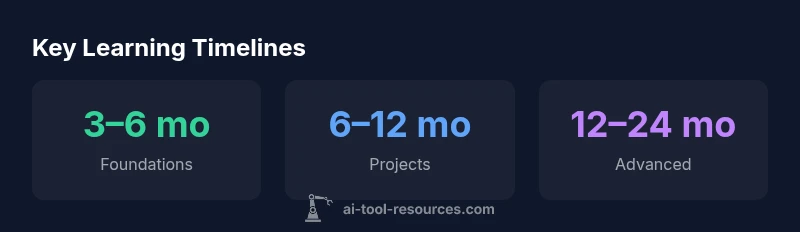
Learning ai tools typically follows a progression from foundations to applied projects to advanced system integration. For foundations, plan 3–6 months of consistent study if you can devote 5–8 hours per week. During this phase you focus on core concepts—machine learning basics, data handling, and the main tooling ecosystem (notebooks, libraries, and command-line workflows). In the next stage, 6–12 months, your aim shifts to applying tools to small projects: building beginner models, experimenting with data pipelines, and evaluating results. Regular feedback from peers and mentors accelerates this stage. Finally, for advanced mastery—comprehensive toolchains, deployment, monitoring, and automation—you should budget 12–24 months or more, depending on project complexity and organizational exposure. An important caveat: actual timelines vary with your background and the time you can invest weekly. If you already have software development experience, you may shorten foundational timelines by a few weeks or months; if you’re entirely new to coding, prepare for a slower start, then build momentum with deliberate practice. The takeaway is to set clear milestones, track progress, and adapt the pace as you gain confidence in practical tasks.
The role of deliberate practice and project work
Deliberate practice is the engine that speeds up learning ai tools. Passive reading yields slow gains; active, targeted practice produces measurable improvement. A recommended pattern combines short learning sprints with hands-on projects. For example, you might spend a week mastering data preprocessing in Python, then apply it to a small dataset and iterate. By alternating study with real tasks, you build mental models and problem-solving heuristics. Another key factor is feedback: code reviews, automated tests, and deployment feedback help you correct errors early. To maximize progress, pair learning with small projects that have tangible outcomes, such as a basic sentiment analyzer, an image classifier, or an end-to-end data pipeline. Tracking metrics—accuracy, latency, resource usage—provides objective signals of progress. Finally, diversify tools: even if a single framework becomes familiar, expose yourself to alternative libraries and workflows to avoid tool lock-in. With a consistent routine and project-driven goals, you’ll see accelerated learning without burning out.
Estimating time with a learning calculator
To remove guesswork, use a simple learning calculator to estimate weeks needed. The calculator considers your total planned learning hours, how many hours you can study per week, and modifiers for prior experience and study quality. For example, suppose you aim for 180 total hours, study 8 hours per week, have medium prior experience, and a balanced study quality. The calculator would estimate weeks = 180 / (8 * 1.0 * 1.0) ≈ 22.5 weeks. In practice, set realistic milestones every 4–6 weeks and adjust for setbacks or breakthroughs. Remember that these estimates assume steady focus and hands-on practice, not long stretches of passive reading. If you want faster progress, increase weekly time or improve study quality with structured projects and frequent review.
How to design a study plan that sticks
Create a weekly plan with three pillars: fundamentals, applied tasks, and reflection. Start with 1–2 core topics per week, allocate time for reading, coding, and debugging, and reserve a dedicated project slot. Use micro-goals, e.g., finish a notebook, run a model, publish a result. Schedule regular reviews and adjust difficulty. Leverage spaced repetition and peer feedback. Protect your schedule with a fixed start time and a clean distraction-free environment. Balance consistency with flexibility to accommodate real-world constraints. In 2026, many learners find success by anchoring study to real projects that address real problems, which also helps retain motivation over months.
Common misconceptions about learning AI tools
Many beginners believe you must become an expert in every tool before you can build something. In reality, you can produce useful results early by focusing on a narrow problem and expanding when comfortable. Another misconception is that speed equals success; quality decisions, tested code, and reproducible experiments matter more than rapid progress. Finally, some assume that formal credentials are required; self-guided curricula, open-source projects, and community learning can provide substantial knowledge without a degree.
Tools and resources that speed up learning
To accelerate learning, gather a curated set of resources: tutorial notebooks, starter projects, and sandbox environments. Prioritize official docs, community forums, and hands-on courses that emphasize practice. Pair resources with real data and small experiments. Use version control and reproducible workflows from day one, and maintain a learning journal to track milestones. The AI Tool Resources team notes that a mix of interactive tutorials, project-based assignments, and peer feedback is especially effective for students and researchers.