Best Way for Professionals to Evaluate New AI Tools
A practitioner-focused guide to evaluating AI tools with a rigorous, repeatable framework: use cases, benchmarks, governance, pilots, and rollout planning—backed by AI Tool Resources’ insights.


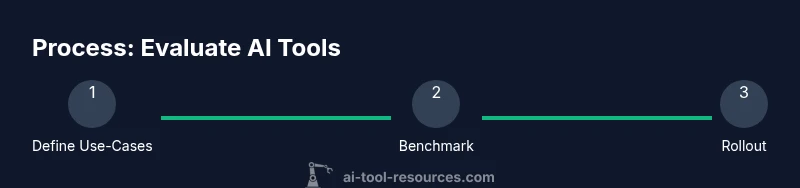
Professionals evaluate new AI tools using a structured, multi-phase process that covers needs, data quality, performance, governance, and risk. Start with clear use cases, define success metrics, and verify with real-world pilots. According to AI Tool Resources, a formal evaluation—covering benchmarks, reproducibility checks, and stakeholder reviews—reduces bias and improves tool selection.
Why a structured evaluation matters for professionals
Evaluating AI tools in professional settings requires more than a flashy demo or a single success story. Organizations face risk from data leakage, biased outputs, compliance failures, and integration blind spots that can derail projects and waste budgets. A structured evaluation helps teams align with enterprise goals, regulatory requirements, and user needs. According to AI Tool Resources, the best evaluations start with a clear statement of the problem, a defined decision rubric, and a plan to validate results in realistic contexts. Without this discipline, teams chase performance metrics in isolation and miss how a tool behaves across data regimes, users, and governance constraints. By formalizing criteria such as data readiness, reproducibility, explainability, and operational impact, professionals can compare tools on an apples-to-apples basis. The result is a defensible, auditable decision that scales beyond a single pilot to a repeatable, governance-friendly procurement process. In a landscape where AI deployments touch sensitive data and regulatory boundaries, the value of a rigorous approach cannot be overstated.
Step 1: Define use cases and success criteria
To start, document 2-4 tangible use cases that reflect real workflows you expect the tool to support. Create a cross-functional team from product, data science, security, and operations. For each use case, define measurable success criteria—accuracy targets, latency bounds, reliability under load, and data privacy requirements. Translate these into a common scoring rubric so every tool can be evaluated on the same footing. Include constraints such as budget caps, compliance mandates, and integration prerequisites. Be explicit about what constitutes a pass versus a fail in each criterion. Transparency at this stage prevents later disagreements and ensures the evaluation addresses the most important business outcomes.
Step 2: Build a neutral evaluation framework
Design a framework that minimizes vendor bias and supports repeatable testing. Pre-register hypotheses and define controlled comparison conditions, such as identical datasets, identical tasks, and blinded assessments where feasible. Establish a tiered scoring scheme (e.g., 0–5) for each criterion, with clear thresholds for go/no-go decisions. Decide who conducts the tests, who reviews results, and how disagreements will be resolved. Document the framework so future evaluations can reuse it with new tools, maintaining consistency across procurement cycles.
Step 3: Assess data quality and readiness
Data quality is often the bottleneck in AI deployments. Audit sources for representativeness, privacy, and governance. Verify data cleanliness, labeling accuracy, and absence of sensitive information in training sets. Assess data lineage and version control so you can reproduce results and explain decisions. If data quality is uncertain, plan data augmentation or synthetic data strategies, and document any limitations that could affect generalization. A robust data plan reduces downstream surprises during pilots and production.
Step 4: Benchmark performance and reliability
Quantify tool performance against defined use cases using robust benchmarks. Track accuracy, precision/recall, latency, and throughput, and report confidence intervals to interpret variability. Run tests across diverse data slices (e.g., edge cases, noisy data, outliers) to evaluate robustness. Examine failure modes—whether errors are due to input quality, model limitations, or integration gaps. Include reproducibility checks by rerunning tests and comparing results across independent teams. A well-documented benchmark enhances trust and enables apples-to-apples comparisons.
Step 5: Evaluate governance, compliance, and ethics
Governance considerations matter as much as performance. Check for model cards, risk assessments, and audit trails that explain how the model makes decisions. Verify privacy controls, data handling practices, and compliance with applicable regulations (e.g., data residency, consent, consent management). Assess bias and fairness, ensuring testing covers protected groups and edge cases. Document safety measures such as content filtering, fallback behaviors, and escalation paths for problematic outputs. A tool that fails governance checks is unlikely to scale safely in production.
Step 6: Run controlled pilots with stakeholders
Pilot the tools in controlled environments that resemble production workflows. Limit exposure to real users where possible and collect qualitative feedback from diverse stakeholders. Track defined KPIs in a live setting to observe performance under real workloads. Use feature flags and staged rollout plans to minimize risk. Schedule routine debriefs to capture lessons learned and iterate on the evaluation criteria as needed. Pilots are essential to uncover practical issues that aren’t evident in isolated tests.
Step 7: Analyze total cost of ownership and ROI
Evaluate not just the license or subscription cost but total cost of ownership. Include data processing costs, integration effort, training, maintenance, and potential downtime. Compare projected ROI against a baseline scenario and compute payback periods. Consider long-term implications such as vendor roadmaps, support quality, and the costs of switching tools later. A transparent TCO model helps leadership assess financial viability and strategic fit.
Step 8: Plan rollout, monitoring, and decommissioning
If a tool passes the evaluation, design a scalable rollout plan. Define monitoring metrics, alert thresholds, and responsible owners. Prepare a rollback plan and sunset criteria for decommissioning underperforming components. Document governance, data handling, and security setup for the production environment. Establish ongoing validation checks to detect drift or regression and to ensure continued alignment with use cases.
Documentation and artifacts you should capture
Maintain a centralized repository of artifacts from each stage: use-case definitions, evaluation framework, data quality reports, benchmark results, governance and risk assessments, pilot results, savings estimates, and the final decision rationale. Include meeting notes, decision memos, and revised requirements as the project evolves. This documentation supports audits, onboarding, and future evaluations, and provides a repeatable blueprint for new AI tool assessments.
Tools & Materials
- Evaluation checklist template(A standardized rubric with scoring levels for each criterion)
- Sample test data (synthetic or de-identified)(Ensure no PII; includes representative edge cases)
- Benchmark suites or tasks(Representative tasks across use cases)
- Pilot environment with integration hooks(Sandbox or staging environment)
- Data provenance and governance documents(Data lineage, privacy impact assessments)
- Collaboration and issue-tracking tool(For collecting feedback)
- Security and compliance checklists(SOC 2, privacy controls, regulatory mappings)
- Cost estimation spreadsheet(TCO modeling and scenario planning)
Steps
Estimated time: 3-5 weeks
- 1
Define goals and success criteria
Identify the business problem, expected outcomes, and constraints. Create 2-4 measurable success criteria tied to the use cases. This anchors every later evaluation decision.
Tip: Get cross-functional buy-in early to avoid scope creep. - 2
Assemble the evaluation team and plan
Form a diverse panel (data science, product, security, operations, legal). Develop a testing calendar, data access plan, and conflict-of-interest controls.
Tip: Assign a neutral facilitator to keep tests objective. - 3
Prepare data and environments
Collect or synthesize test data that mirrors production. Set up sandbox environments with versioned configurations to ensure reproducibility.
Tip: Document data sources and labeling protocols for traceability. - 4
Select metrics and benchmarks
Choose objective metrics aligned with use cases (accuracy, latency, failure rate, fairness). Pre-register hypotheses and thresholds.
Tip: Use multiple metrics to avoid optimizing a single blind spot. - 5
Run controlled experiments
Execute tests under identical conditions across tools. Capture results in a shared, auditable ledger.
Tip: Blinding testers to tool identity reduces bias. - 6
Assess governance and risk
Review model cards, data provenance, privacy controls, and security posture. Validate compliance with regulations.
Tip: Document any risk mitigation strategies and residual risks. - 7
Pilot with stakeholders
Implement a limited production pilot to observe real-world performance and gather user feedback.
Tip: Use feature flags to control exposure and gather iterative input. - 8
Analyze costs and ROI
Estimate TCO and compare against baseline. Assess long-term value, maintenance needs, and potential savings.
Tip: Create multiple scenarios (best/west-case) to capture uncertainty. - 9
Plan rollout and monitor decommissioning
Develop a rollout plan with monitoring, alerts, and a sunset path for underperforming tools.
Tip: Define clear go/no-go criteria for production adoption.
FAQ
What is the first step in evaluating a new AI tool?
Define the problem and use cases. Establish success criteria that are measurable and aligned with business goals before testing tools.
Start by defining the problem and measurable success criteria to guide testing.
How should data quality be evaluated during the assessment?
Audit data sources for representativeness and privacy. Ensure data lineage is traceable and that data used for testing mirrors production as closely as possible.
Check data sources for representativeness and privacy, and track data lineage.
What governance aspects are essential?
Model cards, risk assessments, audit trails, and privacy/compliance controls must be in place. Validate that outputs can be explained and traced.
Ensure governance tools and audits exist to explain decisions.
How long should a pilot run before a go/no-go decision?
Pilot duration depends on use case complexity, but allow enough time to observe stability across varied data and workloads.
Give the pilot enough time to reveal stability across data and workload changes.
Is cost a major factor in evaluation?
Yes. Include total cost of ownership, maintenance, and potential integration costs when comparing tools.
Cost of ownership matters just as much as performance.
What documentation should accompany the decision?
Maintain a decision memo with criteria, results, gaps, and rationale to support audits and future evaluations.
Keep a detailed decision memo for audits and future references.
Watch Video
Key Takeaways
- Define concrete use cases and measurable success criteria.
- Use a neutral framework to enable apples-to-apples comparisons.
- Assess data quality and governance as core inputs.
- Pilot with stakeholders before production rollout.