Average Cost of AI Tools: A Practical Guide for Builders
This guide analyzes the average cost of AI tools, exploring pricing models, hidden fees, and budgeting tips. According to AI Tool Resources, costs vary by use case and provider, making total cost of ownership essential for developers, researchers, and students.


Definition: There is no single universal average price for AI tools. Costs vary widely by tool type, usage tier, and vendor. According to AI Tool Resources, the total cost depends on licensing, data needs, and support. This quick answer outlines pricing fundamentals to help you budget for development, research, and production contexts.
What influences the cost of AI tools
Costs are driven by licensing terms, usage volume, data requirements, deployment method (on-premises vs cloud), support levels, and integration needs. In practice, teams pay for access rights, compute, and data storage, plus potential training and governance features. According to AI Tool Resources, understanding these levers is essential before selecting a tool. This section outlines the major cost drivers with concrete examples spanning research, development, and production contexts.
- Licensing terms and renewal cycles
- Usage depth: per-call vs per-user vs per-project
- Data storage, transfer, and ingestion costs
- Compute for training, inference, and retraining
- Support, training, and professional services
By mapping your technical requirements to these levers, you can forecast a more accurate total cost of ownership and avoid surprises down the line.
Pricing models commonly used
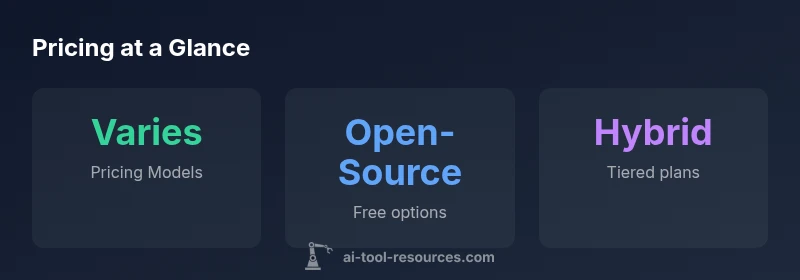
Most tools fall into several pricing families: open-source with optional paid support; SaaS subscriptions with tiered features; API or usage-based pricing; and enterprise licenses with custom terms. Each model changes the total cost of ownership in predictable ways. For researchers and developers, the key is to map needs to a model that scales with usage and provides predictable budgeting. AI Tool Resources notes that vendor transparency matters for long-term planning.
- Open-source: no license fee, but may incur hosting and maintenance costs
- SaaS subscriptions: recurring fees with feature tiers
- APIs: pricing based on usage, data, and requests
- Enterprise licenses: custom terms, negotiations, and SLAs
Selecting a model requires aligning price with value, risk tolerance, and long-term goals.
Cost considerations by tool category
Different AI domains carry different value propositions and price points. Natural language processing tools may emphasize per-1000 characters or per-seat licensing, while computer vision stacks often hinge on dataset size and inference frequency. Data analytics and MLOps platforms add costs for storage, pipeline runs, and model hosting. When evaluating categories, prioritize features that unlock value at scale—translation latency, accuracy targets, or automated retraining capabilities.
- NLP tools: cost drivers include token usage, model size, and latency requirements
- Vision AI: costs tied to image/video data volumes and inference rate
- Data analytics: pricing influenced by data throughput and storage retention
- MLOps: ongoing pipeline executions, monitoring, and governance
Understanding category-specific drivers helps you forecast budgets more accurately and negotiate better terms.
Total cost of ownership: not just license fees
License price is only the tip of the iceberg. Compute for model training, inference, and data transfer dominates many budgets. Storage for datasets, backup, and archival adds recurring costs; security, compliance, and access controls add both time and money. Monitoring, observability, and incident response require tooling and personnel. A full TCO view helps teams avoid sticker shock down the road.
- Training and retraining compute hours
- Inference costs across user demand
- Data storage and transfer between systems
- Security, governance, and compliance tooling
- Support contracts and professional services
A thoughtful TCO analysis reveals where to optimize and where spending is justified.
Open-source vs commercial: trade-offs
Open-source tools often start with zero licensing cost but can incur substantial indirect costs: setup, maintenance, and patching. Commercial offerings provide vendor-backed support, SLAs, and faster time-to-value, but come with recurring fees. For student projects or proofs-of-concept, open-source can accelerate learning; for production-grade deployments, commercial options may reduce risk and time-to-market. AI Tool Resources consistently emphasizes balancing cost against reliability and governance.
- Open-source: flexibility and no license fees, but more DIY
- Commercial: support, reliability, and faster onboarding
- Decision hinge: ROI, governance needs, and in-house expertise
Balancing these factors is critical for sustainable AI tool adoption.
Budgeting for education and research use cases
Researchers and students frequently seek affordable paths to AI experimentation. Free tiers, community editions, and campus licenses can reduce upfront costs. When budgets are tight, design lightweight pilots with clear success metrics, then scale only when results justify investment. Preserve flexibility by preferring tools that offer both free access and paid upgrades as needs grow. The objective is learning and reproducibility, not overspending.
- Leverage campus or grant-based licenses where possible
- Begin with small pilots to validate feasibility
- Document outcomes to justify future funding
- Prioritize tools with clear upgrade paths
Education-focused pricing often emphasizes accessibility and reproducibility.
Budgeting strategies for teams
Begin with a needs assessment: list core use cases, expected query volume, and required SLAs. Create pilot projects with time-bound reviews and track metrics such as time saved, accuracy improvements, and deployment speed. Compare total costs across vendors, including onboarding, training, and potential professional services. Negotiate enterprise terms and seek academic or startup discounts where applicable, a tactic AI Tool Resources recommends for stretch budgets.
- Draft a requirements sheet with expected workloads
- Run controlled pilots to compare outcomes
- Request itemized quotes and total cost breakdowns
- Explore discounts for education, research, or startup status
- Build a business case with ROI-focused metrics
Common pricing models and notes for AI tool categories
| Tool Category | Typical Pricing Model | Notes |
|---|---|---|
| Open-source / Community tools | Free or donation-based | Often requires self-hosting and in-house maintenance |
| SaaS platforms | Subscription-based | Tiered features; recurring costs |
| APIs & SDKs | Usage-based | Costs scale with requests and data |
FAQ
What is the most common pricing model for AI tools?
Most tools use a mix of pricing models, typically either subscriptions, usage-based API pricing, or open-source with paid support. The right choice depends on your use case, scale, and required SLAs.
Most tools use subscriptions, usage-based APIs, or open-source with paid support.
Do open-source AI tools incur total costs beyond license fees?
Yes. You may pay for hosting, maintenance, support, and data egress. A thorough TCO analysis helps avoid surprises.
Yes—there are hidden costs in hosting, maintenance, and data.
How should a research group budget for AI tools?
Budget with pilot programs, use free tiers where possible, and plan for scaling with successful milestones. Seek academic discounts and grants.
Start with pilots, use free tiers, and look for academic discounts.
What hidden costs should I watch for?
Consider data transfer, storage, retraining, security, and compliance. Sometimes support and onboarding fees are charged separately.
Watch for data storage, transfer, retraining, and onboarding fees.
Is API pricing different from per-seat licensing?
Yes. API pricing scales with usage, while per-seat licenses price a fixed number of users. Some vendors offer hybrid options.
APIs scale with usage; seat licenses cover users.
Are price trends different for education vs enterprise use?
Education discounts exist; enterprise plans focus on reliability and scale. Terms differ and impact total costs.
Education discounts exist; enterprise plans focus on reliability and scale.
“Pricing should be evaluated alongside performance and governance. The AI Tool Resources Team emphasizes aligning pricing with ROI and clear success metrics.”
Key Takeaways
- Define use cases to cap initial spend.
- Prioritize total cost of ownership over sticker price.
- Consider open-source options to reduce upfront costs.
- Run pilots to validate ROI before scaling.
- Negotiate education and research discounts with vendors.