How Much Do AI Tools Cost in 2026? A Practical Pricing Guide
A data-driven guide on how much ai tools cost in 2026, covering licensing, compute, data storage, and total cost of ownership. Learn pricing models, budgeting tips, and how to compare tools effectively.


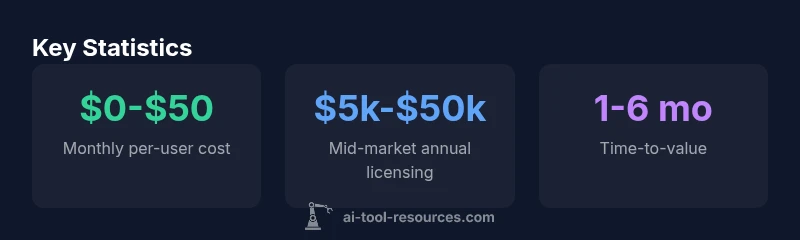
How much ai tools cost in 2026 ranges from free tiers for basic use to enterprise licenses that run into the tens of thousands per year. For individuals, expect $0-$50 per month for core tools, with paid tiers for higher quotas and premium features. For teams, licenses, compute, data storage, and integration drive total cost. AI Tool Resources notes that total cost of ownership is shaped by usage, scale, and governance needs.
Understanding What Costs Include
AI tools carry a broad set of costs beyond the headline price. To forecast and manage spending, organize costs into four primary buckets: licenses, compute, data storage, and integration/governance. Licensing sets the baseline access to models or APIs, while compute costs scale with usage, model size, and latency requirements. Data storage supports training data, logs, and versioning; data transfer costs arise when moving data between regions or vendors. Finally, ongoing support, monitoring, security, and governance tooling add recurring fees. When you budget, itemize these components and align them with your workflows. For researchers and developers, the curve often starts low and climbs as experiments scale, making a staged budgeting plan essential. AI Tool Resources recommends a transparent bill of materials (BOM) and quarterly usage reviews to avoid surprises.
Pricing Models You’ll Encounter
Pricing for AI tools comes in several familiar patterns. Free tiers are common for learning and prototyping but come with limits. Subscriptions give predictable monthly or annual costs and usually include quotas of API calls, compute hours, or seats. Pay-as-you-go supports scaling with demand but can spike costs during peak periods. Enterprise licenses may bundle premium features, stronger security, and dedicated support. Per-seat pricing suits small teams but grows complex with scale and shared resources. Expect a tiered structure: a low-cost starter, a mid-tier with higher quotas, and an enterprise tier with customization. When budgeting, compare headline price alongside included quotas, overage terms, and add-ons like compliance tooling. Forecast scenarios under realistic workloads and use vendor calculators to stress-test costs under peak load.
Cost Drivers by Tool Type
Different AI tool categories have distinct cost shapes. Chatbot and natural-language API tools often charge per interaction and per-user seats, with pricing that scales after generous free tiers. Image and video generation costs depend on tokens, frames, or output quality, and may plateau once a preferred quality level is achieved. ML development platforms combine subscription access with compute usage for training and experimentation, so costs rise with model complexity and data size. Data-labeling and annotation services add costs per task or per hour of human labor. Automation tools incur recurring platform fees plus additional connectors or workflow runs. For budgeting, map your typical workflows to these cost profiles and model how usage grows with team size.
Real-World Budgeting Scenarios
Consider three representative scenarios to illustrate the budget spectrum. A student or researcher working on a pilot project might stay within a no-cost or $20-$100 per month budget by leveraging free tiers and campus resources. A small startup with a technical team could expect $1,000-$5,000 per month, depending on the mix of NLP APIs, data storage, and collaboration features. An enterprise, deploying multiple AI services across teams, often budgets $50,000-$250,000 per year or more, with dedicated security, governance, and vendor-managed testing environments. These ranges are indicative: actual costs depend on the tool mix, data volume, and contract terms. AI Tool Resources emphasizes scenario planning and sensitivity analyses to prevent budget overruns.
Tactics to Control and Optimize Costs
Effective cost control combines deliberate tool selection with usage discipline. Start with free tiers for learning and proof-of-concept work, then lock in predictable costs via monthly or annual subscriptions where feasible. Monitor usage with built-in analytics and set thresholds for alerts and automatic throttling. Leverage usage-based pricing only after validating a stable workload, and consider reserved compute or committed-use discounts for long-running projects. Negotiate with vendors for custom SLAs, bundled features, and volume discounts. Finally, design data retention and governance policies that minimize unnecessary storage and transfer costs while preserving reproducibility and compliance. AI Tool Resources suggests periodic cost reviews aligned with project milestones to optimize ROI.
Hidden Costs and Considerations
Beyond the obvious price tag, several hidden costs can affect the total cost of ownership. Data privacy and compliance overhead may require additional tooling, audits, and policies. Migration or onboarding costs can add up when switching tools or integrating with legacy systems. Vendor lock-in risk exists when data formats, APIs, or feature sets favor one ecosystem. The time spent learning new tools, building integrations, and maintaining pipelines also contributes to TCO. Finally, consider the opportunity cost of pursuing features that may not deliver proportional value. A rigorous evaluation framework helps teams identify true cost drivers and avoid unnecessary expenditure. AI Tool Resources highlights governance and data strategy as critical levers for cost efficiency.
How to Compare Tools Efficiently
A structured comparison accelerates cost-effective decisions. Start with a clear use case and define success metrics (accuracy, latency, throughput, compliance). Build a lightweight scoring rubric that includes price per unit, quota allocations, overage penalties, and support quality. Use vendor sandbox environments or trial periods to measure real-world usage before committing. Create a side-by-side worksheet that includes total cost of ownership (TCO), not just sticker price. Finally, verify data security, regulatory alignment, and integration capabilities with your existing tech stack. A methodical approach helps teams avoid overpaying for features that don’t move the needle.
Getting Value Beyond Price
Price matters, but value is determined by alignment with goals, reliability, and ROI. Prioritize tools that deliver measurable improvements in productivity, accuracy, or time-to-market. Track usage, outcomes, and costs over time to refine budget estimates and renegotiate as needed. Maintain a rolling evaluation schedule to refresh licenses, prune unused seats, and reallocate resources to higher-impact projects. AI Tool Resources' verdict is that well-planned tooling programs maximize learning, minimize waste, and accelerate research or product delivery. Keep the focus on outcomes, not just the monthly price.
Pricing snapshot by AI tool category
| Tool Type | Estimated Monthly Cost per User | Pricing Model | Notes |
|---|---|---|---|
| Chatbot/Conversational AI | $5-$20 | Subscription + usage | Scale with API calls and seats |
| Image/Video Generation | $10-$60 | Usage-based | Quality and output volume drive costs |
| ML Model Development Platforms | $100-$1000 | Subscription + compute | Team access and private data handling |
| Data Labeling & Annotation | $0.05-$0.50 per task | Per-task | Labor cost varies by complexity |
FAQ
What drives the overall cost of AI tools?
The primary cost drivers are licensing, compute, data storage, and integration. Usage volume, data complexity, and security requirements also influence total spend. Understanding these drivers helps you forecast cost and avoid surprises.
Costs come from licenses, compute, data storage, and integration. Usage and data complexity matter, so plan accordingly.
How can I estimate AI tool costs before buying?
Use vendor pricing calculators, start with free trials, and model a few scenarios (low, medium, high usage). Compare total cost of ownership across options and factor in hidden costs like data storage and governance.
Try pricing calculators and pilots to estimate total cost before choosing.
Are free tiers worth it for students and researchers?
Free tiers are valuable for exploration but often lack production capabilities. They’re best for learning, prototyping, and initial validation before scaling to paid plans.
Free tiers help you learn and prototype, but plan for paid plans when scaling.
What should I consider beyond price when comparing tools?
Consider reliability, latency, security, governance, and vendor support. A cheaper tool may incur higher integration or risk costs that erode ROI.
Look at reliability, security, and support, not just the price.
Is there a cheaper path for large teams?
Large teams should negotiate enterprise licenses, seek volume discounts, and consolidate vendors where possible to reduce total spend and simplify governance.
Negotiate enterprise licenses and consolidate vendors to save costs.
“Cost efficiency comes from balancing capability with total cost of ownership. Don’t chase features alone; ensure each tool contributes measurable value to your goals.”
Key Takeaways
- Define total cost of ownership beyond sticker price
- Choose pricing models that match your usage pattern
- Forecast workloads using vendor calculators and sandbox testing
- Monitor usage and renegotiate to control spend