How to Protect Yourself from AI: A Practical Guide
A comprehensive, step-by-step guide to safeguarding privacy, security, and agency as AI tools become more prevalent in everyday work and study.


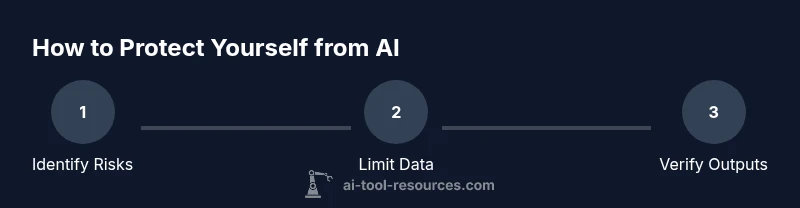
To protect yourself from AI, implement a layered approach combining privacy controls, strong authentication, data minimization, and informed tool usage. Regularly review permissions, verify AI-generated content, and stay educated about evolving threats. This 6-step plan helps individuals reduce risk while engaging with AI in daily work and learning.
What protecting yourself from AI means in practice
Protecting yourself from AI starts with recognizing where AI intersects with your daily digital life: email, social platforms, search, cloud services, and developer tools. When you ask how to protect yourself from ai, you’re really asking how to reduce exposure to data leakage, manipulated content, and automated threats. According to AI Tool Resources, a pragmatic approach combines privacy-conscious defaults with active risk monitoring. This means not only switching on protections but also cultivating a critical mindset about AI outputs and data sharing. The goal is to maintain control over your information while continuing to benefit from AI-enabled tools in education and development.
In practical terms, you’ll focus on reducing data exposure, tightening access controls, and validating AI interactions before trust is extended. These steps help you stay resilient as AI systems become more capable and more embedded in everyday tasks.
Building a personal AI threat model
Before you can protect yourself effectively, you need a personalized threat model that reflects how you use AI systems. Start by identifying key risks: data leakage from chats, impersonation through AI-generated content, and overreliance on automated conclusions. For developers and researchers, add project-specific risks such as leaking confidential code or model prompts. A clear model helps you decide which protections to deploy first and where to invest time. Regularly reassess your threat illustration as tools evolve and new attack vectors appear.
Define three scenarios: casual personal use, educational work, and professional research. For each, map data flows (what data you share, where it travels, and who can access it) and assign a risk level. This structured thinking makes it easier to justify each protective measure and to communicate your approach to teammates or instructors.
Minimizing data leakage: what to control
Data minimization is the strongest guardrail against AI-enabled threats. Limit what you feed into AI systems, especially sensitive personal data, identifiers, or proprietary material. Use local processing where possible and avoid copy-pasting confidential information into chat interfaces. Review privacy policies and adjust permissions in every app or service you use. If a tool requests access to contacts, microphone, or location data, weigh the benefit against the risk and opt out when feasible. Periodically audit your data footprint across platforms and revoke unused permissions.
Remember: the less you reveal, the smaller the attack surface. This principle is especially important for students sharing work samples or researchers handling experimental data.
Strengthening authentication and device security
Strong authentication is a foundational shield against AI-driven compromise. Enable multi-factor authentication (MFA) on all accounts that support it, and prefer hardware keys for highly sensitive services. Use a reputable password manager to generate and store unique credentials for every tool. Keep devices up to date with the latest security patches, enable full-disk encryption, and install reputable anti-malware software. Regularly review login sessions and device access lists, logging out from devices you no longer own or use.
Taking control of access helps prevent attackers from abusing AI-enabled services to exfiltrate data or impersonate you.
Safe AI usage: consent, boundaries, and verification
Not every AI tool is equally trustworthy. Before you enable or rely on a new AI service, read the privacy policy and terms of use. Check what data is collected, how it’s stored, and whether third parties can access it. Set explicit boundaries for what you input—do not share sensitive data unless you know how it will be used. Treat AI outputs as probabilistic recommendations that require human verification, especially in critical contexts like grading, research, or financial decisions. Maintain skepticism about instant conclusions and cross-check with trusted sources.
Adopt a habit of testing AI outputs against known facts and, when possible, using cross-validation with other tools.
Guarding against AI-driven scams and misinformation
AI can generate convincing phishing messages, fake invoices, or realistic deepfakes. To protect yourself, verify claims with independent sources before acting on advice or transfers. Hover for details on links, check sender metadata, and disable automatic execution of attachments from unknown sources. When in doubt, pause and consult a colleague or supervisor before taking action. Train yourself to spot red flags such as unusual requests, urgent language, or mismatched branding. Education and routine practice are your best defenses against AI-enabled manipulation.
If you suspect a scam, report it to your institution or platform and preserve evidence for verification.
Safeguarding your creative work and code
Developers and students often generate code or content with AI assistants. Protect intellectual property by maintaining version control, adding explicit licenses, and not relying on AI as a sole authority for critical decisions. Avoid sharing proprietary algorithms or sensitive prompts with public AI tools. Keep backups of your work in secure environments and use private repositories for collaboration. Regularly review outputs for correctness and ensure compliance with licensing terms for any AI-generated material you publish or submit.
Staying informed: building a safety-first routine
A proactive safety routine includes ongoing education about AI capabilities and risks. Subscribe to credible AI safety resources, participate in campus or team training, and review privacy settings monthly. Maintain a personal incident playbook that outlines steps to take if you suspect data exposure, misuse of AI, or content manipulation. This habit reduces reaction time and helps you recover quickly from an incident. Remember that safety is a continuous process, not a one-time configuration.
Incident response: what to do if you’re compromised
If you believe you’ve suffered data leakage, an impersonation incident, or misuse of an AI tool, act quickly. Revoke compromised credentials, notify your IT or security team, and document what happened. Change passwords, enable MFA on affected accounts, and review recent activity. If sensitive data was exposed, follow organizational policies for reporting and data breach notifications. Early containment minimizes damage and speeds recovery.
Ethical and legal considerations
Engaging with AI responsibly includes respecting others’ privacy, avoiding harm, and complying with applicable laws and institutional policies. Be mindful of how AI-generated content could affect classmates, colleagues, or research subjects. When in doubt, consult your institution’s ethics guidelines or a supervisor. Proactive ethics reduce risk and preserve trust in AI-enabled work and study.
Tools & Materials
- Password manager(Choose a reputable manager; enable emergency access if available)
- Two-factor authentication app or hardware key(Use authenticator app or security key for critical accounts)
- Updated operating system and apps(Enable automatic updates where possible)
- Security software (antivirus/anti-malware)(Keep definitions current and run periodic scans)
- Privacy-focused browser profile and extensions(Limit trackers and block suspicious scripts)
- Backup solution (encrypted)(Regularly back up data offline or in trusted cloud)
- VPN for sensitive sessions(Use on public networks or when handling private data)
Steps
Estimated time: 45-60 minutes
- 1
Identify your risk model
Map out where you interact with AI and what data you share. Identify high-risk use cases and decide which protections to prioritize.
Tip: Document data flows for at least three common tools you use. - 2
Limit data you share with AI
Reduce the amount of sensitive or identifying data you input into AI services. Prefer local processing for sensitive tasks.
Tip: Use data-minimizing prompts and avoid copy-pasting confidential text. - 3
Enable strong authentication
Turn on MFA on all supported accounts and use a password manager for unique credentials.
Tip: Consider hardware keys for the most sensitive services. - 4
Review permissions and privacy controls
Audit app permissions and revoke those that aren’t necessary for function or that reveal sensitive details.
Tip: Disable automatic data sharing where possible. - 5
Vet new AI tools before use
Read privacy policies, terms, and the tool’s data handling practices before enabling it.
Tip: Test with non-sensitive data first to gauge behavior. - 6
Verify AI content and outputs
Treat AI-generated content as probabilistic; cross-check important claims with trusted sources.
Tip: Maintain a checklist for source verification. - 7
Protect your creative and code assets
Keep backups and use licenses to clarify ownership and reuse rights for AI-generated material.
Tip: Use private repositories for collaborative AI-assisted work. - 8
Prepare for incidents
Have a playbook: containment, notification, and recovery steps ready.
Tip: Practice the steps with a tabletop exercise annually.
FAQ
What does protecting yourself from AI involve for individuals?
Protection involves privacy, security, and critical thinking when interacting with AI. It means minimizing data exposure, verifying outputs, and using strong authentication to reduce risk from AI-enabled threats.
Protection means privacy, security, and thinking critically about AI. Minimize data sharing, verify outputs, and use strong authentication.
How can AI threaten my privacy?
AI can aggregate and infer sensitive details from data you share across platforms. It can profile behavior, predict preferences, and potentially misuse data if protections aren’t in place.
AI can infer sensitive details from data you share, so strong privacy controls are essential.
Should I avoid AI tools entirely?
Avoidance isn’t practical for most learners and developers. instead, deploy risk-aware practices: data minimization, verified sources, and robust authentication to stay safe while leveraging AI advantages.
You don’t have to avoid AI; use safeguards to stay safe while still benefiting from it.
How can I spot AI-generated misinformation?
Look for inconsistencies, verify with multiple credible sources, check metadata, and beware of sensational language. Use fact-checking workflows before sharing or acting on AI content.
Check facts with trusted sources and verify metadata before sharing AI content.
What should developers do to improve safety with AI?
Design privacy-first features, document data flows, implement access controls, and maintain clear licensing for AI-assisted outputs. Regular security reviews and user education are essential.
Developers should prioritize privacy, document data flows, and implement solid access controls.
Where can I learn more about AI safety practices?
Consult university courses, reputable industry publications, and official privacy guidance from institutions. Ongoing education helps keep up with evolving AI threats and protections.
Seek education from credible courses and institutions to stay current on AI safety.
Watch Video
Key Takeaways
- Adopt a layered defense approach against AI threats
- Minimize sensitive data exposure and practice data hygiene
- Use strong authentication and device security
- Verify AI outputs before acting on them
- Maintain an incident plan and ongoing AI literacy