How to Secure AI: A Practical Guide for Developers
Practical, step-by-step guidance for securing AI systems—covering data protection, model integrity, deployment defenses, and governance.


This guide shows how to secure AI systems across data, models, and deployment. You will learn a practical, step-by-step framework to reduce risk, from threat modeling to governance and incident response. Key requirements include a formal policy, robust access controls, secure development practices, and ongoing audits. By the end you'll have a repeatable security checklist for AI projects.
Why AI Security Matters
AI systems unlock powerful capabilities, but with capability comes risk when security isn’t integrated from the start. For developers, researchers, and educators, the question is no longer whether to secure AI but how to secure it effectively at scale. According to AI Tool Resources, securing AI starts with a policy-driven baseline and clear ownership across data, models, and deployment stages. In practice, security is not a single control; it’s a framework that spans every phase of an AI project. When teams embed security-minded practices from the beginning, they reduce risk from data leakage, model theft, manipulated outputs, and deployment failures.
Security in AI isn’t only about fending off external attacks. It’s also about ensuring the system behaves safely and predictably in real-world conditions. This means defining who can access what, how data is stored and transformed, how models are trained and updated, and how responses are governed. A mature approach blends governance with technical controls, enabling traceability, accountability, and rapid response when issues arise. For organizations adopting AI toolchains, security-by-design creates a resilient foundation that supports compliance and preserves user trust. In this guide you’ll learn concrete steps, practical tools, and common-sense mindsets to secure AI at scale, with examples drawn from real-world deployments.
Threat Landscape for AI Systems
The threat landscape for AI spans data, models, and operational environments. Data poisoning during training can tilt outcomes, while training data leakage can reveal sensitive information. Inference-time attacks aim to extract training data or manipulate outputs through adversarial inputs. Model inversion and membership inference threaten privacy by reconstructing sensitive information from the model. Supply chain risks, including compromised datasets or third-party components, can undermine entire systems.
Configuration errors—default passwords, weak secrets, misconfigured access controls—are among the most common causes of incidents in AI deployments. Drift, where data distributions shift over time, can degrade model performance and mask security gaps. Access control weaknesses enable insider threats and lateral movement in cloud environments. The goal is not to eliminate all risk but to reduce it to a manageable level through layered defenses, robust monitoring, and clear ownership.
A Practical Security Framework for AI
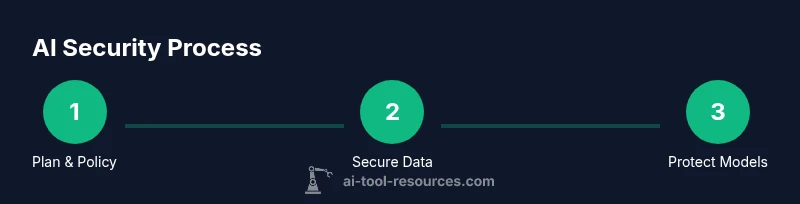
A practical framework organizes defenses into three layers: data, model, and deployment. Each layer has guardrails and checks that feed into governance. Core elements include threat modeling at system design time, secure development practices, and continuous risk assessment. A security-by-design mindset means you treat data provenance, model provenance, and pipeline integrity as first-class concerns.
- Data layer: encryption at rest and in transit, strict access controls, minimal data collection, anonymization where feasible, and data lineage tracking.
- Model layer: secure training pipelines, versioned weights, provenance documentation, robust evaluation to detect adversarial risk and data drift, and protections against model extraction.
- Deployment layer: isolated environments, robust monitoring, tamper-evident logging, and incident response readiness. The framework must be supported by governance, policies, and regular audits to ensure compliance and accountability.
Data Security in AI
Data is the lifeblood of AI, and securing it requires end-to-end controls. Start with data minimization: collect only what you need and retain it only as long as required. Enforce encryption for data at rest and in transit, and manage keys with strong rotation and access controls. Apply privacy-preserving techniques such as differential privacy and secure multi-party computation where feasible.
Access control must be granular: implement least privilege, role-based access, and strict authentication for data pipelines. Data provenance matters—recording where data came from, how it was transformed, and who used it. Regularly audit data pipelines for leaks, integrity failures, or unexpected transformations. Finally, prepare data governance agreements with vendors and partners to ensure consistent security practices across the data supply chain.
Model Security and Lifecycle
Security for models starts at training and continues through deployment and retirement. Use versioned model artifacts and maintain a secure registry so teams can track lineage of data, code, and weights. Implement checks for data poisoning signals during training and robust evaluation tests to detect anomalous behavior before release. Protect against model extraction by limiting exposure and using techniques like watermarking or access controls for model APIs.
Drift monitoring is essential: continuously compare new inputs with historical distributions and trigger retraining when drift threatens performance or security. Keep a change-control process for model updates and require human-in-the-loop review for high-stakes deployments. Document model cards and risk assessments to improve transparency for stakeholders and regulators.
Deployment and Operational Security
Deployment environments must be isolated and tamper-evident. Use containerization and sandboxing to limit blast radii, and enforce network segmentation between data stores and inference endpoints. Implement robust logging, monitoring, and anomaly detection to catch unusual behavior. Automate incident response runbooks and rehearse tabletop exercises to ensure teams can respond quickly to incidents.
Operational security also means preventing misconfigurations. Use infrastructure-as-code with strict peer reviews, automated checks, and drift detection. Secure the supply chain for your software and libraries; verify each dependency’s integrity and update with minimal downtime. Finally, ensure that recovery plans exist for data loss, system outages, and potential model rollback scenarios.
Governance, Compliance, and Incident Response
Governance weaves security into policy and oversight. Define clear ownership, risk tolerance levels, and escalation paths. Align security practices with standards such as the NIST AI risk management framework, ISO guidelines, and regulatory requirements applicable to your industry. Conduct regular audits, third-party assessments, and red-team exercises to identify and remediates gaps.
Incident response readiness requires playbooks, communication plans, and defined roles. Establish detection thresholds, decision criteria for containment, and procedures for business continuity. After an incident, perform a postmortem, update controls to prevent recurrence, and share lessons with teams to reduce future risk. A sustainable AI security program blends technical controls with governance, training, and ongoing improvement.
Authority sources
- NIST AI risk management framework: https://www.nist.gov/topics/artificial-intelligence
- Stanford AI Lab: https://ai.stanford.edu/
- MIT: https://www.mit.edu/
Tools & Materials
- Threat modeling worksheet (e.g., STRIDE/PASTA)(Document attacker profiles and attack paths across data, model, and deployment)
- Identity and access management (IAM) system(Enforce least privilege and strong authentication)
- Data encryption tools (at rest and in transit)(Use AES-256 or equivalent and secure key management)
- Secure development lifecycle (SDLC) guidelines for AI(Integrate security tests into CI/CD for models and data pipelines)
- Model registry and provenance tooling(Track versions, training data, and weights)
- Logging, monitoring, and alerting stack(Detect anomalies and breaches in real time)
- Data minimization and privacy tools(Pseudonymization, differential privacy options)
- Incident response playbooks(Define roles, steps, and communications)
- Dependency security and SBOM tooling(Scan third-party libraries for vulnerabilities)
Steps
Estimated time: Estimated total time: 2-3 hours
- 1
Define security goals and policy
Establish a security baseline aligned with business objectives. Create ownership, set risk tolerance, and document required controls for data, models, and deployment. This step sets the guardrails that shape all subsequent work.
Tip: Draft a concise policy and circulate it to stakeholders for sign-off. - 2
Map system to threat model
Identify adversaries, attack surfaces, and potential failure modes across data pipelines, model training, and inference endpoints. Use a structured method (e.g., STRIDE or PASTA) to capture threats and prioritize mitigations.
Tip: Involve cross-functional teams to uncover blind spots early. - 3
Secure data handling and privacy by design
Apply data minimization, encryption, and access controls from the outset. Design for privacy-preserving techniques where feasible and document data provenance across the pipeline.
Tip: Use differential privacy or secure enclaves for sensitive datasets. - 4
Establish secure development lifecycle for AI
Integrate security checks into CI/CD for data science workflows—linting, dependency scanning, and model evaluation for robustness and adversarial resilience.
Tip: Automate tests to run on every model update. - 5
Protect models and inference environment
Version artifacts, limit exposure, and implement defenses against model extraction. Keep environments isolated and enforce strict API access controls.
Tip: Apply watermarking or attestation where appropriate to prove provenance. - 6
Set up monitoring and incident response
Establish logs, alerts, and anomaly detection for data, models, and deployment. Prepare runbooks, rehearsals, and a clear escalation path for incidents.
Tip: Run regular tabletop exercises to keep teams prepared. - 7
Governance, compliance, and continuous improvement
Align with standards (e.g., NIST AI RMF), perform audits, and update controls after incidents. Treat security as an ongoing process, not a one-off task.
Tip: Document lessons learned and feed them back into policy updates.
FAQ
What is AI security?
AI security encompasses protecting data, models, and deployment from threats and misuse. It combines governance, policy, and technical controls to reduce risk.
AI security means protecting data, models, and deployment from threats and misuse.
Why is threat modeling important in AI?
Threat modeling helps identify potential attack paths and risks in AI systems, enabling mitigations before deployment.
Threat modeling helps identify attack paths before you deploy.
How can I implement least privilege in AI workflows?
Define roles and apply strict access controls to data, model artifacts, and deployment endpoints to minimize exposure.
Define roles and enforce strict access to data, models, and endpoints.
What standards apply to AI security?
Standards include the NIST AI RMF and ISO guidelines; align your program with applicable legal and regulatory requirements.
Standards like NIST AI RMF help guide your security program.
What are common AI security risks?
Risks include data leakage, model theft, poisoning, drift, and adversarial manipulation.
Data leakage, model theft, poisoning, drift, and adversarial manipulation are key risks.
Do I need specialized experts to secure AI?
Specialists help, but you can start with a solid program and tooling. A maturity-based approach enables progress at any stage.
Specialists help, but you can start with a solid program and tooling.
Watch Video
Key Takeaways
- Start with security-by-design from day one.
- Apply layered defense across data, models, and deployment.
- Maintain clear provenance and auditing for all artifacts.
- Plan for incident response with rehearsals and postmortems.