How to Improve AI: A Practical Guide for Developers
Learn proven, actionable steps to improve AI systems—data quality, evaluation, governance, and tooling. A practical guide for developers and researchers exploring AI tools.


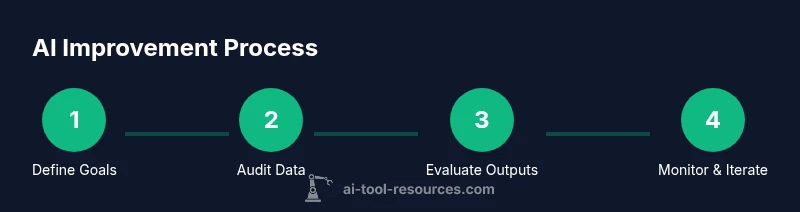
By the end, you will know how to improve AI systems through a practical, repeatable process. You’ll align objectives with measurable outcomes, audit data quality, design robust evaluation, implement governance and monitoring, and choose tools that scale. This quick guide signals the key steps teams use to raise reliability, safety, and impact of AI in real projects.
Aligning AI goals with business needs
According to AI Tool Resources, the most successful AI improvements start by aligning technical goals with real-world problems and measurable outcomes. In practice, teams should frame a single, high-value objective, define success metrics in business terms, and map them to model-level signals. This alignment reduces scope creep and ensures that improvements translate into tangible impact, such as faster decision cycles, reduced error rates, or better user satisfaction. The goal is to convert abstract research ideas into concrete, testable hypotheses and to establish a repeatable framework that can scale across projects. By documenting problem framing, success criteria, and expected constraints early, teams avoid chasing novelty and focus on outcomes that matter to stakeholders.
Data quality and preparation
Data is the substrate that determines AI quality. According to AI Tool Resources analysis shows that improvements to data curation, labeling consistency, and representation coverage directly correlate with better generalization and fewer errors in deployment. Begin with a data quality audit: catalog data sources, annotate missing values, detect distribution shifts, and identify biased or unbalanced samples. Create pipelines to enforce data versioning and reproducibility. Implement data validation checks at ingestion and during batch updates, and establish a data-centric workflow where model changes are validated against data quality improvements. The practical steps include defining data schemas, creating validation rules, and implementing automated tests that fail if data quality deteriorates.
Evaluation metrics that matter
Measuring progress requires metrics that reflect real impact. Avoid chasing an index of novelty; instead, pick metrics that tie to user outcomes and safety. Build a suite of evaluation tests: offline metrics (precision, recall, F1), calibration studies, and reliability assessments, along with online A/B experiments and shadow deployments. Use drift detection to catch shifts in input data and model outputs, and set up alert thresholds for unsafe behavior. The key is to define what “better” means in context and to update targets as data and deployment conditions evolve. A well-structured evaluation plan makes it feasible to compare models fairly over time.
Model selection and training practices
Choosing the right model starts with the problem and data characteristics, not popularity. Start with a baseline that is simple and robust, then experiment with transfer learning, fine-tuning, and domain-specific encoders as needed. Emphasize reproducibility: deterministic training configurations, versioned datasets, and clear separation of training, validation, and test sets. Implement guardrails such as input sanitization, output filtering, and safety constraints to minimize unintended behavior. Track training iterations with a clear change log and ensure that the training process is auditable and explainable to stakeholders.
Prompt engineering and interaction design
Prompt engineering is a practical lever to improve AI behavior without full model retraining. Design prompts that constrain outputs, specify desired formats, and embed safety checks. Use chained prompts to guide reasoning steps, and implement fallback responses for uncertain queries. Consider user experience: provide clarifying questions when inputs are ambiguous, and design interfaces that surface confidence and error bars. Regularly test prompts against edge cases to reduce hallucinations and improve user trust.
Monitoring, logging, and operational excellence
Operational AI requires vigilant monitoring. Implement comprehensive logging of inputs, outputs, and system latency to detect anomalies. Use automatic drift detection for data and performance, and establish dashboards that show trend lines for accuracy, latency, and failure rates. Run automated health checks and alert on out-of-scope predictions or safety violations. A robust monitoring program helps teams react quickly to changes in data, model behavior, and user interactions.
Governance, ethics, and risk management
Responsible AI combines policy with practice. Establish clear governance policies around data privacy, bias mitigation, and accountability. Create risk registers that identify potential failure modes, define mitigation actions, and assign owners. Conduct regular model risk reviews and ensure that stakeholders have access to evaluation results. Ethical considerations—such as fairness, transparency, and user consent—should be embedded in design decisions from the start.
Tools, platforms, and automation for scale
Scale is built on repeatable processes. Invest in MLOps platforms, data versioning, experiment tracking, and continuous deployment pipelines. Use automated testing for data quality, model performance, and safety checks before promotion to production. Adopt standardized templates for governance, risk assessments, and incident postmortems. Automation reduces human error and accelerates learning cycles across teams.
Practical implementation: a step-by-step example
To bring these concepts to life, consider a customer-support AI assistant. Start by defining success metrics (reduction in handling time, improved customer satisfaction). Audit training data from chat logs for quality and bias, then set up a robust evaluation suite with offline metrics and live A/B tests. Improve prompts to steer responses toward structured outputs, deploy monitoring for drift and safety, and establish a governance plan that includes periodic reviews and incident reporting. The example demonstrates how planning, data discipline, and governance converge to deliver measurable improvements.
Common pitfalls and how to avoid them
Watch for data leakage, overfitting to historical data, and misaligned metrics. Avoid optimizing for a single metric at the expense of user experience or safety. Beware drift that degrades model behavior over time and neglecting governance during rapid iteration. To mitigate, implement data splits that reflect future distributions, use multi-metric dashboards, and maintain transparent documentation of decisions and changes.
Roadmap to an improved AI system
Begin with a 90-day plan that pairs data quality improvements with a lightweight evaluation framework. In the next quarter, scale data curation, automate experiments, and formalize governance. Over time, expand to multiple domains, maintain a living documentation hub, and continuously monitor performance and safety. This roadmap emphasizes repeatability, accountability, and incremental gains that compound over iterations.
Authority sources
This article anchors guidance in established best practices and reputable sources. The following references provide authoritative frameworks and governance principles for AI systems:
- NIST AI Risk Management Framework: https://www.nist.gov/itl/ai-risk-management-framework
- Stanford AI Lab (education and research): https://ai.stanford.edu/
- National Academies of Sciences, Engineering, and Medicine: https://www.nationalacademies.org/
Authority Sources (markdown)
- NIST AI Risk Management Framework: https://www.nist.gov/itl/ai-risk-management-framework
- Stanford AI Lab: https://ai.stanford.edu/
- National Academies: https://www.nationalacademies.org/
Tools & Materials
- Data quality and profiling tools(Data profiling, validation rules, anomaly detection)
- Version control for data and models(DVC, MLflow, or similar)
- Experiment tracking platform(Track runs, metrics, and configurations)
- Compute resources(GPUs/TPUs or cloud compute for training and testing)
- Monitoring and drift detection tools(Alerts for data and model drift)
- Governance policy templates(Templates for risk, privacy, and ethics policies)
Steps
Estimated time: 60-120 minutes
- 1
Define goals and success metrics
Identify the business problem and articulate measurable outcomes. Align success metrics with real user impact and safety considerations. Document the desired end-state and acceptance criteria for the AI system.
Tip: Create a one-page objective with concrete metrics that stakeholders agree on. - 2
Audit data quality and coverage
Inventory data sources, assess labeling consistency, and identify gaps or biases. Establish data versioning and validation checks to prevent data quality regressions during iteration.
Tip: Run a bias and coverage audit on representative slices of your data. - 3
Design an evaluation framework
Define offline and online tests, including calibration, fairness checks, and user-impact simulations. Set up safe, repeatable evaluation pipelines that can be automated.
Tip: Use shadow testing before online deployment to catch regressions. - 4
Select a model architecture and training plan
Choose a robust baseline, then evaluate domain-specific encoders or transfer learning. Establish reproducible training configurations and clear separation of data splits.
Tip: Document hyperparameters and random seeds for traceability. - 5
Build data pipelines and version control
Create end-to-end pipelines with data quality gates and versioned datasets. Integrate experiment tracking to compare configurations and outcomes.
Tip: Automate data validation as part of the CI/CD pipeline. - 6
Develop prompts and interaction flows
Design prompts to constrain outputs, specify formatting, and embed safety checks. Test prompts for edge cases and user experience.
Tip: Include explicit fallback responses for uncertain queries. - 7
Set up monitoring and drift detection
Instrument inputs, outputs, and latency. Create dashboards and alerting rules for drift and unsafe behavior.
Tip: Review drift alerts weekly and adjust thresholds as needed. - 8
Establish governance and risk controls
Implement policies for privacy, bias mitigation, and accountability. Schedule regular model risk reviews with stakeholders.
Tip: Keep a living risk register with owners and due dates. - 9
Run pilot experiments and gather feedback
Deploy in a controlled environment, collect qualitative and quantitative feedback, and iterate quickly.
Tip: Prioritize changes that improve user outcomes and safety. - 10
Plan for scale and automation
Prepare for production via automated testing, deployment pipelines, and governance automation.
Tip: Build a modular, reusable pipeline to accelerate future improvements.
FAQ
What is the first step to improve an AI system?
The first step is to align the AI project with a clear business goal and measurable success criteria. This ensures all improvements are decision-driven and outcomes-focused.
Begin with a clear business goal and measurable success criteria to guide all improvements.
How important is data quality in AI performance?
Data quality is foundational. Without clean, representative data, even the best models will struggle to generalize and may produce biased or unsafe outputs.
Data quality is foundational for reliable AI performance.
What metrics should I track besides accuracy?
Track calibration, fairness indicators, latency, and user-centered metrics like task success rate. Use a mix of offline and online tests to capture real-world impact.
Use calibration, fairness, and user-centered metrics along with online tests.
How can I prevent model drift after deployment?
Implement drift detection on inputs and outputs, automate re-evaluation, and schedule periodic retraining or fine-tuning as data evolves.
Set up drift detection and plan periodic re-evaluation.
Do I need specialized tools for governance?
Yes. Governance requires templates, risk registers, and audit trails. Use standardized policies and incident reporting to maintain accountability.
Governance needs templates, risk tracking, and audit trails.
Watch Video
Key Takeaways
- Define goals with measurable outcomes.
- Prioritize data quality and governance.
- Build a robust evaluation framework.
- Automate monitoring and iteration.