AI Tool Writing Letter: A Practical How-To Guide
Learn to use AI tools to draft effective letters—templates, tone control, and a practical workflow for professional results in 2026. Includes best practices, safety tips, and quality checks.


According to AI Tool Resources, you can draft professional letters quickly with an AI tool while maintaining accuracy and tone. Steps: 1) define the letter purpose and audience; 2) craft a precise prompt with required details; 3) generate a draft and edit; 4) personalize and verify before sending. This approach works for cover letters, inquiries, and follow-ups.
Why AI-assisted letter writing matters
In professional communication, letters set the tone and often determine outcomes. AI-assisted letter writing helps standardize structure, preserve clarity, and save time on first drafts. By combining AI-generated text with human oversight, teams can maintain accuracy, brand voice, and personalized warmth. The AI Tool Resources team notes that a well-designed AI workflow reduces repetitive editing and helps writers focus on strategy—while avoiding miscommunications. It is not a replacement for judgment, but a powerful assistant that accelerates routine drafting, supports accessibility, and scales writing across departments.
Key features to look for in an AI letter-writing tool
When evaluating AI letter-writing tools, prioritize features that support professional tone, accuracy, and brand consistency. Look for:
- Tone and style controls that adapt to formal, semi-formal, or casual contexts
- Ready-made templates for common letter types (cover letters, inquiries, follow-ups)
- Audience-aware prompting that tailors content to recipient role
- Built-in factual checks and citation support to avoid misinformation
- Brand-voice enforcement via style guides and glossaries
AI Tool Resources analysis shows that well-structured prompts and guardrails produce higher-quality drafts and smoother handoffs to human editors. Remember to pair AI drafts with your brand style guide to maintain consistency across communications.
Crafting different letters with AI: cover letters, inquiries, apologies, and more
AI letter-writing tools excel when you tailor them to specific letter types. For a cover letter, emphasize alignment with the job description, quantify impact where possible, and explain fit in a concise paragraph. For inquiries, request clear next steps and deadlines. For apologies or complaints, maintain courtesy and provide a concrete resolution path. Keep placeholders for names, dates, and figures to be filled during personalization. Always include a closing that invites a direct response.
When working across departments, create type-specific templates that reflect your organization’s voice. This improves reuse and ensures consistency when teams draft letters to vendors, customers, or colleagues. A well-structured prompt library reduces friction and speeds up the drafting process while preserving nuance and accuracy.
A practical workflow: prompt design, generation, and editing
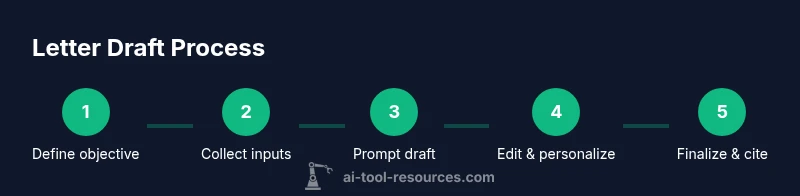
A repeatable workflow starts with a precise prompt and ends with a polished, personalized letter. Start by defining the objective, audience, and required facts. Then craft a compact prompt that specifies tone, length, and any mandatory phrases. Generate a draft, review for accuracy, and replace placeholders with real names, dates, and data. Finally, run a quick polish pass through grammar and style checks, and confirm alignment with brand voice before sending. This disciplined approach minimizes errors and boosts consistency across letters.
Quality controls and ethical considerations
Quality checks matter more than raw speed. Verify all dates, names, and factual claims against reliable sources. Cite sources where appropriate, especially for data or claims that could be contested. Respect privacy by not including sensitive information in drafts unless necessary and permitted by policy. Favor transparent language that makes clear what is AI-generated and what was added by a human reviewer. The ethical use of AI means maintaining accountability: the human writer remains responsible for the final content and any legal or regulatory implications.
Common pitfalls and how to avoid them
Common pitfalls include over-reliance on generic phrasing, failure to localize tone to the recipient, and neglecting factual accuracy. Avoid contract or policy gaps by validating critical details with primary sources. Do not include confidential information in drafts unless appropriate safeguards are in place. Always keep a human review step to ensure nuance, empathy, and alignment with organizational standards. The AI Tool Resources team recommends treating AI drafts as a starting point, not a final authority, to protect quality and trust.
Tools & Materials
- AI writing tool (web app or plugin)(Choose a tool with tone controls and template support)
- Reference letters or templates(Past letters or approved samples to guide tone and structure)
- Brand voice/style guide(Defines preferred vocabulary, sentence length, and formality)
- Grammar and style checker(Proofreads for grammar, consistency, and clarity)
- Quality assurance checklist(A short list to verify facts, dates, and names)
- Data privacy controls(Ensure sensitive information is handled securely)
Steps
Estimated time: 40-60 minutes
- 1
Define the letter objective
Identify the letter type (cover, inquiry, follow-up, complaint) and the outcome you want the recipient to take. Clarify any mandatory facts and constraints before drafting.
Tip: Write a one-sentence objective you want the letter to achieve. - 2
Collect inputs and constraints
Gather recipient details, dates, figures, and any required phrases or branding terms. Note any constraints on length or formality.
Tip: Create a checklist of required data points to include in the draft. - 3
Craft a precise prompt
Create a concise prompt that specifies audience, tone, length, and any must-have sentences or claims. Include placeholders for names and dates.
Tip: Use explicit instructions like 'formal tone' and 'no jargon'. - 4
Generate the draft
Run the prompt through the AI tool to produce an initial draft. Capture both a longer version and a concise version for comparison.
Tip: If the draft misses key points, rerun with adjusted prompts instead of manual edits. - 5
Edit for tone and accuracy
Review for consistency with brand voice, check factual accuracy, and replace placeholders with real details.
Tip: Use a separate check-list for facts, dates, and names. - 6
Finalize and cite sources
Add citations or references if needed, run a final grammar/style check, and prepare the final version for sending.
Tip: Save a version history to support audit and updates.
FAQ
What is AI letter writing?
AI letter writing uses natural language generation to draft letters from prompts. It speeds initial drafting and ensures consistent structure; however it needs human review.
AI letter writing drafts quickly, but you should always review for accuracy.
Can AI draft professional letters accurately?
It can draft well if prompts are precise and you tailor the output with fact-checking and personalization.
Yes, with careful prompts and human review.
How should I handle privacy and data when drafting?
Avoid sharing sensitive information unless necessary. Use trusted tools and review data policies before drafting.
Be mindful of data privacy and platform policies.
What letter types suit AI drafting best?
Cover letters, inquiry letters, follow-ups, and polite requests work well; complex narratives may require more human input.
Great for standard templates and routine letters.
Should AI replace human writers entirely?
No—AI should support rather than replace human judgment. Use a final human review for reliability.
AI helps, but humans must verify.
How do I start with AI letter writing?
Choose a tool, gather samples, design prompts, run a test draft, and review thoroughly.
Start with a single test letter and build from there.
Watch Video
Key Takeaways
- Define the objective clearly
- Use precise prompts to guide AI
- Always review for accuracy and tone
- Personalize with concrete details
- Verify data and cite sources