AI Tool Construction: From Idea to Deployed Tool in Practice
A practical, developer-focused guide to ai tool construction—from defining scope and data strategy to deployment and monitoring—designed for engineers, researchers, and students.


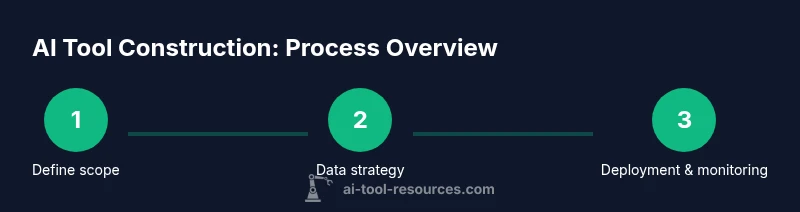
According to AI Tool Resources, ai tool construction begins with a clearly defined problem, a data plan, and a minimal viable pipeline. This quick answer outlines the essential phases—define scope, assemble data, choose baseline models, and prepare for deployment—so developers can start building robust AI tools quickly. Expect iteration, guardrails, and clear metrics to measure progress. The guide emphasizes reproducibility and secure practices.
Defining the scope and feasibility of ai tool construction
A successful AI tool starts with a precise problem statement and measurable goals. Start by translating a real-world need into a quantifiable objective. Examples include reducing manual triage time by 40% or improving classification accuracy by a few percentage points. Clear goals prevent scope creep and guide data collection, model selection, and deployment criteria.
Next, assess feasibility. Inventory data availability, privacy constraints, latency budgets, and the target environment. If data is scarce, consider synthetic augmentation or transfer learning. If privacy is non-negotiable, design with privacy-preserving techniques from the outset. Determine whether a simple baseline model can deliver meaningful value or if a more complex approach is justified. Early feasibility work saves time, money, and risk.
Define success metrics before building. Align metrics with user outcomes: for interactive tools, measure latency, step count, and error rates; for batch tasks, track throughput and accuracy. Establish acceptance criteria for the MVP and a plan for iterative improvement. Create a lightweight experiment plan that enables rapid validation.
Sketch a high-level architecture to guide implementation. Map inputs, processing steps, model components, data stores, APIs, and monitoring signals. Decide on data schemas, evaluation plans, and deployment scripts upfront. Documentation should be living and versioned to support collaboration among developers, researchers, and stakeholders.
In this section on ai tool construction, you’ll see how disciplined planning, cross-functional input, and a staged roadmap accelerate progress from a bold idea to a working prototype. With clear boundaries and measurable milestones, teams can reduce rework and align expectations across disciplines.
Tools & Materials
- Clear problem statement and success metrics(Write a one-page brief and define KPIs to guide scope and evaluation.)
- Data sources with licenses(List sources, licensing terms, and any privacy considerations.)
- Computing resources(Access to GPUs/TPU or cloud credits for experiments.)
- Development environment and tooling(Python, virtual environments, package manager, and reproducible setup.)
- Experiment tracking and version control(Use MLflow/Weights & Biases and Git for traceability.)
- Model evaluation suite(Hold-out data, cross-validation, and bias checks.)
- CI/CD and deployment scripts(Automated tests, pipelines, and rollback plans.)
- Monitoring dashboards(Set up performance and safety dashboards (latency, drift, errors).)
Steps
Estimated time: 6-8 weeks
- 1
Define scope and success criteria
Translate the problem into a precise objective with measurable KPIs. Document user impact, target accuracy or latency, and acceptance criteria for the MVP. This step prevents scope creep and guides all downstream tasks.
Tip: Create a one-page brief and secure sign-off from key stakeholders before proceeding. - 2
Assemble data strategy
Inventory data sources, licensing, and quality. Plan labeling, data preprocessing, and privacy protections. Establish data lineage and versioning from day one to support reproducibility.
Tip: Use a small seed dataset to validate data pipelines before scaling up. - 3
Choose baseline model and architecture
Survey model families suitable for the task (classifiers, transformers, or lightweight rules). Start with a simple baseline to set a performance floor and iterate to improve.
Tip: Document rationale for model choice and compare against a minimal viable alternative. - 4
Build data pipeline and feature engineering
Create modular data ingestion, cleaning, and feature extraction steps. Ensure components are testable, auditable, and scalable for future data growth.
Tip: Version-control preprocessing steps and keep feature definitions explicit. - 5
Train baseline and iterate
Train the initial model using the seed data, track experiments, and compare performance across configurations. Iterate to improve accuracy while monitoring costs.
Tip: Use a small, reproducible training loop and keep training logs centralized. - 6
Set up evaluation and guardrails
Implement an evaluation suite, include fairness checks, and define guardrails for safety. Establish a risk matrix and user-facing fallback rules.
Tip: Add automated tests for edge cases and data drift detectors. - 7
Prototype deployment and monitoring plan
Deploy the MVP to a controlled environment and instrument monitoring for latency, errors, and drift. Prepare a runbook for common incidents and rollbacks.
Tip: Enable feature flags to control exposure and minimize risk. - 8
Plan for iteration and maintenance
Define ongoing data refresh, model retraining, and stakeholder feedback loops. Maintain clear documentation and versioning to support long-term sustainability.
Tip: Schedule regular reviews to align with evolving user needs and compliance requirements.
FAQ
What is AI tool construction?
AI tool construction is the end-to-end process of turning a real-world problem into a functional, deployed AI-powered solution. It covers problem framing, data strategy, model selection, deployment, and governance.
AI tool construction is turning a real-world problem into a deployed AI solution, from framing to governance.
How long does ai tool construction typically take?
Timeline varies with scope and data complexity. A small MVP can take weeks; a full production tool may take months, depending on data readiness and regulatory constraints.
Timeline depends on scope and data; MVPs take weeks, full tools take months.
What data considerations are essential?
Focus on data quality, labeling, privacy, governance, and drift. Plan versioned pipelines and maintain data lineage to support reproducibility.
Prioritize data quality, labeling, and governance, with versioned pipelines.
What are common risks in ai tool construction?
Security, data leakage, model bias, and drift are typical risks. Mitigate with guardrails, thorough testing, and continuous monitoring.
Risks include security, bias, and drift; address with guardrails and ongoing monitoring.
Which tools help with ai tool construction?
Common tool categories include Python, ML frameworks, experiment tracking, CI/CD, and monitoring dashboards. Choose based on team needs and scale.
Use Python and ML tools, plus MLOps for deployment and monitoring.
How do you measure success of an AI tool?
Measure user-centric outcomes, monitor live performance, and assess business impact. Iterate based on feedback and evolving requirements.
Track user metrics and system health; iterate based on real-world use.
Watch Video
Key Takeaways
- Define scope early and lock in success metrics
- Prioritize data quality and governance for durable results
- Adopt modular architecture and MLOps practices
- Monitor continuously and iterate with user feedback
- Address ethics and compliance throughout development