How to Build an AI System: A Practical Developer Guide
A developer-focused roadmap to build an AI system—from scoping and data governance to deployment—emphasizing ethics, governance, and iterative testing for reliable, maintainable results.


By following a disciplined, repeatable workflow, you will define goals, assemble data, select models, and deploy an AI pipeline that can be trained, evaluated, and maintained. This quick guide outlines essential steps to build an AI system with governance, tooling, and deployment considerations, so you can move from idea to production with confidence. See the full steps for a complete path.
Why building an AI system matters
In today’s software landscape, building an AI system that reliably delivers value requires deliberate engineering, governance, and a clear plan. According to AI Tool Resources, the process begins with defining impact, constraints, and risk tolerance before any code is written. This mindset helps align technical work with real user needs and organizational goals. When you pursue how to build an ai system, you aren’t just selecting algorithms—you are designing a repeatable pipeline that can be audited, improved, and scaled over time. Emphasize modularity, testability, and clear ownership from day one to avoid brittle architectures that fail in production. The goal is a system that remains understandable as data, models, and requirements evolve.
Defining scope and success metrics
A strong AI system starts with a clear scope and measurable goals. Define the problems you will solve, the stakeholders involved, and the acceptable risk level. Translate outcomes into concrete success metrics (e.g., accuracy targets, latency bounds, user impact, and safety criteria). Use lightweight, early experiments to validate assumptions before scaling. Document decisions and revisit them after each iteration to ensure the project remains aligned with user needs and business value.
Core components of an AI system
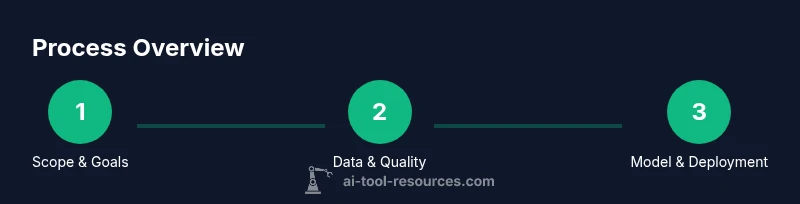
An end-to-end AI system typically comprises three layers: data, models, and delivery. The data layer collects, cleans, and labels information; the model layer trains and evaluates algorithms; the delivery layer exposes a scalable inference service with monitoring and feedback loops. Supporting components include governance artifacts, experiment tracking, and deployment automation. A well-structured architecture helps teams reason about data provenance, model risk, and system reliability across updates.
Data: collection, quality, governance
Data is the lifeblood of any AI system. Prioritize high-quality, representative data and implement labeling standards, versioning, and privacy safeguards. Establish data governance practices that address bias, consent, and lineage. Regularly audit data for drift and gaps, and maintain a data catalog to support reproducibility. AI Tool Resources analysis shows that robust data governance correlates with more reliable deployments, especially when teams document data sources and transformation steps.
Model selection and training workflow
Choose modeling approaches that fit the problem, available data, and deployment constraints. Start with baseline experiments to establish a performance floor, then iterate with incremental improvements. Use reproducible training pipelines, track hyperparameters, and implement robust evaluation protocols that reflect real-world usage. Plan for versioned models and rollback strategies to minimize risk in production.
Infrastructure and deployment considerations
Decide between on-premises hardware and cloud-based compute, balancing cost, latency, and scalability. Containerize services to enable portability and reproducibility, and implement CI/CD pipelines for model deployment. Separate training and serving environments, monitor resource usage, and design for autoscaling. Incorporate observability with logs, metrics, and alarms to detect anomalies early.
Ethics, safety, and compliance
Embed responsible AI practices from the start: protect user privacy, mitigate bias, and ensure explainability where appropriate. Define guardrails for data handling, model outputs, and user interaction. Comply with relevant laws and standards, including data protection and safety requirements. Regularly assess risk and establish a process for incident response and remediation.
Monitoring, maintenance, and iteration
After deployment, actively monitor model performance, data drift, and system reliability. Schedule periodic retraining when data distribution changes or performance degrades. Maintain a backlog of improvements and ensure governance keeps pace with evolving requirements. A culture of continuous improvement helps sustain usefulness and safety over time.
A practical blueprint you can apply today
Here’s a compact blueprint you can adapt: (1) define scope and metrics, (2) assemble a clean data plan, (3) implement a minimal viable pipeline, (4) evaluate with realistic benchmarks, (5) deploy with observability, (6) establish governance and risk controls, (7) monitor and retrain as needed, (8) document decisions for auditability, (9) iterate based on user feedback. The AI Tool Resources team recommends starting with a single, well-scoped use case and expanding gradually to maintain quality and safety.
Tools & Materials
- Development environment (Python 3.11+ and a code editor)(Create a virtual environment and pin dependencies (requirements.txt).)
- Cloud compute credits or on-prem hardware(GPU recommended for training larger models; assess budget constraints.)
- Data sources and sample datasets(Prefer diverse, representative data with proper licensing.)
- Version control (Git) and collaboration tooling(Use branching strategies and code reviews for reproducibility.)
- Experiment tracking and configuration management(Helps compare runs and maintain reproducibility at scale.)
- Documentation and governance templates(Templates for data provenance, model cards, and risk assessments.)
- Containerization and orchestration basics(Docker/Kubernetes or similar to enable scalable deployments.)
Steps
Estimated time: 4-12 weeks
- 1
Define scope and success criteria
Articulate the problem, user impact, and constraints. Establish measurable goals and a boundary for what constitutes a successful deployment.
Tip: Start with a single, well-scoped use case to avoid scope creep. - 2
Map requirements to components
Identify data needs, model types, and delivery surfaces. Create a high-level architecture diagram to guide implementation.
Tip: Keep interfaces clean to support future changes without large rewrites. - 3
Gather and prepare data
Collect representative data, clean it, and establish labeling protocols. Document data sources and transformations for reproducibility.
Tip: Implement privacy safeguards and minimize data leakage during preprocessing. - 4
Choose modeling approach
Select baseline models aligned with data and latency requirements. Plan for experimentation and clear evaluation metrics.
Tip: Prefer simple, interpretable baselines before trying complex systems. - 5
Build a minimal viable pipeline
Create a lean end-to-end workflow from data input to inference with logging. Validate the pipeline with small-scale tests.
Tip: Automate data checks and unit tests to catch regressions early. - 6
Train and evaluate iteratively
Run controlled experiments, track hyperparameters, and compare results against baselines. Use cross-validation where feasible.
Tip: Document every experiment to avoid repeating failed attempts. - 7
Deploy with monitoring
Containerize the service, set up monitoring dashboards, and implement alerting for drift and latency.
Tip: Separate training and serving environments to reduce production risk. - 8
Governance and safety controls
Institute data governance, model cards, and risk assessments. Define escalation paths for issues in production.
Tip: Assign ownership for risk mitigation and incident response. - 9
Plan for maintenance and updates
Schedule retraining, data checks, and periodic audits. Maintain a backlog of improvements and ensure decisions are auditable.
Tip: Automate retraining pipelines where possible to keep the system fresh.
FAQ
What is an AI system and what problem does it solve?
An AI system combines data, models, and software to automate tasks, extract insights, or support decisions. It spans data collection, model training, deployment, and monitoring to deliver value while managing risk.
An AI system uses data, models, and software to automate tasks and improve decisions, with ongoing monitoring to keep it reliable.
How do I start building an AI system?
Begin with a well-scoped use case, define success criteria, and assemble high-quality data. Create a small end-to-end pipeline to validate your assumptions before expanding.
Start with a single use case, define success, collect good data, and build a small end-to-end pipeline to test ideas.
What are common challenges in building AI systems?
Data quality, bias, scalability, latency, and governance are frequent hurdles. Establish clear ownership, robust evaluation, and transparent decision logs to manage these risks.
Big challenges include data quality and governance; plan for monitoring and clear ownership to address them.
How long does it take to build and deploy an AI system?
Timeline varies with scope and data, but expect multiple iterations across data, model, and deployment. Start with a pilot and scale as you gain confidence.
It varies, but start with a pilot and iterate to scale as you validate results.
What governance and ethics considerations are essential?
Incorporate privacy, bias assessment, and explainability from the outset. Establish risk controls, incident response plans, and regular audits.
Privacy, bias controls, and explainability should be built in from day one with audits.
What deployment options exist for AI systems?
Options include cloud-hosted APIs, on-prem services, and hybrid setups. Choose based on latency, cost, and governance needs, and ensure monitoring is in place.
Cloud, on-prem, or hybrid deployments—pick based on latency, cost, and governance, with solid monitoring.
Watch Video
Key Takeaways
- Define scope early and measure success.
- Prioritize data governance and lineage.
- Use a minimal viable pipeline to validate concepts.
- Monitor, retrain, and iterate with governance.