AI Tool vs Model: A Comprehensive Side-by-Side Guide
A rigorous, developer-focused comparison of AI tools and AI models, outlining definitions, deployment, customization, risk, and practical decision criteria to help teams choose the right approach for complex AI tasks.


What are AI tools and AI models? Definitions and core distinctions
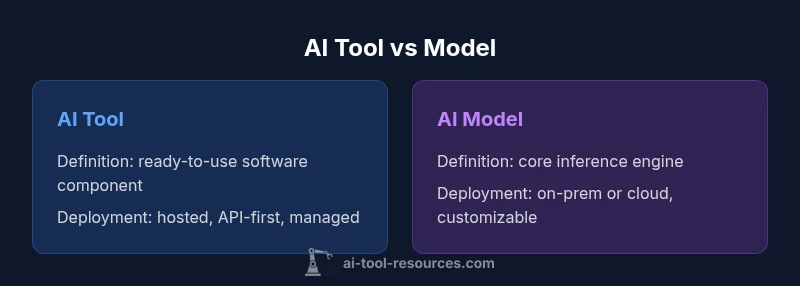
In discussions about AI, it's essential to distinguish between an AI tool and an AI model. An AI model is the mathematical function or neural network that generates outputs from inputs, trained on data to recognize patterns or perform tasks. An AI tool, by contrast, is a complete software unit that packages one or more models with interfaces, data pipelines, controls, and a user workflow, ready for practical use. When you encounter a product labeled as an AI tool, it's typically offering an interface, governance, monitoring, and often pre-configured prompts or pipelines built around one or more underlying models.
For teams in development, the difference matters: a model provides pure capability, while a tool provides a consumable experience and operational scaffolding. The AI tool may host the model, manage data handling, provide user authentication, logging, and rate limiting, and expose tasks through APIs or UI widgets. This distinction influences how you plan product roadmaps, allocate resources, and manage risk. According to AI Tool Resources, most teams begin with a tool to rapidly validate a concept and then decide whether to migrate to a custom model or extend an existing tool with additional models as needs evolve. Understanding the ai tool vs model relationship helps you map requirements to feasible solutions and avoid scope creep.