How to Clean AI Data: A Practical Guide for Developers
Learn a practical, step-by-step approach to cleaning AI data and models. This guide covers data hygiene, preprocessing, bias mitigation, validation, and best practices for reliable AI systems in 2026.


You will establish a repeatable data-cleaning workflow to improve AI model reliability. This guide covers data quality checks, preprocessing steps, bias mitigation, and validation, plus practical tooling. By following a structured approach, developers and researchers can reduce errors and boost reproducibility. According to AI Tool Resources, clean AI data is foundational for trustworthy results.
What is meant by 'clean AI data'?\n\nClean AI data refers to datasets and feature representations that are accurate, complete, consistent, and timely enough to train models that perform well in real-world settings. In practice, it means removing duplicates, correcting mislabeled entries, handling missing values thoughtfully, and aligning formats across sources. The goal is to minimize noise that can mislead the model during learning, while preserving meaningful variation that the model should learn to handle. Consistent data definitions and documentation help teams reproduce results and audit outcomes.
Dimensions of AI data quality\n\nQuality in AI data hinges on several dimensions: accuracy (is the data correct?), completeness (are all required fields present?), consistency (do the same concepts appear in the same format across sources?), timeliness (is the data up to date?), and provenance (do we know where the data came from and how it was obtained?). Data quality also involves verifiability and traceability—each cleaned value should be justified by a source or rule. High-quality data supports stable model performance and easier debugging when issues arise.
Core data cleaning techniques and when to use them\n\nHere are techniques you’ll use most often:\n- Deduplication: remove exact or near-duplicate rows to prevent overweighting repeated records.\n-Missing value handling: decide between imputation, flagging, or removal based on feature type and downstream impact.\n-Standardization: normalize units, formats, and categorical encodings so models learn from consistent inputs.\n- outlier treatment: identify implausible values without discarding genuine rare cases.\n- Noise reduction: filter corrupted records, correct typos, and harmonize labels across datasets. These steps depend on data type (tabular, text, image) and the model you intend to train.
Building a reproducible cleaning pipeline\n\nA repeatable cleaning pipeline should be version-controlled and automated. Start with a data dictionary that defines each feature, accepted ranges, and encoding schemes. Use modular scripts that can be chained into a pipeline (ETL or ELT). Incorporate unit tests that assert post-cleaning data meets the defined quality criteria. Save every cleaned dataset with a clear, versioned filename and a changelog of all cleaning steps applied.
Validation, bias mitigation, and auditing\n\nValidation means verifying the cleaned data yields expected model behavior on holdout sets. Bias mitigation involves checking distributions across groups and applying fair representations or debiasing where appropriate. Auditing should be ongoing: log cleaning decisions, monitor data drift, and schedule periodic audits as data sources evolve. Documentation of decisions helps teams justify changes to stakeholders and regulators.
Practical workflow example: cleaning a tabular dataset\n\nConsider a customer dataset with missing age values and inconsistent currency units. Step-by-step, you would (1) define acceptance criteria for completeness and currency formats, (2) standardize currencies to a single unit, (3) impute missing ages using a reasonable strategy, (4) deduplicate identical customer records, and (5) validate with a holdout sample to ensure model metrics do not degrade. Include notes about data provenance and versioning for traceability.
Scaling cleaning for large datasets and streaming data\n\nFor large-scale or streaming data, adopt incremental cleaning: apply transformations on the fly, maintain a clean data lineage, and implement sampling checks to catch anomalies early. Use data sketches or online validation to detect drift without incurring excessive latency. Parallelize heavy operations and leverage distributed processing frameworks to keep pipelines responsive and auditable.
Tools & Materials
- Raw dataset in a common format (CSV/JSON/Parquet)(Have a clearly defined data dictionary describing each field)
- Python environment with pandas, NumPy, and scikit-learn(Create a virtual environment and lock dependencies)
- Jupyter or notebook-like interface(Optional for exploration; use IDE and scripts for production)
- Version control system (Git)(Track data cleaning scripts and dataset versions)
- Validation dataset and evaluation metrics(Keep a separate holdout to verify cleaning impact)
- Data dictionary(Document feature definitions, units, ranges, and encodings)
- Privacy and compliance tools(Scan for PII and apply masking where needed)
Steps
Estimated time: 3-6 hours
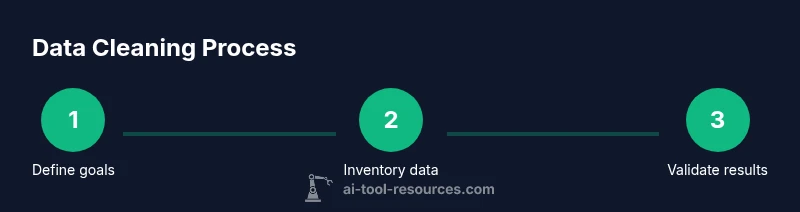
- 1
Define quality goals
Specify the desired accuracy, completeness, and consistency criteria. Align with stakeholders and document acceptance criteria before touching data.
Tip: Write measurable targets (e.g., <X% missingness, <Y% duplicates) to guide later checks. - 2
Inventory data sources
List all data sources, their formats, and update frequencies. Understand provenance to map lineage and potential biases.
Tip: Create a data lineage diagram to visualize how data flows into your dataset. - 3
Identify issues and anomalies
Run quick audits to find missing values, inconsistent encodings, and obvious outliers. Prioritize fixes by impact on model performance.
Tip: Flag anomalies with flags in a cleanliness report for traceability. - 4
Clean and transform data
Apply deduplication, imputation, standardization, and label harmonization. Maintain a log of every transformation applied.
Tip: Use idempotent operations so re-running the step yields the same result. - 5
Validate cleaned data
Evaluate model-ready datasets on a validation set. Check distributions, correlations, and performance metrics to ensure no unintended distortions.
Tip: Compare metrics before and after cleaning to quantify impact. - 6
Document and automate
Summarize cleaning rules, create reusable scripts, and automate the pipeline with tests and versioning.
Tip: Include a changelog and ensure reproducibility across environments.
FAQ
What does 'clean AI data' mean and why does it matter?
Clean AI data means data that is accurate, complete, consistent, and timely enough to produce reliable model results. It matters because poor data quality leads to biased, unstable, or brittle AI systems. Clean data improves generalization and makes debugging easier.
Clean AI data means accurate and consistent data that helps models learn reliably. It matters because bad data leads to biased or unstable AI.
Which tools are essential for data cleaning?
Essential tools include a Python data stack (pandas, NumPy, scikit-learn), a version control workflow, and a solid data dictionary. For large datasets, consider distributed processing and validation datasets to assess impact.
Use Python data tools, version control, and a data dictionary. For big data, add distributed processing and validation checks.
How often should data cleaning occur in a project?
Cleaning should be an iterative process aligned to data updates and model cycles. Perform cleaning on every major data refresh, after feature engineering, and before retraining models.
Clean as data updates and model retraining occur, not just once at the start.
Can data cleaning introduce new biases?
Yes, cleaning can inadvertently distort distributions if not done carefully. Always monitor for shifts across groups and validate that the post-cleaning data still represents the target population.
Cleaning can shift data if not careful; watch for group distribution changes and validate.
What is the role of documentation in data cleaning?
Documentation captures what was changed, why, and when. It aids reproducibility, audits, and collaboration across teams, especially during model updates or regulatory reviews.
Document what you change, why, and when to keep things reproducible and auditable.
Watch Video
Key Takeaways
- Define clear quality goals before cleaning.
- Use a reproducible, version-controlled workflow.
- Validate cleaned data with holdout sets and bias checks.
- Document decisions and maintain audit trails.
- Scale pipelines responsibly for large or streaming data.