How to Validate AI Tools: A Practical Step-by-Step Guide
Learn a practical, evidence-based approach to validate AI tools before deployment. This guide covers criteria, testing, governance for trusted AI and risk.


By the end of this guide you will know how to validate AI tools before deployment. You will define success criteria, assemble representative data, run controlled experiments, and assess accuracy, reliability, bias, security, and governance. You’ll also create a reproducible validation report and establish ongoing monitoring to catch drift as models update.
Why Validate AI Tools
Validation is not optional; it is the guardrail that prevents incorrect decisions, biased outcomes, and unsafe deployments. When you validate, you turn the adoption of AI from guesswork into evidence-based practice. The AI Tool Resources team emphasizes that validation should focus on real-world conditions, not just laboratory accuracy. According to AI Tool Resources, validating AI tools requires a structured, repeatable framework that spans data, model behavior, and governance. In practice, teams start by articulating the problem, constraints, and success criteria, then map those to measurable indicators.
- Actionable takeaway: validation should be an integral part of the project planning phase, not an afterthought.
Define Validation Criteria
Before you test, you must translate the problem into measurable criteria. Start with a crisp problem statement and define success metrics that align with user needs, regulatory expectations, and risk tolerance. Common criteria include accuracy on representative data, fairness across subgroups, robustness to input perturbations, interpretability, and operational reliability under load. Document each criterion with target values, confidence intervals, and acceptance thresholds. This creates a shared contract that guides experiments and reduces scope creep. In the absence of clear criteria, you risk chasing noise rather than meaningful outcomes.
- Pro tip: tie success criteria to business value and risk exposure to keep validation focused.
Testing Methods
A robust validation plan uses a mix of testing methods tailored to the AI tool’s use case: unit tests for isolated components, integration tests for system behavior, and end-to-end experiments that simulate real user interactions. Include out-of-distribution tests to assess generalization and adversarial or red-team testing to reveal hidden failure modes. Use both labeled and synthetic data to probe edge cases, and employ multiple metrics (accuracy, precision/recall, calibration, fairness gaps, latency) to capture a complete picture. Document the results with traceable code versions and data snapshots.
- Practical approach: run seasonal or scenario-based validation to reflect operational changes over time.
Data Considerations
Data quality and distribution are the backbone of validation. Ensure datasets are balanced to avoid bias, representative of the deployment domain, and free of leakage from training to evaluation. Establish procedures to detect and correct mislabeled samples and to monitor data drift after deployment. If synthetic data is used, validate its fidelity against real-world distributions. Privacy and compliance controls must be enforced to protect sensitive information.
- Tip: implement data lineage and versioning so every validation run can be reproduced.
Reliability and Robustness
Models should behave predictably under varied conditions. Assess stability across input variants, deployment environments, and load levels. Validate fail-safe mechanisms and fallback strategies when predictions are uncertain or unavailable. Establish criteria for acceptable latency and throughput, and test scaling behavior. Consider rollback plans if a model update degrades performance.
- Insight: robustness testing helps prevent surprising downtimes that erode trust.
Safety, Ethics, and Governance
Safety and ethics go beyond technical performance. Evaluate for potential harms, bias amplification, privacy risks, and regulatory compliance. Define governance processes for model updates, impact assessment, and incident response. Maintain an auditable trail of validation decisions, metrics, and test results to satisfy internal controls and external requirements.
- Important note: involve cross-functional stakeholders (legal, security, product, user research) in critical validation milestones.
Documentation and Reproducibility
A credible validation effort produces a clear, reproducible record. Include data sources, pre-processing steps, model configurations, evaluation scripts, metrics, and decision rationales. Store artifacts in a versioned repository and attach a succinct executive summary for non-technical readers. Reproducibility enables audits, collaboration, and future validation work as models evolve over time.
- Best practice: timestamp every run and declare the exact versions of data and code used.
Operationalizing Validation in Teams
Turn validation into a repeatable business process. Define roles (data engineer, ML engineer, QA, product owner, governance lead) and establish a validation cadence aligned with release cycles. Create lightweight dashboards to monitor critical metrics in production and schedule quarterly reviews to refresh data and criteria. Foster a culture where validation findings drive decisions about deployment, updates, and decommissioning.
- Spotlight: make validation a required checkpoint before any production release, with sign-off from governance.
A Practical Validation Plan (Template)
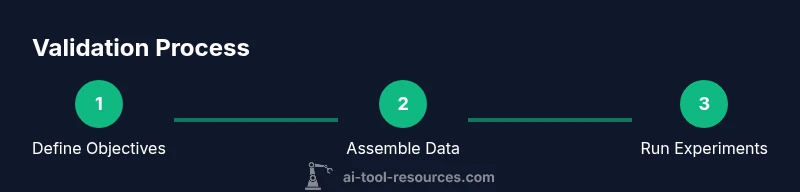
This section provides a template you can adapt. Start by listing objectives, success criteria, data sources, and evaluation methods. Then execute planned experiments, capture results in a structured report, and outline actions based on outcomes. Finally, define a monitoring plan for post-deployment drift and specify roles and responsibilities for ongoing validation.
- Core idea: treat validation as a living process, not a one-off task.
Tools & Materials
- Representative data sets (training and test splits)(Include edge cases and synthetic data where needed)
- Evaluation scripts and a test harness(Reproducible, versioned code)
- Validation criteria checklist(Clear success/failure thresholds)
- Governance and risk assessment templates(Bias, safety, privacy considerations)
- Logging/telemetry and audit trails(Record inputs, outputs, and decisions)
- Documentation templates for results(Executive summary and technical appendix)
- Secure testing environment and data access controls(Isolate experiments from production)
- Update/drift monitoring plan(Plan for post-deployment validation)
- Reproducibility guide for engineers(Optional internal readme)
Steps
Estimated time: 3-5 weeks
- 1
Define objectives and success criteria
Clarify the AI tool’s intended use, success metrics, and risk tolerance. Align objectives with stakeholder expectations and regulatory constraints. Create a concise problem statement that translates into measurable indicators your team will track.
Tip: Tie objectives to concrete business outcomes and governance requirements. - 2
Assemble representative data
Gather data that reflect real-world usage, including edge cases. Split into training, validation, and test sets with careful labeling and privacy controls. Document data provenance to enable reproducibility.
Tip: Include synthetic data only after validating its fidelity to the real distribution. - 3
Set baselines and evaluation metrics
Establish baseline performance using established metrics and define acceptance thresholds. Plan for multiple metrics (accuracy, calibration, fairness, latency) to capture diverse aspects of performance.
Tip: Make thresholds explicit and review them with governance. - 4
Build a repeatable test harness
Create a modular, versioned framework to run experiments with deterministic seeds. Record inputs, configurations, and outputs to enable exact replay of results.
Tip: Version-control both code and data artifacts. - 5
Run validation experiments
Execute planned tests across scenarios, including out-of-distribution and adversarial conditions. Compare results against baselines and document any deviations or unexpected behaviors.
Tip: Use pre-registered statistical tests to interpret differences. - 6
Analyze results and identify failure modes
Catalog failure modes, their severity, and potential mitigations. Assess data quality, model behavior, and system interactions that led to failures.
Tip: Prioritize fixes by impact on user safety and governance requirements. - 7
Document findings and establish monitoring
Produce a validation report with actionable recommendations, risk considerations, and a plan for ongoing monitoring after deployment. Include versioning and an update calendar.
Tip: Set a cadence for re-validation after model updates.
FAQ
Why should I validate an AI tool before deployment?
Validation helps ensure the tool performs as intended, minimizes risks, and satisfies governance requirements. It turns uncertainty into evidence and provides a record for audits and future improvements.
Validation helps ensure the AI tool works as intended and reduces risk, providing a clear audit trail for improvements.
What data qualifies as representative for validation?
Representative data reflects real user scenarios, including edge cases and potential distribution shifts. It should be labeled consistently, privacy-safe, and sourced with documented provenance.
Representative data mirrors real use, covers edge cases, and has clear provenance and labeling.
How often should validation be repeated?
Validation should occur before every major deployment and after significant model updates or data distribution shifts. Schedule periodic reviews to refresh data, criteria, and tests.
Validate with each major update and after data shifts; set regular reviews to refresh tests.
How do I document results for governance?
Record objectives, data provenance, test configurations, metrics, and decisions in a centralized, version-controlled report. Include risk assessments and planned mitigations for transparency.
Keep a centralized, versioned record of objectives, data, tests, metrics, and decisions.
Can validation catch all possible failure modes?
Validation reduces risk by revealing many common failure modes, but no process guarantees catching every edge-case. Continuous monitoring and iterative improvement are essential.
It reduces risk by catching many failures, but cannot catch every edge-case; ongoing monitoring is essential.
What are common mistakes when validating AI tools?
Relying on a single metric, using non-representative data, ignoring data drift, and skipping governance reviews are frequent errors. Correct these by broadening metrics, data checks, and stakeholder involvement.
Common mistakes include relying on one metric, non-representative data, ignoring drift, and skipping governance.
Watch Video
Key Takeaways
- Define validation criteria before testing
- Use representative data and controlled experiments
- Document results and establish ongoing monitoring
- Involve governance for ethical risk and compliance
- Adopt a reproducible framework for future updates